Does the Bible Teach that the Earth is Flat?
The Bible does not teach a flat Earth, even when it accommodates that ancient perception. Its authority rests in what it affirms, not in all it references.

NASA, Public domain, via Wikimedia Commons
The Bible never explicitly states that the Earth is flat. Nevertheless, many in the past, and a few in the present, have asserted that Scripture implies a flat Earth. They argue that people who take the Bible seriously as God’s Word must therefore adopt this view as factual.
Two sorts of passages are usually cited in substantiation: those that speak of the “four corners of the earth” (Isaiah 11:12; Revelation 7:1) and those that refer to the “ends of the earth” (Deuteronomy 28:49; Acts 1:8).
Before drawing conclusions based on English translations, however, we should look carefully at the Hebrew and Greek terms.
What does “Four Corners of the Earth” Mean?
Regarding “four corners of the earth,” the Hebrew term is kanap. This term most often refers to wings, both literally (as in birds, cherubs, and seraphs) and figuratively (God wraps us in his wings, Psalm 36:7; Psalm 91:4, or when the wind/spirit or dawn has wings, Psalm 104:3; Psalm 139:9). It also refers to edges, such as the edges of one’s garment (Deuteronomy 22:12; 1 Samuel 24:11).
Notably, kanap never refers to architectural corners, for which Hebrew uses pinnah, miqṣo’a or qaṣah. Since kanap broadly refers to extremities,1 “corners” is not a defensible translation.
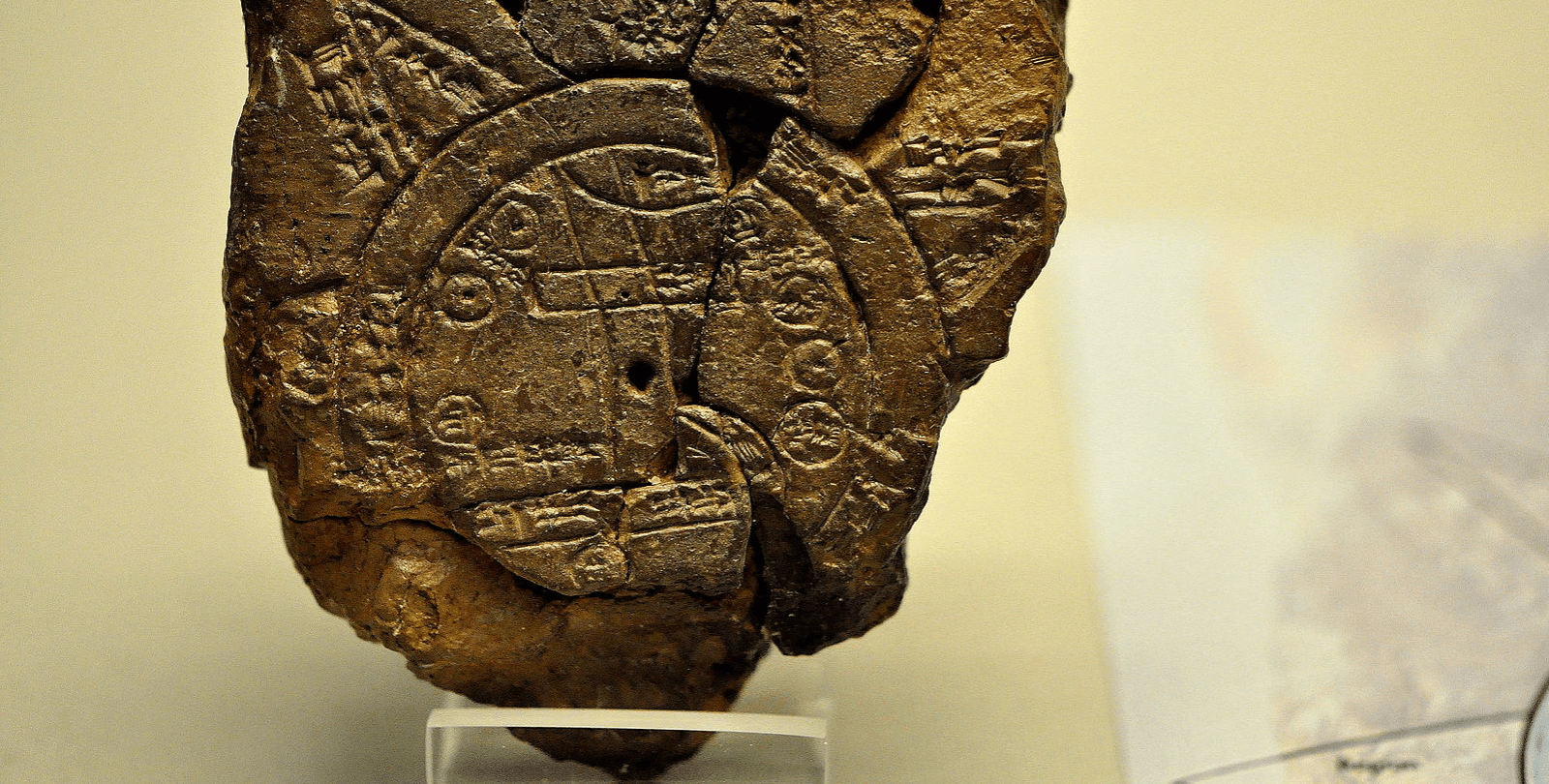
Osama Shukir Muhammed Amin FRCP(Glasg), CC BY-SA 4.0 <https://creativecommons.org/licenses/by-sa/4.0>, via Wikimedia Commons
A sixth century BCE Babylonian map of the world illustrates this point. The circle around the rim is the salt sea, and eight triangles protrude from the perimeter. In the text, these protrusions are labeled as nagû, which refers to the remote extremities of the known world.2
It is interesting to note how the triangular shapes are reminiscent of wings. In one ritual text, the nagû are paralleled to the four corners. All of this indicates that the use of terminology such as “corners” or “wings” does not suggest that they thought the world was square.
What do Biblical References to the “Ends of the Earth” Mean?
In terms of “ends of the earth,” the Hebrew term (qeṣah) can be rendered as “edge,” but more accurately pertains to a border (Deuteronomy 28:49). It describes the place where the land touches the sea, as in Joshua 13:27. The Greek term (eschaton) functions similarly, referring to a border or extremity.
What does Isaiah 40:22 Mean by “the Circle of the Earth”?
The closest the biblical text comes to identifying the Earth’s shape is in Isaiah 40:22, where reference is made to the “circle of the earth.”
Some have used this passage to suggest that Isaiah understood the world to be spherical. However, the Hebrew word (ḥûg) only designates the curvature of the horizon without specifying dimension. It could describe either a sphere or a disk.

Diego Delso, delso.photo, License CC BY-SA 4.0<https://creativecommons.org/licenses/by-sa/4.0>, via Wikimedia Commons
Of course, the unimpeded view of the horizon does appear circular. The language of appearance is evident in statements about the Sun moving across the sky.
If Isaiah indicates a circular shape, then whatever is meant by “corners” in the passages we discussed earlier must be figurative rather than literal, otherwise the descriptions would conflict.
How did Ancient Israelites Understand the Shape of the Earth?
Understanding the meaning of words is important, but this alone does not resolve the question. Ultimately, we must also take into account the historical ancient context.
In the ancient world, the common view was that the world was a flat disk.3 Although biblical passages do not state this explicitly (Isaiah 40:22 comes closest), the textual evidence suggests that Israelites thought the same. There is no evidence that God gave them a different idea.
I would argue that it does not matter what they believed about the shape of the Earth, because it was not their intent to offer factual data about cosmic geography.
For that reason, I would not argue that the biblical authors did not believe that the Earth was flat. They probably did.
Rather, I would argue that it does not matter what they believed about the shape of the Earth, because it was not their intent to offer factual data about cosmic geography.
Accommodation: How God Communicates Within Human Limitations
This is where the idea of “accommodation”4 becomes important. Accommodation was strongly supported by the Protestant Reformers, but it was acknowledged much earlier. The concept is that, given the limitations of human language and understanding, God accommodates the capacity of the audience when delivering divine communication.
This does not compromise the Bible’s authority; rather, it acknowledges that the Bible’s authority attaches only to what it intentionally affirms.
Even strong views of inerrancy recognize this distinction. For instance, the Lausanne Covenant states that the Bible is “without error in all that it affirms.”5 This implies that some of what can be found in the Bible is not affirmation, such as the speeches of Job’s friends, who are wrong.
How the Bible References Ancient Beliefs Without Affirming Them
We can refer to those elements that the Bible contains, but does not affirm, as “reference.” In these instances, the Bible makes tacit reference to the cultural beliefs of the day without affirming them as truth that it is teaching.
To say this another way, the Bible does not upgrade the science that the Israelites shared with everyone else in the ancient world. Indeed, there is no case of the Bible offering new revelation regarding areas that we consider science today.

What Does the Bible Say About Science?
What does the Bible say about science? Explore how Scripture has shaped values, virtues and motivations that drive modern scientific inquiry.
When discussing the question of a flat Earth, we are speaking specifically about cosmic geography, which also includes concepts such as the pillars of the Earth and a solid sky. These ideas were commonly believed in the ancient world and were accepted by the Israelites as well. Notably, God did not tell them anything different.
But once we recognize the reality of the category of “reference,” it would not matter whether the Bible has occasional statements that suggest a flat Earth. They would be identified as reference, not affirmation.6
A Parallel Case: Ancient Physiology in the Bible
The category of physiology is another example of reference without affirmation. People in the ancient world had no knowledge of the brain’s physiology,7 and believed that cognitive processes took place in internal organs such as the liver, kidneys, and heart.
Love and belief were thought to be founded in the heart, the center of the will. Emotion was associated with the liver and thought was associated with the kidneys.8 Biblical usage coincides with these ancient Near Eastern perceptions.
The theology, authority, and truthfulness of Scripture is vested in its affirmations and not in its references, which often feature accommodation.
Cosmic geography and physiology should be treated in similar ways. If one insists the Bible implies that the Earth is flat and therefore this must be accepted as reality, to be consistent they must also believe that cognitive processes take place in the heart, liver, and kidneys.
If, on the other hand, they are willing to accept the physiological beliefs of the ancient world as an example of reference without affirmation, there is no reason to treat cosmic geography differently.

Bill Anders, Public domain, via Wikimedia Commons
Conclusion: Does the Bible Teach that the Earth is Flat?
In conclusion:
- The biblical references that some believe refer to a flat Earth are not as straightforward as a casual reading suggests.
- The Israelites did likely believe that the Earth was flat, as did everyone in the ancient world.
- Nevertheless, the Bible does not teach that the Earth is flat, even when it accommodates that cultural perception.
- We must distinguish between reference and affirmation when reading the Bible.
- The theology, authority, and truthfulness of Scripture is vested in its affirmations and not in its references, which often feature accommodation.
About the author

John Walton
Related resources
If you enjoyed this article, we recommend you check out the following resources:

Article (Advanced)