Francis Collins on Truth, Science, Trust, and Faith
Our society is divided, including the Church, and distrustful of science and scientists. Francis Collins weighs in on how our faith calls us to do better.

Photo by Kimanzi Shallom
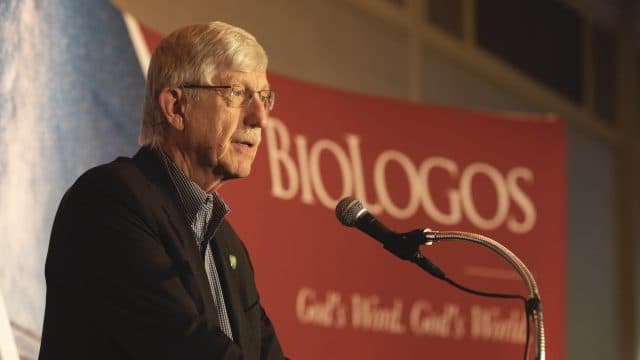
In his keynote presentation at the 2024 BioLogos conference, Francis Collins offered not only a lament about the downward spiral of Americans’ respect for one another and our institutions, but also an urgent call to action for turning the tide of mistrust back to a place of mutual understanding, if not wholesale agreement.
Breaking his talk down into four interrelated topics—Truth, Science, Trust, and Faith—he opened with a short introduction to our descent into divisiveness and appealed to the “under-appreciated, exhausted majority” between the extremes to help lead the way out of the morass we find ourselves in.
The philosophical concept of post-modernism began as a way of seeing art and literature as subjective and culturally based rather than objective, he said. But when it eventually began to be applied to areas like science, “fireworks” went off.
“You can’t be a scientist who thinks that there’s no such thing as objective truth; otherwise, you would not bother to go to work.”
Now, postmodernism primarily shows up in political discourse, he said.
Listeners hear a message that’s objectively based, but reject it because they don’t like the message and/or the messenger.
What troubles Collins most is when anger and divisiveness boils over in our churches, and “good, honorable people” get pulled into believing that their faith is going to be destroyed by perceived enemies, and so they must take up arms.
“We really need to call ourselves back to our foundations to be part of the solution,” he said.
We must regain our sense of trust “because you can have truth, and you can have science and faith…but unless we figure out what information to trust, what institutions to trust, we’re going to continue to slip into a more chaotic environment.”
Truth
But how does one decide what information to trust?
Collins thinks about discerning truth via a series of four circles.
At the center are “necessary truths” like those found in mathematics. The next circle is for firmly established facts, where evidence is incontrovertible, like the fact that Earth is round or slightly elliptical and travels around the sun, not the other way around.
“If it’s firmly established…it does not care how you feel about it. That’s a really important part of these kinds of truths. They may make you uncomfortable, and they may even make you angry or disappointed, like, Why does it have to be that way? Sorry. It doesn’t care about how you feel; it’s a fact.”
Next is a “zone of uncertainty,” where there is promising, as yet unproven information like the existence and nature of dark energy. ”We seem to think that it’s a real thing, because the physics point to it. But we don’t know enough about it to say with any great clarity what that is.”
Finally, in the outermost circle, are opinions like dogs are better pets than cats or the best baseball team is the Boston Red Sox.
“The problem I think we’re having right now is not distinguishing…which category are we in here? And if we could be more clear about that, I think it would help our discourse a lot,” he said.
Complicating the matter is the problem of cognitive bias, which is the internalized way of approaching information that makes it difficult for us to accept facts and truth claims that interfere with our core beliefs.
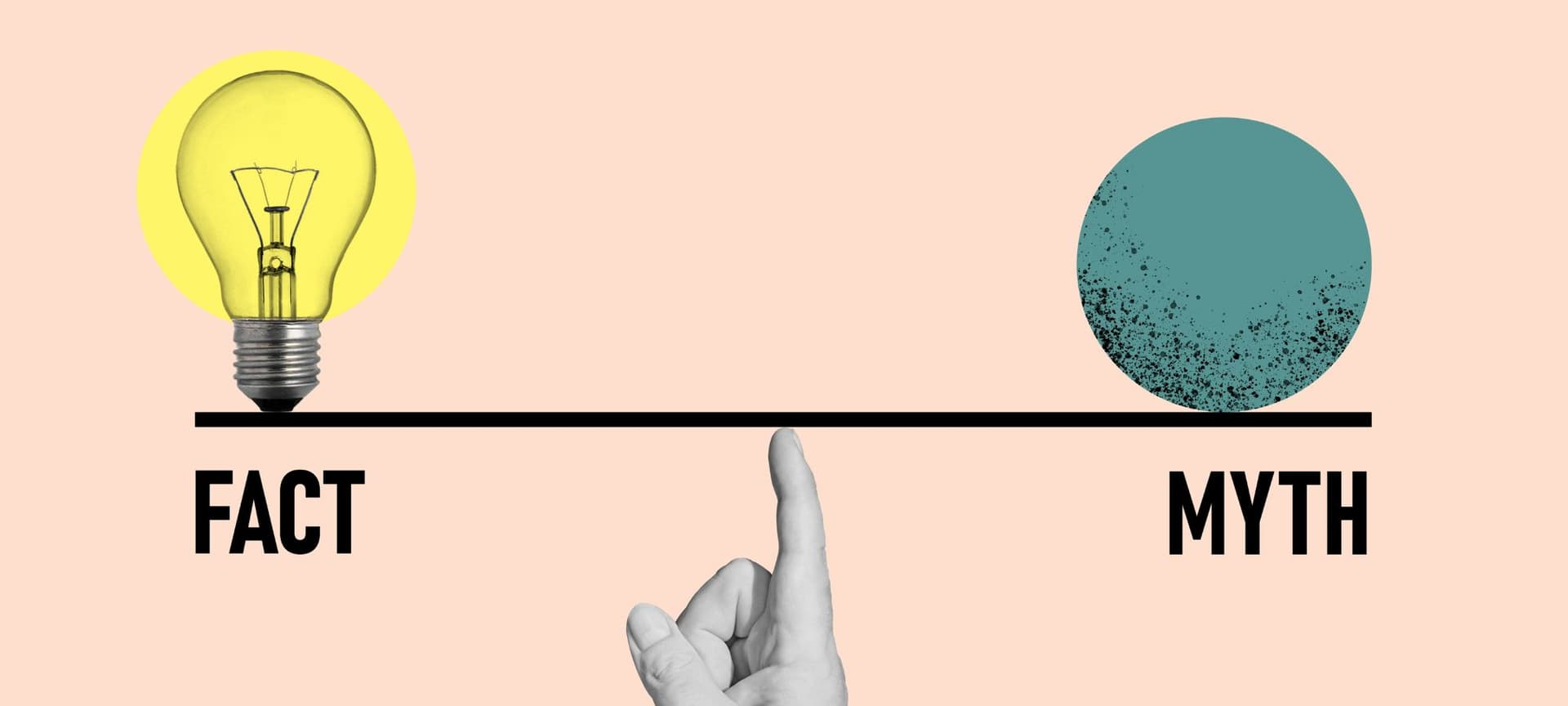
Image used under license from Shutterstock.com
“If it’s firmly established…it does not care how you feel about it…They may make you uncomfortable, and they may even make you angry or disappointed, like, Why does it have to be that way? Sorry. It doesn’t care about how you feel; it’s a fact.”
Science
“Science develops hypotheses,” he explained. “It does experiments to test those. It depends on replication. It does make mistakes, but it’s ultimately self-correcting. If the result is interesting enough for somebody to care, they’re going to repeat the experiment, and you’re going to find out about it. Science is a reliable way to discover truth about nature.”
For example, although there has been much controversy around the COVID-19 pandemic, he believes that in 100 or 500 years, people may judge that “the scientific response to the worst pandemic in more than 100 years, was pretty astounding, in terms of the way in which scientists came together from academia, from government, from the private sector, working together 100 hours a week, as we all were doing in 2020, trying to figure out not just the vaccines, but also possible therapeutics and diagnostic tests so that we would have the tools we needed to deal with this terrible pandemic.”
The tragedy, he said, is that 200,000 unvaccinated Americans died unnecessarily, which is four times the number of US casualties in the Vietnam War.
“It was not just that people were distrusting science,” he explained. “They were distrusting scientists, as well. And some of the scientists, sometimes myself included, didn’t do a great job of communicating the facts of the matter in a way that explained our uncertainties as this was blowing up in front of us…The bottom line is somehow the enemy, the virus, was replaced by other enemies of people around us; it must be their fault. And we’re still there now. And that is deeply troubling.”
…[Science] does make mistakes, but it’s ultimately self-correcting…Science is a reliable way to discover truth about nature.
Another area where scientific facts get muddled is climate change.
“Thermometers don’t really care what political party you belong to,” he said, referencing a graph of Earth’s temperatures since 1850.
Temperatures began rising steeply in 1950 and that change “absolutely cannot be explained by previous natural cycles,” he said. Collins worries however that climate change is often presented as a hopeless catastrophe rather than a problem that can be solved. “There are things that are already being done,” he said, noting that greenhouse gasses have declined 17% since 2005 in the US because of targeted action.
“Some of the goals that are out there are not pie in the sky. If we all decided to make them a priority, they are achievable. But again, it’s not going to happen by doom and gloom. It is going to happen by individual responsibilities and governments supporting that.”
Trust
At the heart of our division is the decline in trust among Americans. Citing an annual Gallup poll, Collins explained that trust in every major American institution except the military declined between 1977 and 2023.
In 1977, trust for most institutions hovered around 50%, he said, but now trust in schools, organized labor, banks, branches of government, journalism, and businesses hovers in the 20s, with the least amount of trust astoundingly reserved for Congress, at about eight percent.
Coincidentally or not, these statistics correlate with studies showing that the religiously unaffiliated are on the rise, having grown from around seven percent of the US population in 1995 to 30 percent today.
Whatever their affiliation, people tend to consider four interlocking elements when deciding whom to trust, Collins said. The first three are pretty straightforward: Does the person have integrity? Do they have competence? Do they have expertise and the humility to understand the limits of their expertise?
It’s the fourth question that can get us into trouble. Are their beliefs and values aligned with our own?

Image used under license from Shutterstock.com
As people of faith, we need to re-anchor our worldview, not in political arguments or messages, but in biblical principles.
“I know this person and I get them. They get me. And that is exactly the wrong place sometimes to go for something where your bubble doesn’t have the kind of expertise you need. It’s over there in that other group that you’re not feeling very comfortable with,” he said.
“We need to work on our intellectual radar to tell the difference between facts and fakes,” he said, beginning with developing more discernment about our news sources and relearning how to listen to people whose views and beliefs differ from our own.
“The goal of those conversations is not to get that person to say, ‘Oh, I was wrong and you’re right,’ because that’s not going to be the way it works.” Instead, you’ll foster greater understanding for one another. You’ll learn to acknowledge differences without demonizing others, he said.
Faith
“As people of faith, we need to re-anchor our worldview, not in political arguments or messages, but in biblical principles,” he explained.
Christians should be in the best position to advocate against divisiveness and animosity and in favor of love, grace and truth, especially when it comes to the admonition to love our enemies and to pray for those who persecute us, because our faith is the source of our hope and from which we draw our strength.
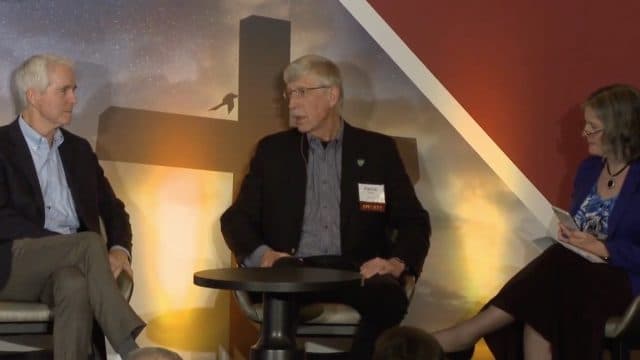
Collins concluded by sharing the news that he had recently been diagnosed with an aggressive form of prostate cancer and would begin treatment soon after the conference. He connected this news to the principals he shared, saying, “I trust, certainly, in my surgeon or I wouldn’t have picked him. I’ve trusted the rest of the medical staff that will be taking care of me. I trust in all the people who’ve done the work up until now to assure me that this is probably going to be curable. But mostly, I have trusted Jesus will be right there beside me. And that gives me the greatest comfort of all.”
Francis Collins speaking on his cancer diagnosis at the 2024 BioLogos Faith & Science conference.
A Pledge and a Blessing
Suggesting that his audience pledge to do better, he closed with a benediction that is often ascribed to St. Francis, but was actually written by a Benedictine sister:
“May God bless you with discomfort at easy answers, half truths, and superficial relationships, so that you may live deep within your heart.
May God bless you with anger at injustice, oppression and exploitation of people so that you may work for justice, freedom, and peace.
May God bless you with tears, to shed for those who suffer from pain, rejection, starvation and war. So that you may reach out your hand to comfort them and to turn their pain into joy and goodness knows so much of that suffering around us now.
May God bless you with enough foolishness to believe that you can make a difference in this world, so that you can do what others claim cannot be done.”
This is what he’s asking us to do.
About the author

Christine DiPasquale
Related resources
If you enjoyed this article, we recommend you check out the following resources: