From the Ground Up: Soil and Spiritual Formation
For Beth Madison, soil science and the spiritual formation of our souls have more in common than we might think. Both need proper care for our flourishing.
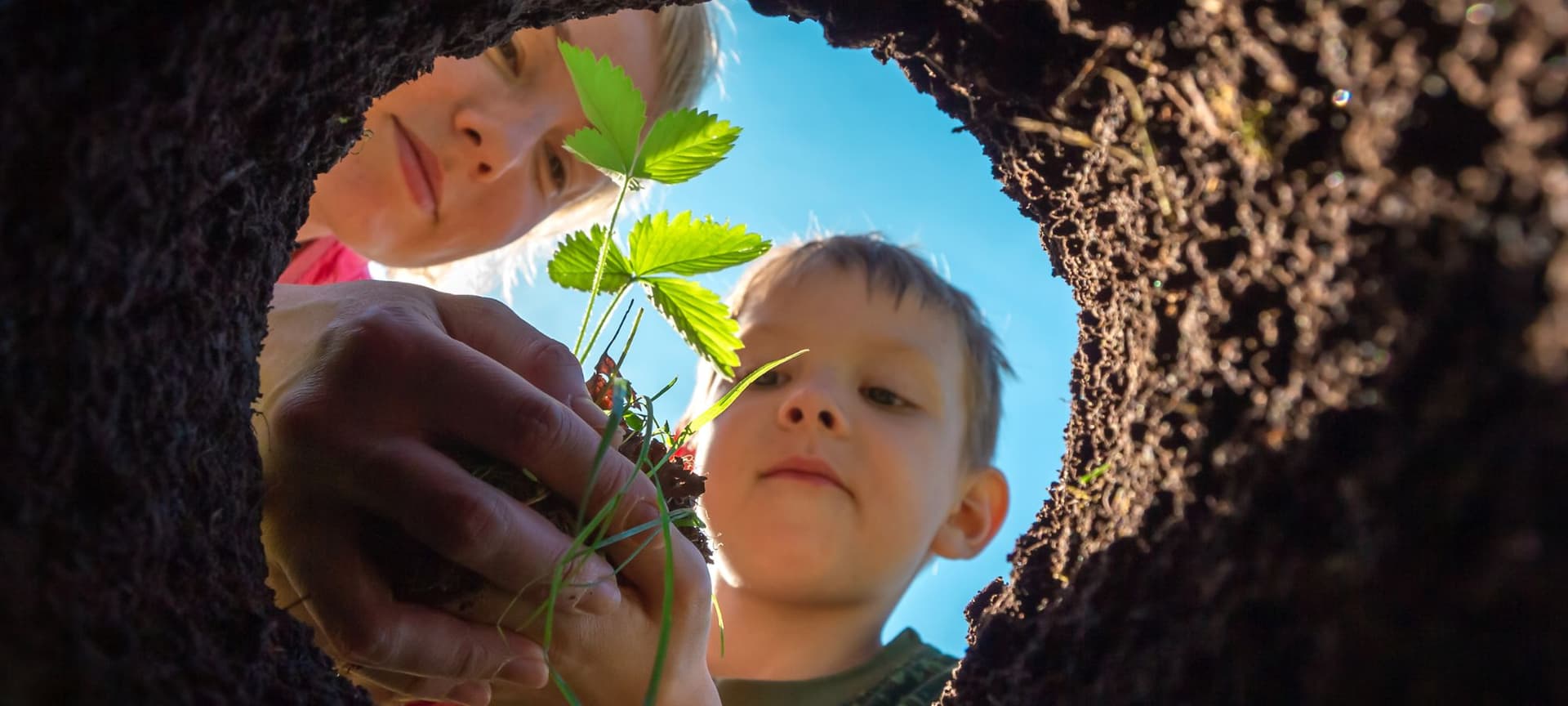
Image used under license from Shutterstock.com
Recently, some scientists have proposed adding humans to the list of factors affecting soil formation. That would place us alongside climate, time, living and formerly living organisms, topography, parent material, and other natural materials and processes that make soil. But, why humans? It’s estimated that less than five percent of the Earth’s soils are unaffected by human action. Poor land management practices, pollution, urban development, and climate change are dramatically changing the soil beneath our feet. Even though soil is considered a renewable resource, we (and future generations) can’t afford to lose any more of it to erosion, degradation, or decay.
Soil is a beautiful and valuable gift from God, but it is often overlooked and underappreciated. In the words of a former soil science professor of mine, “We’ve got to stop treating our soil like dirt.” I first heard those words nearly 40 years ago, but the need for repeating them is as true now as it was then, and to as many who will listen. Soil is far more than just weathered rocks that have been broken down over time by chemical and physical forces. It is a synergistic and dynamic mix of living and formerly living organisms, minerals, and other materials that can feed our world and redeem our waste products and water supplies. A healthy soil bursts with chemical and microbial activity far beyond what we can measure or understand, even after decades of exploring its wonders in research.
As a Christ-follower who is a soil scientist and farmer’s daughter, I posit that without intentionality in our lives, we might feel the same about the soil of our souls as we do about the soil under our feet. We often don’t realize the importance of the need for diligent and dedicated stewardship of our soils and our souls. I know my own life choices often reflect my lack of valuing the soil under my feet and in my soul. Yet, I’ve found the more dedicated I am to increasing the health of the soil under my feet, the more aware I am of the need to cultivate growth in the soil of my (and others’) souls. I want to help others make this connection too.
I’ve found the more dedicated I am to increasing the health of the soil under my feet, the more aware I am of the need to cultivate growth in the soil of my (and others’) souls. I want to help others make this connection too.
A Need for Connection
As fewer and fewer people are actively involved in agriculture, we are losing our connection to land and soil. As a result, we might not see land-altering events as life-changing until they are disruptive enough to land on the news or impact our daily lives in unavoidable ways. Yet, land-altering events are life-changing for many populations, especially the most vulnerable of us living on the margins of life via poverty, culture, age, location, and other factors.
A lack of identification with and knowledge of soil can easily promote apathy when instead we should be moved to action. Wendell Berry writes, “Human necessity is not just to know but to cherish and protect the things that are known, and to know the things that can only be known by cherishing…so that in seeing or remembering them the heart may be said to ‘to sing’.” As Christians, we are called to be caretakers of creation. But how can we be caretakers if we are disconnected from what we are supposed to be caring for? The good news is that we don’t have to be soil scientists, farmers, or gardeners to care for and care about creation.
In my experience, education is a great way to help people connect more deeply with creation. Recently, a colleague asked me, “What is a watershed?” I replied that a watershed was an area of land that drains (or “feeds”) into a certain source of water such as a river or lake. She then asked, “Do we really need all these signs that talk about watersheds?” I responded with a (hearty) yes and a brief explanation that water can move vertically and horizontally through soils. This means that if someone dumps oil/chemicals in one area of the watershed, the entire watershed can be polluted because of water movement through the soil. Then, if that happens, surrounding areas can also be contaminated as the water from that now-contaminated river or lake flows into another watershed or large body of water.
Needless to say, I was delighted when she responded with, “Ok, that makes sense, now I understand the need for the signs.” Education can make all the difference in protecting soil and water quality, one conversation or one sign at a time.

Image used under license from Shutterstock.com
A lack of identification with and knowledge of soil can easily promote apathy when instead we should be moved to action…Education can make all the difference in protecting soil and water quality, one conversation or one sign at a time.
On Soil and Souls
Humans can impact our world positively or negatively. Sadly, we have done more of the latter, to people and our planet, and even the soil under our feet. The health of our people and planet, including our soil, is a direct reflection of our actions.
As a Christian who’s a soil scientist, I see the same for my own life. People can affect my life in every way just as I can affect others in their lives. My actions can either display God’s grace or my gain, God’s love or my lusts, God’s mercy or my manipulations, and so on…The bottom line is this: what I’m allowing to form the soil of my soul will be exhibited in how I deal with others. It’s gonna be Jesus and joy. Or it’s gonna be me and the hurt of my own making.
Just as soil is formed through soil-forming factors, our souls are formed by soul-forming factors. Soil does not choose how it is formed, including the input from us as a sixth soil-forming factor. Our souls are similarly shaped and formed by external factors, some by our own choosing and others by God’s.
In my own life, I’m learning to submit to the factors of God’s choosing because I believe his way is best. His climate for me, be it fire or flood, storm or silent nights, is best. His timing of events for me is best. The people He puts in my life, be they living now or previously, are for good. His Word as parent material for wisdom is best (see Psalm chapter 1). And finally, trusting Him in the topography of mountains or valleys or everywhere in-between is necessary, even and especially when it’s not easy. As He is doing good in my life with those soul-forming factors, good soil will be produced in and from my life (see Psalm 111:7). A good soil in my soul which produces good fruit from my life for others and for me in the doing (see Galatians 5:22-23 and Matthew 13:1-23).
From the Ground Up
One of my favorite examples in Scripture of soul formation is from the book of Daniel. Shadrach, Meshach, and Abednego’s lives are evidence of the value of having a deep, well-rooted, solid-soul trust in God as Creator, Provider, and Sustainer. They stood firm over time in climates adverse to their faith, surrounded by people who believed differently, with the topography of mountains of trusting God to overcome because of their strong belief in God. These soul-forming factors impacted the growth of their faith. And their faith made them (literally) stand up and stand out where even the king took notice and responded to their faith in the living God.
Their faith had an impact on their world from the ground up. In turn, their lives were that sixth soul-forming factor on the lives of many then and now. That’s the kind of life I want. A life that acts as a soul-forming factor on others’ lives in faith to point them straight to Jesus. For Jesus is the only one who can truly change the soil of someone’s soul. And when he does the changing, nothing or no one can escape his impact in all parts of his or her life.
There’s no time like the present to start seeking our good God to grow a life-changing faith in us. When we are changed like that, it’s not just for us. Rather, it’s for the whole world to know and believe the truth that only Jesus can redeem and restore all of us, all the way down to the smallest particle of the soil of our souls! I don’t think anyone could experience a greater life-change than that. And a life-change of that nature has the potential to alter all lands in all ways forever. Now that’s the kind of soul science this soil scientist wants for everyone for today and forever.
Jesus is the only one who can truly change the soil of someone’s soul. And when he does the changing, nothing or no one can escape his impact in all parts of his or her life.
About the author

Beth Madison
Related resources
If you enjoyed this article, we recommend you check out the following resources:
Podcast Episode
Faith and Soil

Article