When Children Wonder About Creation
Churches can help children return to their rightful place in the natural world, healing a growing rift.
Image used under license from Shutterstock.com
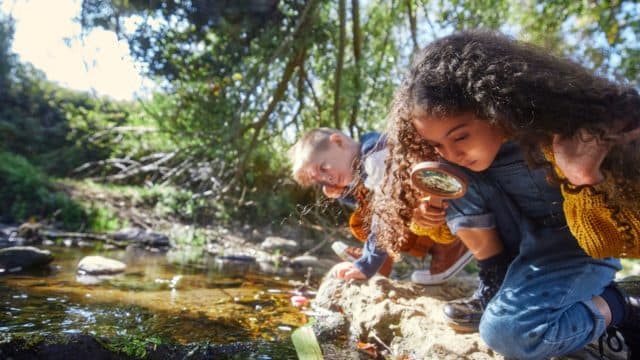
It’s a sunny, hot June day in North Carolina. A troop of children and adults weaves through a stand of hickories, maples, ironwood, white pines, and Virginia pines. Mountain laurel and rhododendron blossoms peek out from the undergrowth. The group stops around a red oak, a prizewinner among the rest. One girl, about 10 years old, takes her turn with a stethoscope.
She puts the earpieces in and places the bell on the red oak’s bark. She tunes out the birdsong and breeze and holds her breath. The rest of the group holds their breath with her. The moment stretches out as she listens. She hears it! The sap flowing up and down the tree makes a faint, rhythmic gurgling that the stethoscope picks up. The girl’s eyelids flutter up in wonder. In the patterns of nature, present in this red oak’s “heartbeat,” she senses something of God’s design, purpose, and goodness. She thinks to herself, “This is God’s world that Jesus came to redeem. Me and this tree, we’re all part of it.”
My friend Mary Anne Inglis witnessed this moment while she led a creation care Vacation Bible School camp some years ago. Produced by A Rocha USA, the Wild Wonder VBS curriculum invites children to delight in God as creator, redeemer, and sustainer of all things by immersing them in the wonders of the created world. The curriculum bridges a gap in the science-faith conversation, which often overlooks a critical age group: children.
Where Children Belong
“Let the little children come to me, and do not hinder them, for the kingdom of heaven belongs to such as these,” said Jesus (Matthew 19:14). From their earliest moments, children have a sense of their birthright belonging within the wild and glorious realm of God’s creation, which Christ came to set right. But recent decades have seen a painful separation of children from nature.
The average North American child today spends seven hours looking at screens daily and a mere seven minutes in unstructured play outdoors, according to paleontologist Scott Sampson in “How to Raise a Wild Child.” Children today spend significantly less time outside than their parents and grandparents. This lack of meaningful experiences in God’s creation has become so acute that journalist and author Richard Louv has coined the term “nature-deficit disorder.” A centuries-long trend of urbanization has moved modern life indoors. Combined with our increased reliance on phones and screens in recent decades, as well as societal pressure on parents to helicopter parent and prioritize kids’ safety, and today’s children are left with very few opportunities to explore the critters and seedlings and wild spaces unfurling just beyond their doorsteps.
The Children and Nature Network, which Louv founded, marshals a growing body of research to show what’s at stake. Nature-deficit disorder contributes to a diminished use of the senses, difficulty concentrating, obesity, and higher levels of emotional and physical distress. When children are disconnected from nature, they also identify with and care less about creation, weakening any impulse to steward the created world as God has called us to do. But the opposite is also true. When children spend abundant time in nature, they are more focused, less depressed, perform better in school, and are healthier emotionally, relationally, and physically. What the research doesn’t identify, but what Scripture makes abundantly clear, is that connecting with creation is also essential to our spiritual well-being.

Image used under license from Shutterstock.com
When children are disconnected from nature, they also identify with and care less about creation, weakening any impulse to steward the created world as God has called us to do.
Repairing the Rift
“But ask the animals, and they will teach you, or the birds in the sky, and they will tell you; or speak to the earth, and it will teach you, or let the fish in the sea inform you. Which of all these does not know that the hand of the Lord has done this?” Job asks this of his friends who attempt to “counsel” him in his great losses (Job 12:7-9). God’s hand is behind all of this, Job proclaims, extending an arm to include his own situation as well as the far reaches of creation. When we spend time in nature, paying attention to the smallest details, creation by its very nature points our gaze toward God, the Creator.
It’s no wonder that many people, especially young people, sense God’s presence more tangibly under a canopy of trees than beneath any human-built cathedral. We were made to worship in the company of all that God has made, not just among the works of our own hands. Spending time in the natural world evokes a sense of awe that is similar to the state of mind induced by prayer, meditation, and other spiritual disciplines. Psychologist Dacher Keltner documents that awe deactivates our default mode network, the part of the brain obsessed with the self: What do they think of me? What will happen to me? What’s in it for me? States of awe and wonder lead us to the deep truth that we are part of something vast and mysterious, something bigger than what we in our normal waking states can comprehend.
All of this can happen out in a churchyard, listening to sap gurgling up and down the xylem and phloem of a red oak tree.
In our time of climate crisis and nature loss, the church has an opportunity to repair the rift our society has wrought between children and nature. Children are aware of the grave ecological challenges we are facing, though we might not speak explicitly of this to them at a young age. They sense that things are not right. Christian communities, now more than ever, can offer spaces of delight, beauty, and joy for children to reconnect with the rest of God’s good creation, in which they rightly belong. We are called to care for creation, but we can’t care for that which we don’t know.
It’s no wonder that many people, especially young people, sense God’s presence more tangibly under a canopy of trees than beneath any human-built cathedral.
Starting With Children
Providing experiences for children to connect with nature can be transformative for the rest of the congregation. Since Mary Anne’s church, St John in the Wilderness in Flat Rock, North Carolina, started running Wild Wonder camps in 2016, the congregation has started a garden program where they grow vegetables for a local food bank. They’ve transitioned from paper and plastic products to compostable or reusable products. They use china plates and cloth tablecloths (which they had stored in cupboards already) instead of Styrofoam plates and plastic tablecloths, for a monthly church breakfast. The question, “How do we honor God in every facet of the church?” has shaped the congregation’s choices, down to the tableware.
Today, churches can access a growing collection of faith-based resources that disciple children and their grownups to love God through caring for creation. With or without a designated curriculum, however, churches can ask the same questions in their own context. What is faithfulness in our era of environmental crisis and nature-deficit disorder? How can we inspire awe and wonder, joy and delight, in children and adults, that leads them to God?
The answers may lie just beyond the church walls.
Join the conversation on the BioLogos forum
At BioLogos, “gracious dialogue” means demonstrating the grace of Christ as we dialogue together about the tough issues of science and faith.
About the author

Liuan Huska
Related resources
If you enjoyed this article, we recommend you check out the following resources: