What Nature and Scripture Tell us About the Bethlehem Star
BioLogos President Deb Haarsma reflects on what nature and Scripture tell us about the Bethlehem star. What did it mean then? What does it mean for us today?

Image used under license from Shutterstock.com
The star of Bethlehem inspires decorations everywhere this time of year. We see stars in department stores, on wrapping paper, on Christmas trees, and on houses. When I was a kid, our Christmas tree always had a lit star at the top—I can still see the white plastic star shape, slightly yellowed and warped from the incandescent bulb. In our neighborhood today, one family places a large lit star high in a tree above the nativity scene in their front yard.
In the Biblical accounts, the star described in Matthew 2:1-12 joins the brilliant angel chorus of Luke 2 in proclaiming that Christ comes to bring light to our dark world. But what did that star look like? Was it even a star? What did it mean to the Magi? Does it mean anything to us now?
A Star in the East
In the King James translation of Matthew 2 the Magi tell Herod in verse 2, “we have seen his star in the east.” In verse 9 we read, “the star, which they saw in the east, went before them, till it came and stood over where the young child was.” Christmas cards often show a beam of light like a search light, shining directly into the stable with Mary, Joseph, and the baby Jesus. The problem is that no astronomical object stands still over a particular spot on earth! Stars rise in the east and set in the west every night, just like the Sun does every day. From an astronomical perspective, verse 9 just doesn’t make sense.
When I first realized this conundrum, I figured that the Bethlehem star was simply a miracle. God certainly has the power to create a brilliant miraculous light for the birth of his Son. When God guided the Israelites out of Egypt, he used a moving pillar of fire (Exodus 13:21-22). When God revealed himself to Paul on the road to Damascus, he used a brilliant light that blinded Paul (Acts 9:1-9).
What Nature Tells Us
Although it could have been a miracle, astronomers for centuries have looked for a natural explanation. What exactly did the Magi see? The answer to this question is far from the main point of the text (which I’ll come back to later), but it has fascinated scholars for centuries. Many have back-calculated what the sky looked like around the time of Jesus’ birth.
If the Bethlehem star was something bright and temporary, it could have been a supernova, a comet, or a nova. However, the object also needs to be rare and significant enough to prompt the Magi’s journey, and comets and novae are just too common. Plus, comets were seen as negative portents in the ancient world, not positive ones. A supernova might be rare enough, but a bright supernova would have been seen by cultures around the world; the Chinese kept good records and did not record one at that time.
Perhaps the biggest problem is that a bright astronomical object would be visible to Herod and his advisors, not just the Magi. Yet Herod is surprised to learn of the Magi’s message. If there was a blazing search light on the village of Bethlehem, wouldn’t Herod have said, “Why yes, we saw that too”? It seems the Magi noticed something subtle in the heavens that most people missed. For these reasons, many scholars today think that the Magi saw something in the motions of the planets that had special significance in their astrological thinking. Most likely it was a motion of the planet Jupiter. Jupiter is often the brightest planet in the sky and was seen as the king of the planets in ancient times as well as today.
…many scholars today think that the Magi saw…a motion of the planet Jupiter. Jupiter is the brightest planet in the sky and was seen as the king of the planets in ancient times as well as today.
What Scripture Tells Us
The Greek text actually offers some clues that do not come through in English translations. I was excited to learn about these in the 1999 book “The Star of Bethlehem” by Michael Molnar. Molnar explains how the phrase “In the east” is actually the Greek technical phrase en te anatole, referring to what today’s astronomers call heliacal rising.
What is heliacal rising? Briefly, as the planets orbit the Sun, they appear to us to move relative to the background stars, traveling around the sky once a year. At heliacal rising, a planet appears in the morning sky near the rising Sun, just visible in the dawn light. The term translated “went before” is the Greek term proegen which refers to retrograde motion, when a planet briefly moves relative to the stars in the reverse of its usual direction. The term translated “stood over” is the Greek term epano, the pause when the planet changes its direction during retrograde motion. Molnar explains how the ancient astrologers attached much significance to these motions. When these motions were made by the planet Jupiter, in a constellation associated with Judea, the motions would indicate that a king had been born in Judea. Thus, the language in Matthew would mean that “The planet which they had seen at its heliacal rising went into retrograde motion and became stationary relative to the stars, showing a Judean king has been born.”
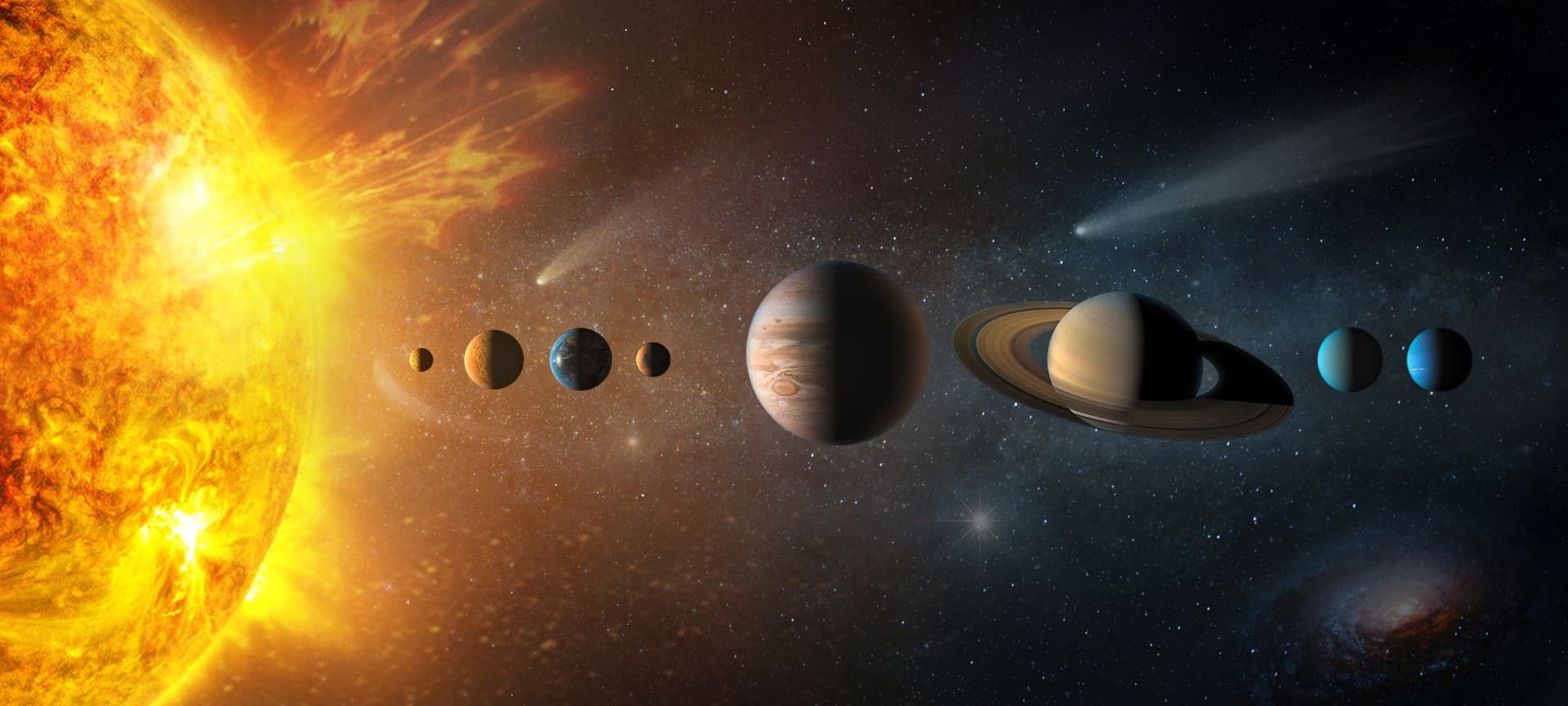
Image used under license from Shutterstock.com
Rather than a miraculous stationary searchlight shining down on the stable (which Herod and everyone would have noticed), the Magi saw a planet in retrograde motion. Molnar proposes that the Bethlehem star is the planet Jupiter around 6 B.C. when it underwent retrograde motion, heliacal rising, and a few other special motions…
When I learned this, I was astounded! Matthew 2: 9 made so much more sense. Rather than a miraculous stationary searchlight shining down on the stable (which Herod and everyone would have noticed), the Magi saw a planet in retrograde motion. Molnar proposes that the Bethlehem star is the planet Jupiter around 6 B.C. when it underwent retrograde motion, heliacal rising, and a few other special motions (a conjunction with other planets and an occultation with the Moon). But many other models are still discussed. The book “Would You Baptize an Extraterrestrial?” by Vatican astronomers Guy Consolmagno and Paul Mueller gives a nice overview of different astronomical options, as well as more discussion of astrology, miracles, and ways to understand scripture and science.
God’s Word for Us Today
But let’s step back a moment. Rather than just focusing on a technical explanation, I’d like to invite us to consider the main point of the scriptural text. What is God teaching us in this passage? God’s word is written for us, even if it wasn’t written directly to us. With any scripture passage we should first consider what it meant to the original audience and the inspired human author, before considering its meaning for us today, and certainly before considering modern scientific explanations. For the first readers (most of whom were not astrologers), this account in Matthew shows that Jesus’ birth was heralded in both the natural world (the star) and in the nations (the Magi). Matthew describes these impressive signs to show that Jesus was no ordinary child. He foreshadows that Jesus would bring a new kingdom that would transcend the Jewish people and encompass heaven and earth.
Moreover, the text is filled with contrasts between the Magi and Herod’s court. This passage is so familiar that I had missed the contrast until my pastor pointed it out in a sermon one Christmas. Compared to the Jewish scholars, the Magi knew so little. They weren’t Jews, they weren’t steeped in Hebrew prophecy, and they didn’t know the law of Moses. But they were curious, and God used that curiosity and a sign in the heavens to draw them to himself.
Whatever the sign was, when the Magi saw it, they didn’t get stuck in scholarly debates. I find that particularly impressive—they were scholars, and surely they debated among themselves about what it all meant! Instead, they decided to set aside their scrolls and set out on a long, uncertain journey. Despite the inevitable inconveniences of the trip, they didn’t stop asking questions and stayed eager to learn. They didn’t see the newborn King as competition; rather, they rejoiced when they found the Christ child. They didn’t travel to gain power or wealth—rather they traveled to offer their worship and their costliest treasures.
[The Magi] were curious, and God used that curiosity and a sign in the heavens to draw them to himself.
The leaders in Jerusalem didn’t bother traveling five miles.
May God open our hearts to follow wherever he leads, with curiosity and joy. The old hymn by W. Chatterton Dix, “As with Gladness Men of Old,” says it well. Here are the lyrics—consider reading them afresh, and reflect on where God is leading you this season.
As with gladness men of old
did the guiding star behold,
as with joy they hailed its light,
leading onward, beaming bright,
so, most gracious Lord, may we
evermore be led by thee.
As with joyful steps they sped,
Savior, to thy lowly bed,
there to bend the knee before
thee, whom heav’n and earth adore,
so may we with willing feet
ever seek thy mercy seat.
As they offered gifts most rare
at thy cradle, rude and bare,
so may we with holy joy,
pure and free from sin’s alloy,
all our costliest treasures bring,
Christ, to thee, our heav’nly King.
Join the conversation on the BioLogos forum
At BioLogos, “gracious dialogue” means demonstrating the grace of Christ as we dialogue together about the tough issues of science and faith.
About the author

Deborah Haarsma
Related Resources


Podcast Episode
Deb Haarsma | Break Forth into Praise
Podcast Episode
Heino Falcke | The Hidden World Above