We Can’t Recycle Our Way Out of the Environmental Crisis
Ecologist Rick Lindroth has some sobering words on the environmental crisis, how we got here, what will and won’t work, and the need for creation connection.
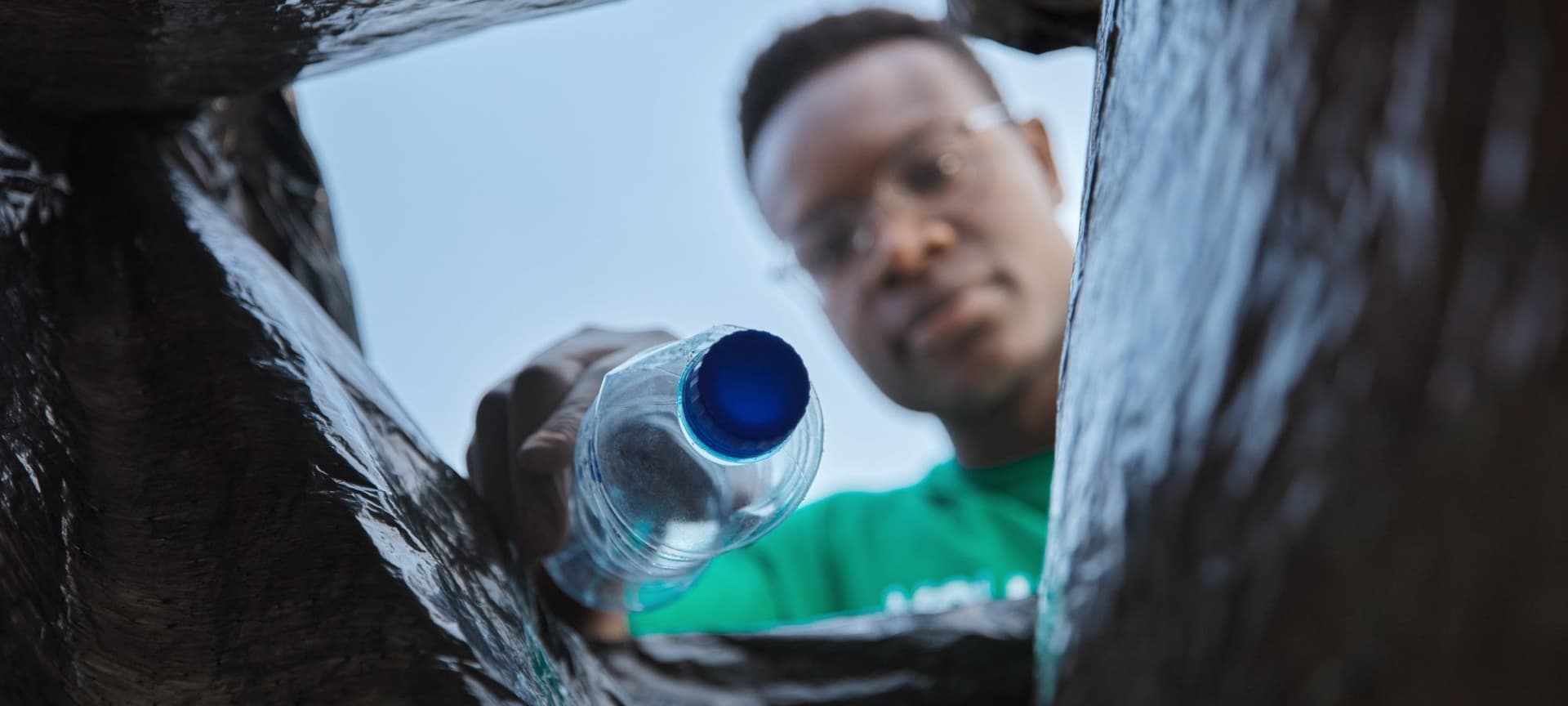
Image used under license from Shutterstock.com
Ecologist Rick Lindroth uses the phrase “free range” to describe his childhood because he grew up in rural northern Illinois roaming freely in a backyard with acres of fields, forests, and marshes. He knew by the age of 7 that he wanted to become a biologist, and this early connection to nature is what he credits for that inspiration.
Establishing a deep connection to the natural world is thought to be especially important between the ages of seven to 12. That’s exactly what happened to Rick. He says that at a young age “nature was imprinted on my soul.”
Now a retired biology professor, he’s helping his grandkids and others develop similar connections with nature. Last summer, he convinced his grandkids to explore a nearby grassy field. Rick recalls, “It took some convincing, because they weren’t too excited at first. The grass was ‘too scratchy.’ ‘There might be snakes’ and the proverbial ‘this is boring’—but I knew that if I could get them to open their eyes, to use their senses, we’d have a great time.” And they did.
They found caterpillars, monarch butterfly eggs, and more. It brought him joy to witness his grandkids move from disinterest to excitement. He recalls, “Within moments, the kids’ attitudes were transformed…they were running from plant to plant…and they were so excited. We collected a dozen [caterpillars]…brought them home, reared them up, and then released the adult butterflies. It was a formational experience in nature connection that started when they learned to engage their senses.”
As a scientist and person of faith, Rick wants to help people of all ages, especially Christians, develop…meaningful connection with nature.
As a scientist and person of faith, Rick wants to help people of all ages, especially Christians, develop this type of meaningful connection with nature. For him, connecting with nature isn’t just for scientists or nature enthusiasts, it’s for everyone. And connection with nature isn’t just for our physical, emotional, and social well-being, although those are very important. Nature connection is fundamentally important for our spiritual health. Rick writes, “what the Christian community has largely failed to realize is that in distancing ourselves from nature, we are distancing ourselves from God.”
But how exactly have we gotten ourselves here in the first place? And where do we go from here? Can we regain our connection with nature and repair the chasm we’ve wedged between ourselves and God? Rick believes so. In his talk at the recent BioLogos 2024 Faith and Science Conference, he answered these questions and challenged us to respond.
How We Got Here
While training to become an ecologist, Rick says that he was optimistic and hopeful, “working under the assumption that if we learned about the damage that humans were causing to ecosystems, we’d actually want to do something about it.” Sadly, he confessed that in retrospect he was “profoundly naive. Despite all of that effort, despite all of the efforts of tens of thousands of scientists around the world, we’ve hardly moved the needle on creation care. Our understanding of human impacts on earth has far exceeded our interest in actually doing anything…Earth is worse now than when I started my career 35 years ago.”
For Rick, dualism, bad theology, and technology are some of the main reasons we’ve gotten ourselves into this terrible predicament. Dualism is “the philosophical separation of the mental or the sacred from the physical or the secular. That philosophy has fully integrated into our western worldviews, beginning with Greek Platonism, accelerating with the Enlightenment disenchantment, and especially with the rise of secularism.”
As for bad theology, Rick believes that “we’ve incorporated dualism, the division of the sacred and the secular, into our religious beliefs, leading to the desacralization of the world and escapist eschatology. We’ve reduced the gospel to simply the salvation of individual human souls, and we’ve emphasized dominion in relation to the natural world. Dominion is actually a posture of colonialism. It emphasizes possession, control, extraction and enrichment for the privileged few.”
When it comes to technology, it has wedged a divide making us “physically and functionally separate from the natural world.” According to Rick, “for over 99% of human history we’ve lived closely connected to the natural world. That connection shaped us physically, emotionally, spiritually, and socially. But over the last 100 years, that connection has largely been lost. Today, the average American spends 93% of their life indoors. Kids, on average, spend less than 10 minutes per day in unstructured outdoor play, but seven hours per day in front of screens.”

Image used under license from Shutterstock.com
“[Creation connection] is not going to [solve all our problems] but what I’m arguing today is that it’s an essential and critical step towards doing so. Creation connection is necessary if we are to fully worship God as the creator of the cosmos, to live as created beings enmeshed within the community of the created, and if we are to love the sacred, extraordinary Earth and those who will inherit it from us.”
What We Can Do About It
In his talk, Rick said that information and knowledge can only get us so far. In fact, he shared that there’s research that shows “that information and knowledge have a very minimal impact on creation connection. In other words, we can sit and watch the wonderful videos about nature or look at nice pictures all day long, and it doesn’t really do much to connect us with nature.”
Surprisingly, even physically experiencing nature has at best only a moderate impact on connecting us with nature. Rick shared that this is likely because “oftentimes our time spent in nature is simply used as a backdrop for recreation. I’m walking or I’m cycling, or I’m fishing or I’m doing something else, but I’m not really connecting with nature.”
Even the simple act of recycling is something that Rick believes is a good act, but is, sadly, often used as an easy way out of committing to do more. “We’ve reduced our perception of creation care to a short list of duties and prohibitions—what I call environmental legalism. To be honest, this is why I wish recycling didn’t exist. It gives people an easy way out. It happens to me all the time: the topic of creation care comes up, and people are quick to tell me, “we recycle!” I hate to break it to you, but we’re not going to recycle our way out of the climate crisis or the biodiversity crisis. It’s not going to happen.”
“We’ve reduced our perception of creation care to a short list of duties and prohibitions what I call environmental legalism…I hate to break it to you, but we’re not going to recycle our way out of the climate crisis or the biodiversity crisis.”
So then what does work? Rick said, “Immersive experience: thoughtful, intentional, mindful, and especially emotional connection to the created world around us now.”
As for what these look like in practice, Rick shared a few suggestions. “Start simple and develop over time. Ask yourself, what’s my next step? Find activities that you enjoy: wonder-walks, gardening, birding, cooking, art. A lot of what we already do has a connection to the natural world. We just need to find it and think about it.”
He also finds it helpful to find ways to “practice daily liturgies of beholding creation. These actually will rewire our minds. So step outside. Look at the sunshine, look at an eclipse, look at leaves—mindfully, intentionally, thoughtfully, emotionally. Hold that for 30 seconds a day, and it will rewire your brain paths to better connect with the natural world around us. Keep a nature journal. I started an awe diary. Learn the names and habits of your wild neighbors, engage with a like-minded community, model your creation care commitments, and work towards local, institutional and societal changes that promote creation care and creation connection.”
A Benediction
Soberingly, Rick acknowledged that creation connection will not solve our environmental challenges. But, he gave us a compelling reason to practice it and work towards a better future.
“[Creation connection] is not going [solve all our problems] but what I’m arguing today is that it’s an essential and critical step towards doing so. Creation connection is necessary if we are to fully worship God as creator of the cosmos, to live as created beings enmeshed within the community of the created, and if we are to love the sacred, extraordinary Earth and those who will inherit it from us.”
Rick ended his talk with a befitting benediction:
“May we seek to better know God through the book of his world.
May we embrace this world as sacred, enchanted and saturated with divine mystery.
May we engage in immersive, transformative practices to grow our connection with creation.
And may our care for creation flow from a wellspring of connection that is animated by love, sustained by hope, modeled for the world and regenerative for all the earth.”
Amen to that.
About the author

Ciara Reyes-Ton
Related resources
If you enjoyed this article, we recommend you check out the following resources:

Podcast Episode