What are the Waters Above the Firmament?
What are the waters above the firmament? Genesis 1 reflects ancient cosmology, reminding us that God accommodates the audience’s capacity when communicating.

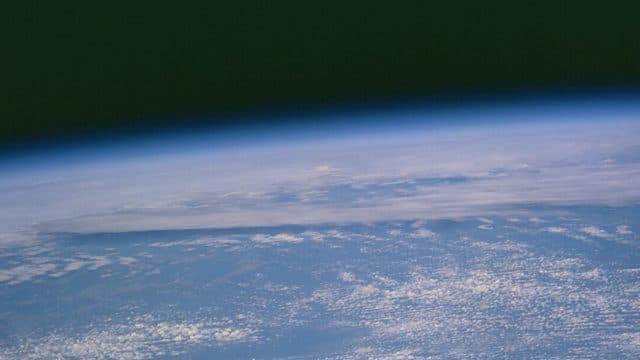
ADARSHluck, CC BY-SA 4.0 <https://creativecommons.org/licenses/by-sa/4.0>, via Wikimedia Commons
Genesis 1:7 reads, “And God made the firmament, and divided the waters which were under the firmament from the waters which were above the firmament; and it was so.” (KJV)
This passage raises questions: What is the “firmament”? And what are the waters above that it separates from the waters below?
To answer these questions, we must raise some of our own. What did Genesis’s author mean when he referenced a firmament? What did people think about the universe at the time Genesis was written? And how did God choose to communicate with those who held these perspectives?
In addition to helping us interpret Genesis 1:7, exploring these questions deepens our understanding of Scripture’s authority.
What are the Firmament and the Waters Above in Genesis 1?
How Bible Translations Render “Firmament”
The record of the second day of creation in Genesis 1:6-8 (NIV) reads:
And God said, “Let there be a vault between the waters to separate water from water.” So God made the vault and separated the water under the vault from the water above it. And it was so. God called the vault “sky.” And there was evening, and there was morning—the second day.
In this translation, the word “vault” stems from the Hebrew term rāqīʿa. The King James Version translates it “firmament,” which reflects the Latin Vulgate firmamentum and the Greek Septuagint translation stereōma, both of which convey something solid.

Woodcut by Lucas Cranach featured in Luther’s Bible showing the view of the cosmos with a solid sky. Master MS, Public domain, via Wikimedia Commons
These translations reflect a belief common in pre-modern times that there was a solid sky—a “dome” (NRSV, NRSVue) of sorts—that held back waters. This view persisted even during the Reformation.
In this conception of the world, the Sun and Moon moved inside the dome. Some also believed that the stars were engraved on its underside.
More recent translations have used terms that are less specific. One popular choice is “expanse” (ESV, HCSB, NASB, JPS, and NET; NLT uses “space”), which parallels the NIV’s “vault” and refers to the space between the waters rather than something solid that divides them.
Looking across these translations, we can see a clear divide between those that describe the firmament as something solid and those that describe it as more of a space between.
What Biblical Usage Tells Us—and What it Doesn’t
If we are to know what the author of Genesis wanted to convey to his audience, we need to better understand the Hebrew word rāqīʿa. Does it refer to a space that sits between, or something more material that divides?
Identifying the meanings of words in an ancient (and dead) language can be a challenge. However, we can rely on a principle that also holds for modern, spoken languages: meaning is derived from usage.

Image used under license from Shutterstock.com
Unfortunately, the noun rāqīʿa only occurs seventeen times in the Old Testament. It appears nine times in Genesis 1, and five times in the context of Ezekiel’s throne vision (Ezekiel 1 and Ezekiel 10, referring to that on which the throne of God rests). The other three instances (Psalm 19:2; Psalm 150:1; Daniel 12:3) are vague.
These passages are general and referential; they do not offer any description or explanation. That means we have very little to go on. It also suggests that the original reading audience knew what the word meant.
Lacking explanatory usage, many interpreters have extrapolated the understanding of rāqīʿa from the related verbal root rqʿ, which appears eleven times in the Bible. In some contexts, this verb is used to describe hammering out metals.1
While it is generally wise to seek a word’s meaning by its usage, in this case it is clear that the data are inconclusive, and we cannot come to any confident decisions about the term’s nuances.2
Ancient Cosmology: How did the Original Audience View the Universe?
As we have now discovered, it is difficult to understand the word rāqīʿa through its biblical usage alone. Another tack we can take is to look at beliefs in the world of Genesis.
When we do, we find that across various cultures, ancient peoples believed in a solid sky.
Mesopotamian texts speak of different levels of the heavens being made of varying types of stone, an idea that may also be reflected in Exodus 24:10.3
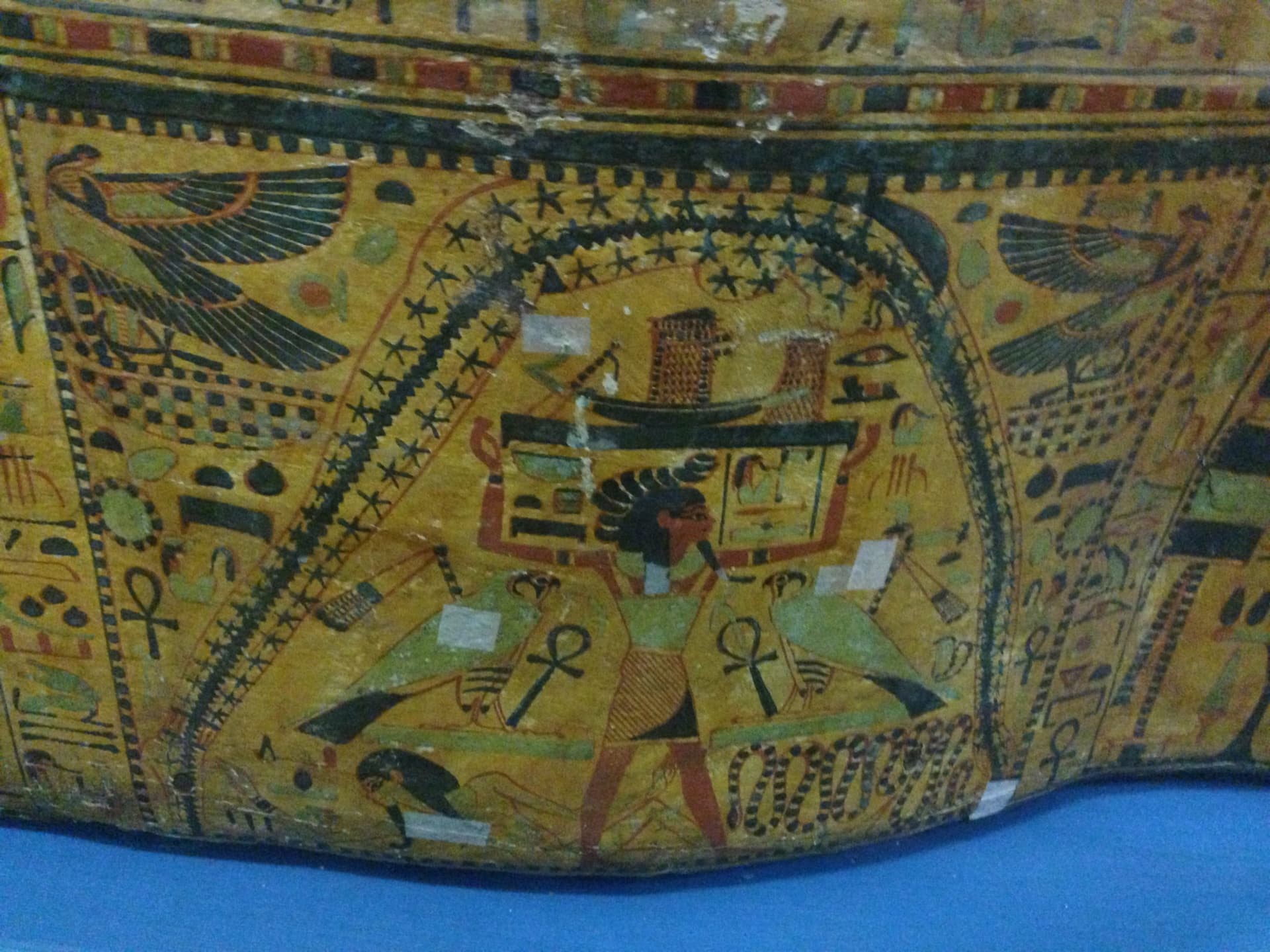
Portrayal of Egyptian cosmology. The sky god, emblazoned with stars, is held up by the air god standing over the earth god. Photo courtesy of the author.
Egyptian art consistently portrays the sky god being held up by the air god, and the Babylonian Shamash stele portrays the throne of the sun god resting on the waters.4 That Yahweh’s throne is “founded on the waters” (presumably those held back by the solid sky) suggests a similar cosmic geography.

The Shamash stele, featuring the sun god on his throne which is resting on the waters above the solid sky. Photo courtesy of the author.
Based on Ptolemaic planetary models, cosmologists of the fourteenth and fifteenth centuries “moved toward viewing the heavens as composed of solid hard orbs, and this trend continued and culminated in the sixteenth century.”5
Even during the time of the Reformation, theologians argued about how thick the solid sky was and the material from which it was made. By this time, we can see that even though the concept of the solid sky continued, it had taken on a very different understanding than the ancient Near Eastern view.
Given this background, we can conclude that regardless of the specific nuance of the term rāqīʿa, the audience of Genesis would have believed that a solid sky held back the waters above and created a space between the waters above and the waters below.
Accommodation: Why Genesis References Ancient Cosmology
The concepts in Genesis 1 reflect ancient world cosmology, not one that we would consider scientifically accurate today.
But this is not a problem, since we do not count on the Bible to provide descriptions or understandings that correspond directly to modern science.
Even scholars in church history, writing long before modern scientific understandings developed, recognized that God’s word was accommodated to the perspectives of the time.6 When moving ancient writers to produce what we now call Scripture, God did not take up the task of correcting all of the views that they held as people of their time.7
This is important because it can help us avoid potentially distorting views of the authority of Scripture.
Also read:
- Does the Bible Teach that the Earth is Flat?
- What Does the Bible Say About Science?
- Common Question: Is Genesis real history?
We do not have to provide scientific explanations in an attempt to prove that the Bible was more sophisticated than what the people of the time would have believed. Instead, we recognize that God was not undertaking to reveal scientific truth in general, or the ultimate nature of the cosmos in particular. He was willing to communicate in the context of the cognitive environment of the Israelites, using their language and cultural ideas.
Genesis 1 does not provide a revised cosmic geography for Israel—rather, it uses the cosmic geography they shared with the rest of their world.
Conclusion: What are the Waters Above the Firmament?
In trying to better understand Genesis’s reference to the firmament and the waters above, we can note four takeaways:
- Understanding the meaning of the Hebrew word rāqīʿa (“firmament”) is difficult, since translations differ and other uses of the term in Scripture do not provide clarity.
- The author and audience of Genesis would have assumed a solid sky that held back the waters above.
- When inspiring Scripture, God did not undertake to directly reveal scientific truth. Rather, God accommodated the capacity and context of the audience.
- As with the shape of the Earth, studying references to the firmament reminds us that biblical authority resides in what Scripture affirms, not in all it references.
About the author

John Walton
Related resources
If you enjoyed this article, we recommend you check out the following resources:

Article (Advanced)