Ancient Humans | Becoming ourselves (Paleolithic)
From the Paleolithic to the Neolithic, this two-part series explores the development of both the physical and spiritual aspects of humanity.
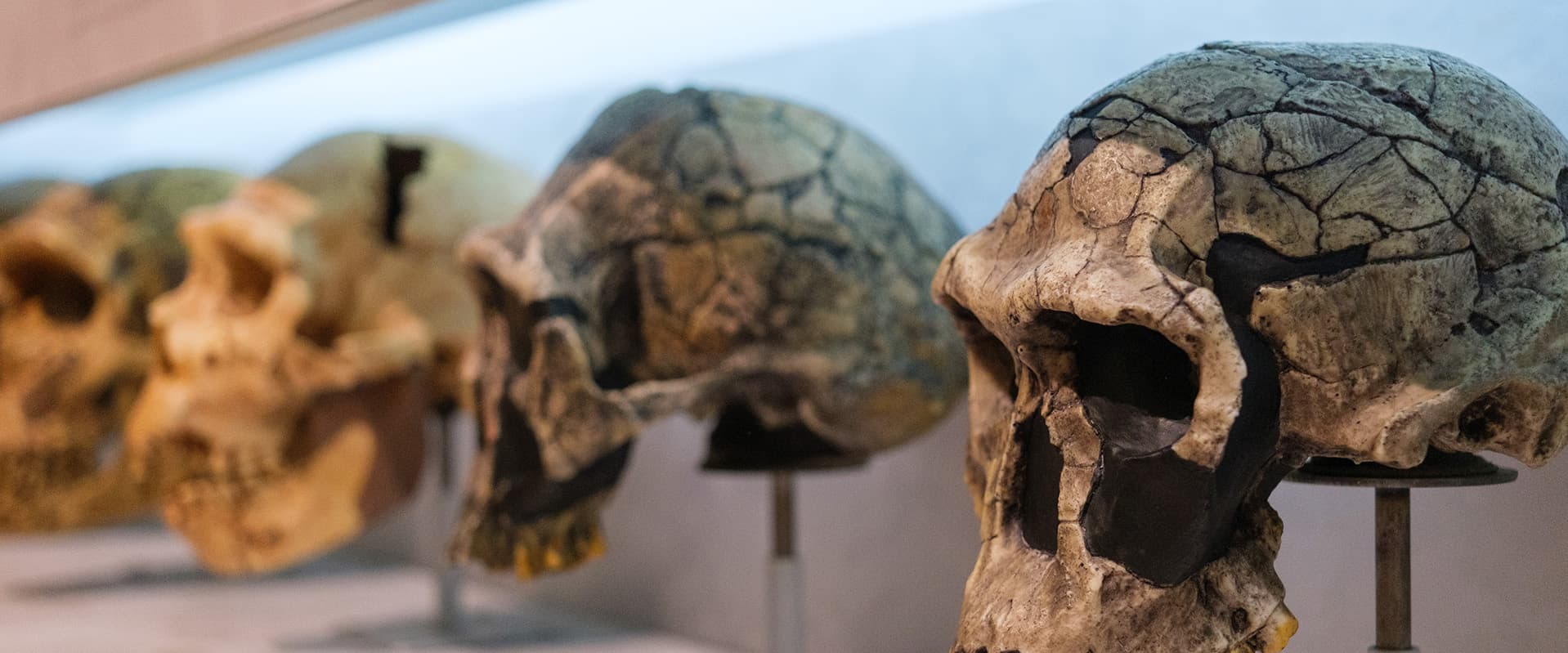
Image used under license from Shutterstock.com
From the Paleolithic to the Neolithic, this two-part series explores the development of both the physical and spiritual aspects of humanity.
Description
From the earliest bipedal ancestors to the dawn of spiritual awareness, we delve into the archaeological, anthropological, and theological questions surrounding our shared past. Join us over two episodes as we uncover the blurred lines between ancient hominins and modern humans, and ponder the moments that shaped our anatomy, behavior, and spirit.
In this first episode, we trace the incredible evolution of our ancient ancestors through the Paleolithic era. We explore how archaeologists piece together the puzzles of the deep past, discovering the fascinating story of hominins learning to walk upright, growing bigger brains, mastering tools and fire, and developing complex social behaviors. A significant part of this journey involves understanding the complex story of Neanderthals—who they were, what they did, and their eventual intermingling with Homo sapiens. We examine the archaeological evidence that reveals how our physical and behavioral traits developed, setting the stage for the emergence of modern humans.
Theme song and credits music by Breakmaster Cylinder. Other music in this episode by Northern Points, Babel, Nick Petrov, Jonathan Boyle, Big Score Audio and High Street Music, courtesy of Shutterstock, Inc.
- Originally aired on June 12, 2025
- WithJim StumpandColin Hoogerwerf
Transcript
Stump:
Welcome to Language of God. I’m Jim Stump.
Hoogerwerf:
And I’m Colin Hoogerwerf.
Stump:
Today we’ve got a series that’s been long in the making.
Hoogerwerf:
Yeah. It’s hard to say exactly how long. Maybe as long as 2 million years but there’s a lot of argument over that.
Stump:
Ok. but I meant more like we’ve been working on this episode for a long time.
Hoogerwerf:
Oh yeah, I guess that’s true too.
Stump:
Probably 3 or 4 years now? That’s maybe when we started talking about it and recording interviews for it. And it has drawn us to some really interesting places—
Hoogerwerf:
—Into some 5000 year old stone tombs, for example.
Stump:
—but also to some really interesting places intellectually. It’s a pretty fun exercise to try to put yourself back in the lives of hunter gatherers, or the first people that started growing their own food, and try to imagine how you might see the world, or how a person might start to give explanations for things they don’t understand. And standing in front of a cave wall where one of our ancestors 15,000 years ago actually stood and drew pictures of mammoths has a way of connecting us to this long story. We’ve gotten to stand in a few of these places and we want to bring that connecting experience here through some of those stories.
Hoogerwerf:
One of the main questions we’re after is to try to figure out when, in the history of our genus, we became…human (whatever that means) I think we can expect that, whatever it does mean, it probably didn’t happen instantly but it unfolded slowly with maybe some jumps and starts along the way. And I guess you could really start the story of becoming human just about anywhere, going back to the earliest building blocks, as far as the first single celled organism a couple billion years ago. But you don’t have to go nearly that far to a time when our ancestors were a lot closer to being like us but were pretty obviously not the same thing as we are now. Maybe only a couple of million years.
Stump:
So that will be our starting point. Which puts us into a time period that’s called pre-history.
Rohl:
Human pre-history, the periods before we have writing.
Hoogerwerf:
Meet Darrell Rohl.
Rohl:
Assistant Professor of Archaeology, digital humanities and history.
Stump:
Darrell teaches at Calvin University, just down the road from the BioLogos offices.
Rohl:
—it’s difficult, but also really exciting to think about what is happening in people’s minds at these times, because in historical periods we have writings left behind from at least some of the people, right?
Stump:
Written words left behind are the easiest way and maybe the most reliable way we have to actually get inside the mind of someone who is gone. But that doesn’t take us very far back when we’re talking about the scope of the human past, if we say that humans, as a genus have been around for a couple of million years—
Rohl:
So we go back to say, maybe 2.3 million years ago with the first recognized member of the homo genus, and we say that that’s a human, right? If we’re going to say that, then history, in terms of those periods of the human past in which there is writing, history is less than 1% of the human past.
Hoogerwerf:
So the vast majority of the time we’re exploring, we’re going to have to find other ways to know about what was happening.
Rohl:
For pre-history, we’ve got the physical stuff that they left behind. We may have artworks that have been left behind, we’ve got evidence of their behaviors. And so we need to actually take the artworks, try to see can we identify some symbolism in these artworks? We need to pay attention to the behaviors, can we find patterns in these behaviors? But there is an awful lot of us living in our present day—there’s a hermeneutical element to this. We are interpreting the evidence that we see without them telling us directly what they mean or why they did these things.
Stump:
The science of archeology is one tool we can use to try and get at this question of when we became human. But as Darrell says, there’s a lot of interpretation involved even just in knowing what to make of the basic scientific facts. And before we can answer when we became human we first need to define human, which, if you’ve listened much to this podcast, you’ll know is not a simple question. That involves a lot more than science to answer, especially for Christians who understand humans to be made in the image of God. To better understand what that means we need some help from theology. But we believe that theology should happen in conversation with accurate information about our history and biology.
Hoogerwerf:
So as we explore this question we’re going to lean on both science and theological and philosophical ideas, sometimes at the same time. As always, there will be some side paths to take. One of them will be to ask, how do we actually know this stuff about ancient humans? Sometimes you hear these stories about things that happened tens or even hundreds of thousands of years ago, how people lived, what they ate, how they made tools, which might seem like pretty detailed knowledge for something that happened so long ago…this will be a chance to take a look at archeological sciences and see how they get this information and why it could be trustworthy as we use it to explore how we came to be.
Stump:
By the end of these episodes — like we do in about all our episodes — we’ll think about how this knowledge and understanding of ancient humans affect what we think about ourselves today, maybe even how our own spiritual inclinations might benefit from knowing something about where they came from.
Hoogerwerf:
Ready?
Stump:
Here we go.
Part One: The Very Beginning (2.5mya to 450kya)
Hoogerwerf:
If we want to define the edges of something that doesn’t have a clearly defined edge—like when humans became human—it might be helpful to overshoot a bit and work backwards. So, about 66 million years ago a giant asteroid crashed into earth and ended the reign of the dinosaurs. That is the event that marks the start of the geological era we are still in which is called the cenozoic. Over the next 60 million years the mammals found some open evolutionary space. The first primates came about around 55 million years ago. The first of the great apes around 25 million years and then the last common ancestor with chimps about 7 million years ago. That’s the beginning of the hominins, a taxonomic group that includes our own species.
Stump:
And still 7 million years ago, there’s nothing we’d call anything like human. Moving forward we start to get fossils of things like Ardipithecus ramidus, more than 4 million years ago, and then australopithecus (the famous Lucy fossil) from 4 million to 2 million years ago.
Hoogerwerf:
In this same span, between 4 million and 2 million years ago are a couple important markers of time. 2.5 million years ago is when we moved into the pleistocene. That’s a geological epoch which really has to do with climatic changes, it was a long period of variable climate and lower sea levels. Those things obviously connected to our story here. But even more relevant is the transition into the paleolithic around 3.3 million years ago. That’s a time period defined not by geology but by archeology and marks the first stone tools. We’ll spend the rest of our episode in the paleolithic.
Stump:
So the creatures making those stone tools are early human ancestors but if you met one out on the street it wouldn’t take you any time at all to know that this was not a member of your species.
Hoogerwerf:
We saw some fossils and even a representations of australipithecus at the American Museum of Natural History, where we got a tour from A previous podcast guest David Lahti
Lahti:
So people are often really surprised at two things. One is the height—only about three feet tall to three and a half for a male, and smaller for a female. And if you weighed them at that amount of time ago, the male would have weighed twice as much as the female.
Stump:
So it might be helpful here to talk about a couple of terms that are often used in these kinds of conversations. We can talk about whether a species is anatomically modern or behaviorally modern. When we go back far enough we’re going to be focused on that first one…do their bodies look like ours?
Hoogerwerf:
At 2.3 million years ago, something like Homo habilis, which is the first species in our genus, does start to resemble a human, at least in comparison to anything else that is around. But there are still some obvious anatomical differences and behaviorally there is no question that this is a different kind of creature.
Stump:
Now it could be tempting to tell this story where before humans can become behaviorally modern they have to get all the anatomical parts and pieces in place. That would be too simple a story. It might be the case that some of our behavior does rely on some physical traits, and we’ll see some of that, but behavior can also lead to physical changes. These two things are in a complicated dance.
Hoogerwerf:
Without trying to disentangle them too much, we can at least start with some of anatomical changes. We know these changes to bodies don’t happen overnight. It’s a very gradual change over thousands and millions of years. But it’s not so gradual that there aren’t some steps along the way that maybe we could call milestones.
Wall-Scheffler:
I would say long distance mobility, a large prefrontal cortex, and probably those would be the two things,
Stump:
Here’s our next guest.
Wall-Scheffler:
My name is Cara Wall-Scheffler and Professor and Chair of the Department of Biology at Seattle Pacific University.
Hoogerwerf:
Cara was on the podcast before for our Uniquely Unique series where we crossed paths with some of these same questions.
Stump:
Bigger brains, both in volume and in the particular regions like the prefrontal cortex, were new developments that are obvious in the fossil record. Less obvious is long distance mobility. This really starts with bipedalism. Some of those earlier hominins were transitioning to moving primarily on their hind legs.
Wall-Scheffler:
Terrestrial bipedalism emerges pretty confidently by 4 million years ago, but we don’t have any evidence that bipedalism involves particularly long distances, either on a seasonal basis or on an annual basis. So we’re talking about sort of, probably no more than 20 kilometers.
Hoogerwerf:
But that all changes, and now we’re talking about a species that can go much long distances, and that allows for populations to start spreading.
Wall-Scheffler:
Between 1.7 and 1.9 million years ago, we have bipedal species all over the old world, and so we definitely have some semblance of long distance abilities by that point.
Stump:
Walking on two feet and being able to travel long distances open up lots of new opportunities.
Wall-Scheffler:
And so you move into highly seasonal environments, you have more flexibility over the annual cycle. You can move to a new area if you use up all the resources in the area where you find yourself.
Hoogerwerf:
Of course lots of animals also can move long distances and have very long migrations. But for these hominins it’s in combination with walking on two feet, which allows for them to use their hands in really different ways. They can carry things on these long journeys. There’s some new behavior that comes along with the new anatomy.
Wall-Scheffler:
And so it’s long distance movement in combination with long distance transport of goods, of tools, and that is something we know from chemistry.
Stump:
Stone tools can be traced with precision, through their chemistry, back to the place where the stone would have originally come out of the ground, and so there are lots of sites where these old stone tools are found long distances from where the stone would have been gathered, showing us that these tools were being transported and probably that people were seeking out special kinds of rock for certain kinds of tools.
Hoogerwerf:
Ok. So by 2 million years ago we have many species of these strange new hominins spread out over large parts of the world, walking upright and moving long distances, using tools—transporting tools—
Wall-Scheffler:
there is some argument that you have fire by this point.
Hoogerwerf:
But we’re still a really long way from anything we’d call modern, anatomically or behaviorally.
Stump:
Yes, but before we skip ahead a few million years, there’s another milestone worth talking about:
Carpenter:
Cooperation.
Hoogerwerf:
This is Angela Carpenter.
Carpenter:
I am Associate Professor of Religion at Hope College. I teach mainly theology and ethics.
Stump:
Angela has been working at the intersection of science and theology, particularly how evolution and ways of life of ancient humans influenced our moral development.
Carpenter:
So it’s been really fascinating to me to see how far back these traits go and how central cooperation was to the development of the kinds of creatures that we are today, and really thinking about questions of belonging and the emotional capacities of human beings to love, to have reverence for another being, seeing that emerge really, really early.
Hoogerwerf:
Take the example of the development of stone tool technology—
Carpenter:
My understanding is that anthropologists working on the development of these technologies have tried to reproduce them themselves and said, you know, you can’t just, every generation anew, reinvent stone technology. This is complex. It’s something that would have had to have been passed down from one generation to the next. It would have had to have been learned in some form, even if this is just by proximity and observation. So you’re getting a kind of intentionality and complexity in cooperation even, you know, a million and a half years ago, that is different than we see in other kinds of cooperative species.
Stump:
The development of human cooperation and sociality is a really active area of research. People tend to have strong opinions and very different opinions about when it happened, how it happened, and what it means. We could do a whole episode, maybe even a whole series on human cooperation, and maybe we will someday, but for this episode, we’re not going to get too far into that except to say that clearly cooperation was another milestone in human development that distinguishes us from other primates.
Hoogerwerf:
I think now we can start to trace a line forward. We start to see several species emerge that are walking, making tools, cooperating—which probably also means communication using language—and you start to imagine how some of these characteristics become important for the thing that we’re really interested to see—the development of a sense of spirituality.
Carpenter:
So I see the capacity for relationship with God, even thinking about love of divine being, as really being dependent on our human social capacities, and without those emerging, you don’t get a creature that is capable of relationship with divine being.
Hoogerwerf:
So this is an interesting thing she’s saying, that a relationship with God emerges out of these other capabilities. I think it’s fair to say that God has a relationship with everything in creation, so maybe what we’re really talking about here is the first time that a relationship with God really becomes much more of a two-way relationship.
Stump:
We could maybe call this capability the Image of God. Maybe we haven’t gone far enough in our story of ancient humans to be comfortable saying that these early members of the homo genus who were bipedal and starting to adopt some of the social and cognitive abilities necessary for an awareness of the divine were yet bearing “the image of God.” We’ll see how that progresses as we go further on in time. But whether God’s image was conferred on us all at once or was more gradual is an open question and one that some people have very strong opinions on. There’s nothing in science that forces us to say that this kind of capability for awareness of the divine didn’t happen all at once, but I also think there’s nothing in theology that forces us to say it didn’t happen gradually.
Carpenter:
So what would it mean to think of the Imago Dei as the possibility for us to become in relationship with the divine, to become like God by being in relationship with God. It seems to me that that’s sort of consistent with an evolutionary understanding of human development and plasticity and becoming, in a social niche.
[musical break]
Part Two: Archeology
Hoogerwerf:
I think it’s time to take one of those side paths I mentioned earlier. We’ve already started to talk about archeological evidence. And in this period of pre-history, archeological evidence is the only thing we have to try to answer some really big questions about what it means to be human. I think it will be good groundwork to talk a little about this discipline of science.
Stump:
Let’s go back to Darrell Rohl, starting with a very basic definition of archeology.
Rohl:
It’s the study of the human past, based on the physical stuff, the physical remains that have been left behind from that past.
Hoogerwerf:
Archeology is an interesting discipline of science because there are really several different approaches for how someone might integrate archeological work with the bible.
Rohl:
And the one is that they are doing archaeology of Bible lands and Bible time. So it’s archaeology that is specifically about the people, the places, the periods that are narrated in the biblical text. And they’re driven by their interest in that history, they’re driven by their interest in understanding the cultural context of the text, and they may or may not have particular religious reasons for approaching that.
Stump:
Because archeology covers such a broad timescale, archeologists tend to specialize in fairly narrow research windows, either in time periods or geography or both. And so this is one of those specializations. But this isn’t always motivated by any faith commitments. There are plenty of bible times archaeologists who are not not coming from any particular faith tradition.
Hoogerwerf:
Another approach to archeology is specifically from people that come to it with a specific faith tradition.
Rohl:
That is, archaeology as a tool of apologetics. Archaeology trying to prove the historicity and to prove the Bible.
Stump:
There can be a critique of this kind of archeology
Rohl:
That often comes not just from a, we want to demonstrate the accuracy of the events narrated in this text, but we want to demonstrate the accuracy of the history of this text, because that will lead people to accept the theological claims of the Bible. If the history is not accurate, the theological claims can’t be accurate. If the historical claims are accurate, then the theological claims must be accurate.
Stump:
There’s not necessarily any problem with trying to explore the stories of the bible from a historical perspective. The problem comes in how we try to use that evidence.
Rohl:
And a key lesson that I teach my students in my classroom is that as much as we might like it to, archaeology can never prove the theological claims of the Bible. Theological claims cannot be proven or demonstrated by physical evidence.
Hoogerwerf:
Darrell thinks about his own approach to archeology as a third kind of way, and seems to match very well to the way the BioLogos thinks about any kind of scientific endeavor.
Rohl:
As I think about, you know, the purpose of archaeology, what archaeology does, and I think about humanity, I’m finding ways where I think that archaeology beyond the study of Bible lands and times, beyond archaeology as a tool of Christian apologetics can also be a Christian pursuit. If we are reflections of God’s image, then really, we ought to be able to receive spiritual value, we ought to be able to see maybe glimpses of God’s glory, in all of humanity across all time.
Hoogerwerf:
And archeology can help us do that. But how does archeology actually work? How do we come to be able to say that a 2 million year old individual was walking on two feet, using fire, eating a particular diet, and cooperating with others?
Rohl:
From my point of view, it is one of if not the most kind of inter- or trans-disciplinary fields of inquiry that we have.
Stump:
And it probably makes sense to start with the image most people have of when they think of archeology.
Rohl:
The most obvious way of understanding the relationship between archaeology and the natural sciences in particular would probably be the almost foundational connections between archaeology and geology. That’s a really easy one: archaeologists dig.
Wall-Scheffler:
So we dig in the dirt for remains and we can remove those things from the dirt and apply different chemical methods in order to date them. And then we also have assumptions that things are on top are young, and things that are deep are old.
Hoogerwerf:
Knowing something about the rock and how the earth has formed helps to know something about what is found in the rock. Things found in certain layers give information about timing. Soil science also comes into play here. So geology, stratigraphy, soil science. But digging and geology can only get us so far.
Rohl:
Biology is a big one, right? So if archaeology is the study of the human past, based on the physical stuff that’s been left behind, we need to recognize that human beings are biological creatures.
Hoogerwerf:
But even saying simply ‘biology’ is not really going deep enough. There are lots of ways that biology interacts with archeology. We’ll just breeze through a few here.
Rohl:
[with increasing speed] Archeobotany, Palynology, looking at the pollen remains that are left behind, bio-archeology, not quite the same thing as osteology or human anatomy, zooarcheology, the study of past human animal interactions.
Stump:
Ok. Lots of biology. How about chemistry? Seems pretty important here.
Rohl:
This is a huge one, right? Like, physical stuff, you know, the physical material remains that are left behind. Everything is made up of chemicals, right? So whether we’re talking about organic or inorganic things, everything’s made of chemicals. And because of archaeology’s focus on the physical or material remains of the human past, all archaeological evidence can be subjected to chemical analysis.
Hoogerwerf:
And again, that’s just the start of how chemistry is used in archeology:
Rohl:
[with increasing speed] Archeocemistry is one of these key fields, radio carbon dating, other sorts of chemical dating methods, residue analysis, source provenance studies, x ray fluorescence, stable isotope analysis.
Stump:
Just a side note: Radiocarbon dating is one people have probably heard about and can be pretty accurate, but only for things living within the last 50,000 years. Before that there’s not enough of the carbon isotope left to date. But there are some other kinds of radiometric dating for older things.
Hoogerwerf:
And there are still more areas outside of these fields.
Rohl:
Archaeological geophysics.
Stump:
That’s a combination of geology and physics, for example the use of sonar to see what is underground without actually digging anything up.
Rohl:
Archoeastonomy.
Hoogerwerf:
That’s the study of astronomical knowledge of the past.
Rohl:
Paleopathology.
Stump:
The study of diseases of the past.
Hoogerwerf:
Ok, so clearly archeology uses a lot of different tools. And when you start to put all these tools together you can start doing some pretty cool things. So let’s say you find some bones in a cave. First, you know something about their age from the geology and layer where they are found, and what is above and below them. Then you can do some carbon dating or a another method of dating to refine that even more and get a pretty good idea of when the individuals were alive.
Stump:
And then you start looking at the skeleton itself and someone who knows something about teeth will notice that the teeth are pretty worn, giving an estimated age of 30 to 45 years old for this individual. And you could look at the bones and notice that the skull has some major damage, a fracture to the left side of the skull that would have probably left the individual blind in one or both eyes. And there’s other skeletal damage, but also signs of healing, which show that maybe this person would have survived through some periods where it would have needed help from others to survive.
Hoogerwerf:
And then maybe you could gather up some soil samples from around the site and pollen in that soil will tell you something about the climate and vegetation of the time. And in the same layers are many stone tools and also bones from animals. And in the cave you can find evidence of fire from deposits on the cave walls. And it goes on and on, these little pieces of evidence, obtained through chemical and biological analysis that become clues to a story that can be pieced together to tell us something about life of these individuals.
Stump:
This is not some hypothetical. There are lots of sites that could fit this description, but these details specifically reference a site called Shanidar cave in Northern Iraq. Many individuals were uncovered in the cave and turned out to be neanderthal fossils, dating back to around 45 to 60 kya. This cave has been under study since the 1950’s. And all these clues have led to a story, this is another instance where the science itself is mixed with interpretation. For a while it was thought that the pollen found with one of the burials was evidence that whole flowers were placed with bodies being buried which would be evidence of a different kind of burial ritual. Then it was concluded that pollen was probably deposited by a burrowing rodent much later. Another reminder of where science blends into interpretation.
Part Three: Neanderthals
Hoogerwerf:
Neanderthals first come on the scene around 450kya. So we’ve come a long way from where we started about 2 and half million years ago. Over this time the homo genus has led to a bunch of different species and spread out across much of the world. Stone tool technology has developed a lot. Controlled use of fire has become fully developed. Brain size has increased. And you start to have something that looks quite a bit like we do and is even developing some behaviors that are pretty interesting…
Stump:
Now, Neanderthals are often portrayed in popular media—in commercials and cartoons and movies— as the counterpoint to what it means to be human. Just grunting, prehistoric-looking creatures. Essentially another ape.
Finlayson:
That’s what neanderthals have been relegated to be at some points you know.
Stump:
This is Clive Finlayson, one of the most prominent Neanderthal scholars in the world today.
Hoogerwerf:
Wait, he’s a Neanderthal scholar — a scholar who studies Neanderthals, or a scholar who is a Neanderthal??
Stump:
Ha. He’s from Gibraltar, and I had the chance to visit him a couple of years ago. He’s been working at Gorham’s Cave, which is in the Rock of Gibraltar, and he had agreed to take me into it to see first-hand the marvelous things they’ve been uncovering… and then the night before, it rained. According to local regulations, people can’t go into those limestone caves for 48 hours after it rains because they’re worried about chunks of rock falling off and landing on people.
Hoogerwerf:
That seems reasonable.
Stump:
I think I would have risked it… but he said there was nothing to be done. So instead I met him at his office at the Gibraltar museum and saw some of the exhibits.
Hoogerwerf:
It’s not just popular media that has had a bias toward homo sapiens as the only intelligent animal. Science has a bit of a history of this too. For a long time many of the markers we look to for defining what it means to be a behaviorally modern human—things like art and language and tool use—those didn’t seem to show up in the archeological records for neanderthals because scientists didn’t expect them to and so didn’t look for them. But that seems like it’s changing.
Finlayson:
What does it mean to be modern human? And, you know, we started off in the old days, it was anatomically modern humans. Then, when they realized that that was a mess, it became behaviorally modern humans. And we’ve got this idea of a modern behavioral package. I listed what makes a modern human a modern human in my book. And then I said, well, you know, I demonstrated that all those behaviors have been found in neanderthals. To which then the conclusion has to be: either the modern human package doesn’t exist or neanderthals were modern. There’s only two conclusions you can draw from that. And I still believe that.
Stump:
Clive mentioned several different lines of evidence that have pointed toward some behaviorally modern activity for neanderthals.
Finlayson:
One of the things was, “modern humans caught birds. We found a lot of evidence. Neandertals, we have no evidence in the archeological record, they caught birds. Therefore, they were incapable of catching birds.”
Stump:
Well, it turns out there is evidence that they could catch birds, shown by bones found with fire marks on them.
Finlayson:
The birds weren’t just food, which was originally the, you know, “they can’t catch them” because they can catch them. Not only that they can catch them, they can catch the big eagles, and get their feathers and the talons.
Hoogerwerf:
Ok, so maybe they could catch birds. What about some of the other markers we use to talk about modern humans? Use of fire? Intentional burials?
Stump:
I asked Clive about both of these things.
Finlayson:
They had fire, the control fire, of course, which is very important.
Stump:
Burial gets a little harder. At Gorham’s cave, Clive said he didn’t necessarily expect to find burials there because they were living in the cave. You wouldn’t bury your dead in the same place you were living. There are a few sites where some people think they see evidence of burial. And the main one is one we’ve already mentioned, at Shanidar. But that one is problematic.
Finlayson:
I mean, Shanidar was the famous one of the burial with the flowers. And then people showed that the point of the flowers was not associated with the burial rooms of different moments. So therefore, they discarded that.
Stump:
So the jury is probably still out, at least as far as a consensus goes on Neanderthals doing intentional burial.
Hoogerwerf:
So what about art? Were neanderthals making art?
Stump:
This is also complicated. But this is one of the really interesting things at the caves in Gibraltar that Clive found.
Finlayson:
And that was a very interesting story, if you like, I can tell you about this
Stump:
So this happened over 10 years ago now, but Clive was down in the cave excavating.
Finlayson:
And we exposed a surface of rock that had been covered for 40,000 to 50,000 years from the date, so nobody would touch that surface. And then a colleague of mine said, “look at these marks.” We found straight lines, criss crossing, what has been known as the hashtag now. I realized immediately that if this was made by people, this was huge. Because it could only have been made by Neanderthals, because 60 centimeters of deposited above it came later was Neanderthal. So there’s no way modern humans could have done that.
Stump:
That was one of the things I was excited to see in the cave, but then didn’t get to. They did have a replica of it at the museum though.
Hoogerwerf:
Ok, I’ve seen some pictures of this. It really is just a rough looking version of the hashtag. Two straight lines crossing another two straight lines roughly perpendicular. I mean it’s cool to know that someone stood there 40 thousand years ago and purposely made these marks. But as far as art goes it doesn’t quite move me.
Stump:
I think the question is whether it is symbolic in any way, because if it is, then that’s a pretty huge marker of a very similar intelligence to our own. But if it was just a neanderthal making some scratch marks, then, yeah, I don’t see that it is much different than the scratch marks I saw in a cave in France made by cave bears.
Hoogerwerf:
Ok, so tools, art, fire, a bunch of evidence that they are at least a lot more capable than maybe they’ve been represented. How about the big one…did they have language?
Stump:
Well language doesn’t fossilize of course. But there are some other ways to try and figure this out. We’ve been able to see through DNA evidence that neanderthals shared the foxp2 gene which has been associated with language. At least there are some humans without a working version of that gene, and their language abilities are significantly impaired. And they have found some Neanderthal fossils with a hyoid bone in the neck similar to ours, which is also necessary for speech.
Finlayson:
So I think, again, the ability for language and speech was there. And those were—they had it. But it’s a different question, what did they say? We can’t answer that. But yeah, I think that they have that ability.
Tattersall:
I think Clive represents Neanderthals extremely well, and we’re certainly on the same page that they are, were, extremely smart hominins.
Stump:
This is Ian Tattersall. He is one of the best-known anthropologists today, and has written many popular books.
[b-roll from greeting at museum]
Stump:
We met Ian at the Museum of Natural History in New York City where he brought us up through the back of the museum past rows of cabinets filled with curious artifacts. And he’s got a bit of a different idea of Neanderthals.
Tattersall:
They were very resourceful. They exploited their environments with great ingenuity. But they just weren’t, they didn’t have the same relationship with the world as we do today.
Hoogerwerf:
Ok, so here’s a different way of talking about what it is that makes us human…the relationship we develop with the world around us. And a lot of the way we have developed our relationship with the world around us is through language.
Tattersall:
You know, the very first Homo sapiens didn’t have language. Language had to be acquired. And I think that because language seems to be the obvious trigger for symbolic thought, which is what we uniquely do in the modern world, which we know by observation, that both can only know by inference at earlier times. But my feeling is that it’s possible to be extremely smart and all of these things without having language as we know it, and without having the same kind of thought, thought, the symbolic thought processes that we do.
Stump:
I think this is a really interesting argument that symbolic thought may be one of the biggest markers of what it means to be a modern human. I think Ian would even be ok with there being somewhat of a spectrum of symbolic thought, but it’s something he doesn’t see signs for in the neanderthal record. Clive does. And Clive goes a bit further when it comes to neanderthals.
Finlayson:
I don’t even like the term modern human. But I think the neanderthals are homosapiens anyway.
Stump:
Do you?
Finlayson:
Yeah, a subspecies because from a biological species argument, if you interbreed freely, you’re the same species, if you use that argument.
Tattersall:
My argument is not that they were not intelligent and capable. My argument is that they were not us, and not because of anything that they might or might not have done specifically, but because if they were us, they would probably have messed up the world in the same way that we have, and they didn’t do that.
Hoogerwerf:
Well the debate between whether neanderthals should be considered behaviorally modern, or whether they should be considered a subspecies of homo sapiens isn’t going to be solved here but there’s still a really interesting point here that Ian brought up that will eventually transition us into an entirely new period of pre-history.
Tattersall:
It’s just around about 100,000 years ago, but maybe a little less, maybe a little more, depending on what proxies you accept, that Homo sapiens started to behave in an unusual way that involved what I call symbolic thought, as a sort of a shorthand for something we don’t fully understand. What it is that we do that is so different with information, that is so different from everything else. But what we seem to do is to sort of disassociate or deconstruct the world around us into a vocabulary of discrete symbols. And we give things names. You know, once we’ve given things names, we can move those names around in our heads and imagine other kinds of worlds in a way in which I don’t think is possible to do strictly intuitively.
Stump:
This capability in our ancestors did something really dramatic in the world. 100kya there may have been as many as 5 different species existing within the homo genus. And then by around 40kya there was just one. Homo sapiens. Did neanderthals go extinct because they couldn’t compete with the more intelligent homo sapiens? Well that story is pretty flattering to ourselves in ways that may not be entirely accurate. And we know that at least in some ways the neanderthals didn’t go extinct at all.
Finlayson:
I suppose the phenotype of the Neanderthal is extinct in a sense, but a lot of the genotype is still around.
Hoogerwerf:
Right, their genetic line has continued to a degree, because there is conclusive evidence that Homo sapiens and neanderthals mated. But their phenotype—the distinctive appearance of Neanderthals—has been subsumed into our ancestral line.
Either way, we find ourselves in a world with only one species of bipedal, tool-using, fire-making, large brained apes. And very quickly then, the species spreads out to cover the entire globe, finding their way to the American continents, traveling over oceans to far off islands, and generally making a mark wherever they go. We seemed to have crossed well over the blurry lines now from something that was pretty clearly different than what we are to being human. But our question to start off with is not only about the journey to becoming anatomically or behaviorally modern, we also want to know something about the spiritual becoming of humans. When did our image bearing come into the form that we understand it now?
Stump:
As we move into this time period, partly because it’s just more recent, but partly because of what humans start to do and leave behind, we get some better glimpses into what seems like a new kind of awareness of the world. We’ll come back to that in the next episode.
Credits
Language of God is produced by BioLogos. BioLogos is supported by individual donors and listeners like you. If you’d like to help keep this conversation going on the podcast and elsewhere you can find ways to contribute at biologos.org. You’ll find lots of other great resources on science and faith there as well.
Language of God is produced and mixed by Colin Hoogerwerf. That’s me. Our theme song is by Breakmaster Cylinder. BioLogos offices are located in Grand Rapids, Michigan in the Grand River watershed. Thanks for listening.
Photos from the Episodes
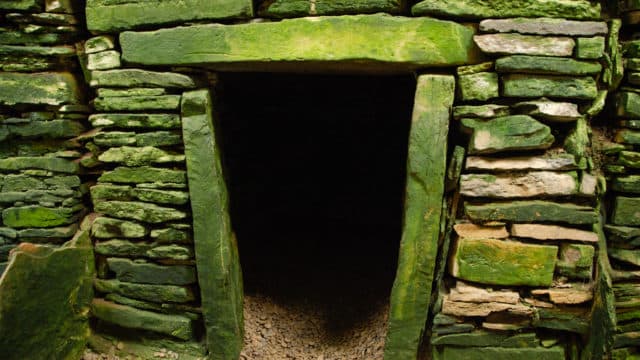
Inside an ancient tomb, Orkney.
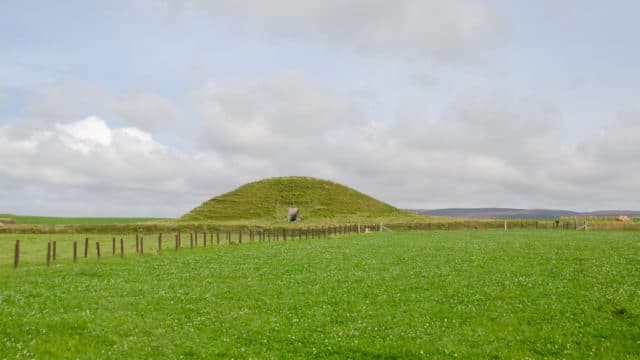
Maeshowe tomb, Orkney.
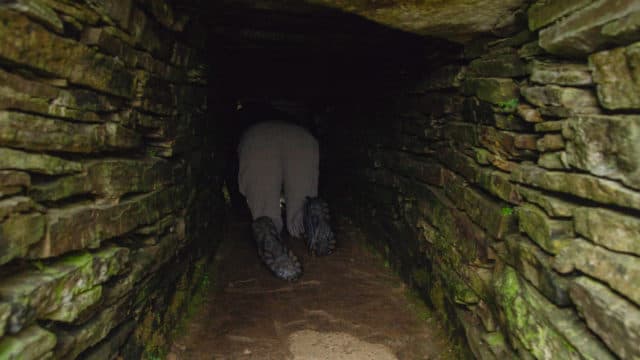
Jim crawls in Cuween Hill Chambered Carin, Orkney.
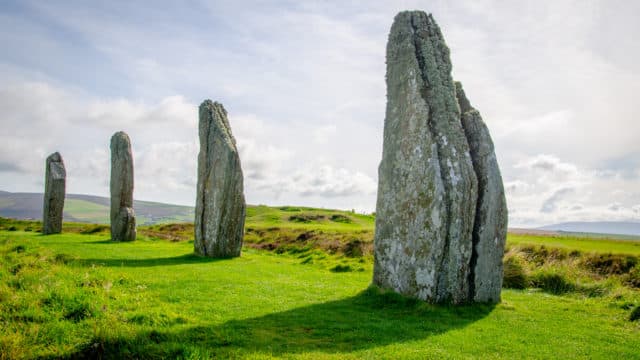
Standing stones, Orkney.
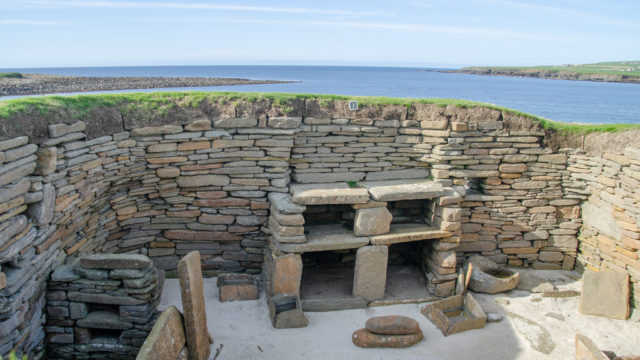
Skara Brae village site, Orkney.
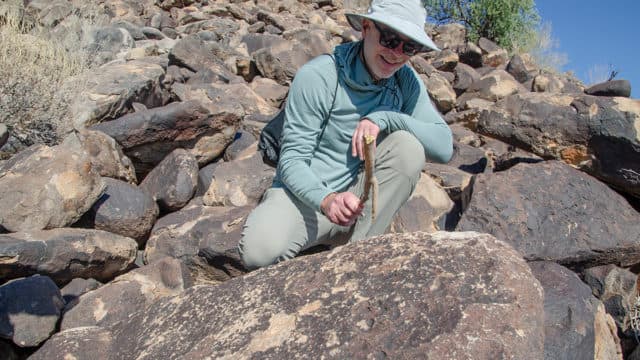
Jim hits a bell rock, Southwestern US.
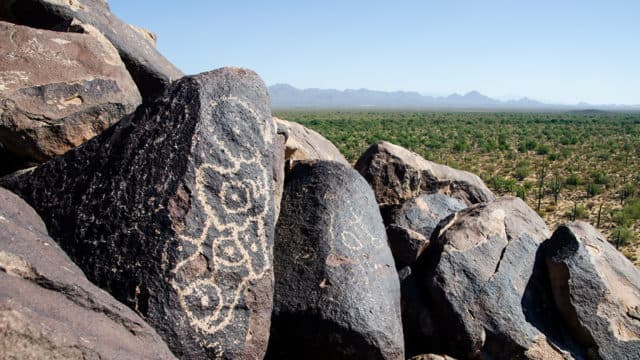
Petroglyphs, Southwestern US.
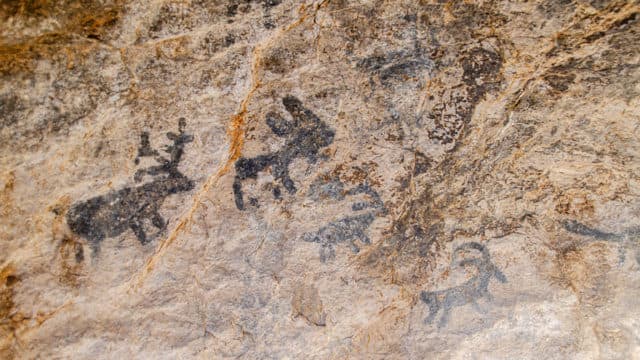
Pictrographs on cave wall, Southwestern US.
Featured guests
Darrell Rohl
Darrell is Associate Professor of History and Director of the Archaeology Program at Calvin University.

Cara Wall-Scheffler

David Lahti

Angela Carpenter
Clive Finlayson
Clive Finlayson is is Beacon Professor at the University of Gibraltar and is the Director, Chief Scientist and Curator at the Gibraltar National Museum.
Ian Tattersall
Ian Tattersall is Curator Emeritus at the American Museum of Natural History on New York City and author of several popular books including Understanding Human Evolution (2022), Masters of the Planet: The Search for Our Human Origins (2012), and The World from Beginnings to 4000 BCE (2008).