Cool Creatures | Ferns
If you give ferns much thought, it may be only as understated plants. What could they teach us about theology? It turns out quite a lot.
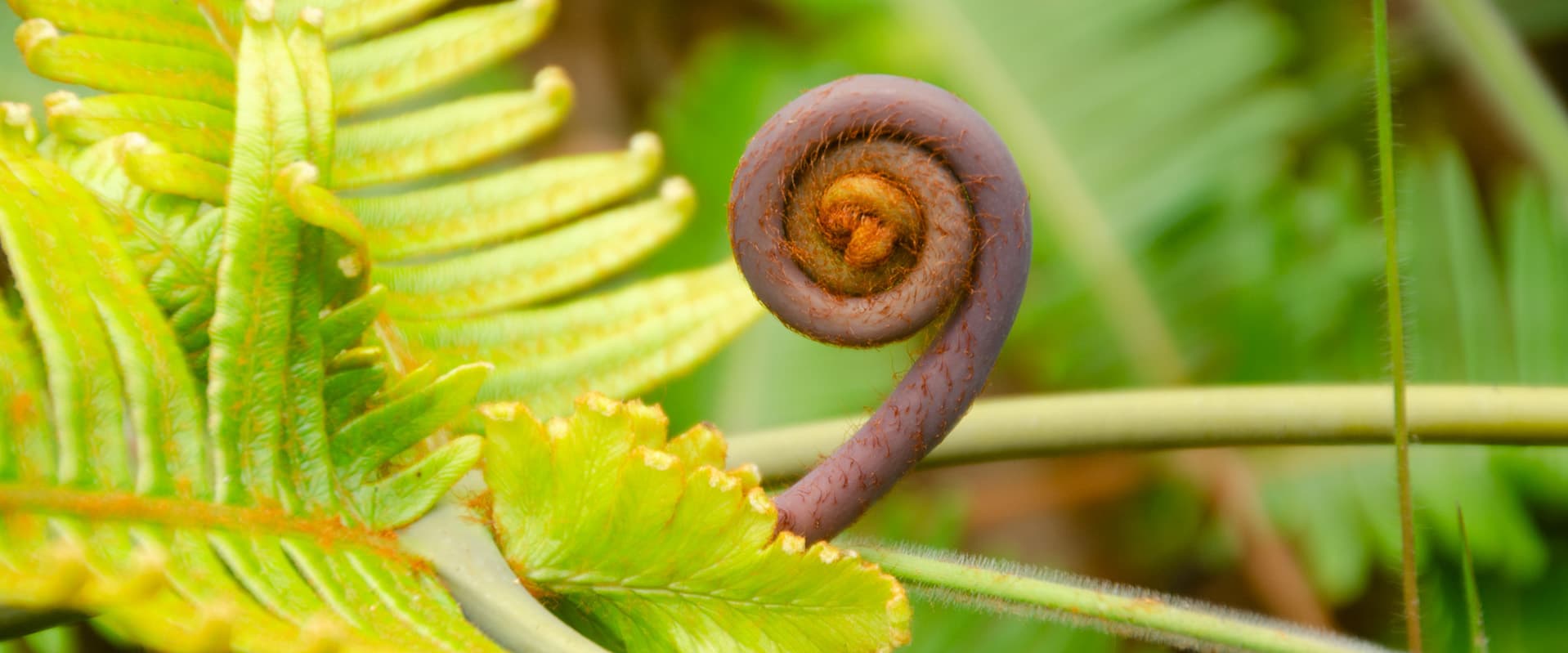
Photo by Colin Hoogerwerf
If you give ferns much thought, it may be only as understated plants. What could they teach us about theology? It turns out quite a lot.
Description
You might think of ferns—if you think of them much at all—as the unassuming and understated members of the plant world. What could they teach us about philosophy or theology or wonder? It turns out quite a lot. When we explore that strange world of fern reproduction and learn about the two life phases of ferns it brings up questions about identity and what it means to be an individual. And the exploration itself becomes a practice of wonder and celebration of the diversity of life God creates.
- Originally aired on October 30, 2025
- WithColin HoogerwerfandJim Stump
Transcript
Stump:
Welcome to Language of God. I’m Jim Stump
Hoogerwerf:
And I’m Colin Hoogerwerf.
Blake-Mahmud:
I’ll keep this lid on, because they don’t like the natural air so much.
Hoogerwerf:
That’s Jennifer.
Blake-Mahmud:
I’m Jennifer Blake Mahmoud. I am an assistant professor at Hope College.
Hoogerwerf:
Jennifer is a botanist and we met her on an early fall afternoon at a state park on the shores of Lake Michigan.
Stump:
To go and see some ferns.
Blake-Mahmud:
So ferns have these two different life phases. In fact, all plants have these two different life phases. And these two different phases look really different, they act really different in the environment…
Hoogerwerf:
Before we actually stepped into the woods, while we were still in the parking lot, Jennifer brought a petri dish over from her car and we both leaned over to look into it.
Blake-Mahmud:
This one is one half of that phase that you never, ever think about like when you think of a fern, you think of something that’s like from the and fluffy, right? Well, the other half of its life, it looks like this.
Hoogerwerf:
Growing on the surface of the petri were a couple of tiny green leafy looking specks. If you’ve seen lichen, they looked a little bit like that.
Blake-Mahmud:
So this is a very, very big one. That is one that’s about a normal sized one, but they’re very, very small, and they have different numbers of chromosomes than the ones that we’re gonna see. They reproduce differently.
Stump:
What do you call these?
Blake-Mahmud:
These are called gametophytes.
Stump:
Ok we’re getting a bit ahead of ourselves. We’re going to make our way back to these strange parts of a fern lifecycle—the gametophytes—because ferns, and specifically the way they reproduce, challenge some of our most basic ideas about what it means to be a creature, and what it means to be an individual.
Hoogerwerf:
We’ve done a few of these episodes now, called cool creatures, where we do our best to develop a relationship with a creature. When we orient ourselves in this way, with an openness to wonder at the diversity of life, we stumble into all sorts of surprising questions and pathways of curiosity that are just as delightful as the creatures themselves.
Stump:
A fern, or really any plant, is probably not the first thing that comes to mind when you think of a cool creature.
Blake-Mahmud:
Part of it may be a little bit how our brains are hardwired, in that there have been strong selective pressures to pay attention to things that move, and less of a selective pressure to pay attention to things that are kind of stationary.
Stump:
Jennifer is a botanist, so clearly she thinks about plants. But for most people, plants don’t take up the same kind of main stage cultural relevance that animals do.
Lewis:
Botanists have noticed that people, in general, like animals more than plants, or they’re more attracted to them. And I think a lot of that has to do with the fact that we are ourselves animals, and so we see the similarities and are immediately attracted to that.
Stump:
And that’s Ray Lewis
Lewis:
I’m professor of biology at Wheaton College.
Hoogerwerf:
Ray brought up a term:
Lewis:
Some have used the term plant blindness.
Hoogerwerf:
the idea that people just don’t notice plants. But he actually had a term he thought was more precise: plant awareness disparity.
Lewis:
But it’s, you know, that there’s an inequality in terms of how we perceive plants.
Stump:
Ok, so plants don’t get the same kind of attention by humans as animals do. That seems to be kind of fair. We are animals after all and we pay attention to things that are like us. Might this very fact point to a question we should be asking in an episode called cool creatures, do we need to ask what even counts as a creature? Are ferns—or any other plants—creatures?
Hoogerwerf:
Well, if you ask the internet…no. There are a lot of different definitions for “Creature” but most of them that I can find say something about “an animal”, sometimes exclude humans, some include humans as creatures, many say a creature is something with the ability to move around. Some definitions go as far as saying a creature is any living thing except a plant. If we went with that definition then bacteria and protists are creatures but not oak trees.
Stump:
I can kind of understand where that would come from. Bacteria and protists are small of course but both move around their world in ways similar to animals. There’s something about plants that makes it hard for us to imagine them as fellow creatures, even if the literal definition of the word “creature” seems to imply they are created things, which we believe them to be.
Hoogerwerf:
Well it seems like maybe we could all use a little help from someone that really does see plants as fellow creatures.
Blake-Mahmud:
I love creatures, and I definitely consider plants to be part of those creatures.
Hoogerwerf:
As I’ve learned more about plants, most of the reasons one could give for excluding them from the category of creature start to break down. They do a lot more than we give them credit for. But “plants” is a big category. This is an episode on ferns. And, I’ll admit, there was a time just after starting down this path that I had some doubts about whether ferns were really interesting enough to make a whole episode about. That got blown away as I started learning more about them.
Scott:
I think people might underestimate them and think, well, they’re not very interesting. But in fact, it’s like anything else, once you get to know it in detail, there are some amazing, fascinating things about ferns.
Hoogerwerf:
That’s Rod Scott.
Scott:
I am retired from Wheaton College where I was the biology department geneticist for about 32 years.
Hoogerwerf:
Rod spent much of his career doing the work of a pteridologist—
Scott:
A pteridologist, somebody who studies ferns
Hoogerwerf:
So today we’re going to do our best impression of a pteridologist and we’re going to report on some of the things we learned about ferns—things that highlight something about the vast variation of the ways life exists, blurring boundaries and making us rethink the convenient categories we like to try to put on life.
Stump:
All coming out of looking more closely at a fern, of paying attention to ferns, of wondering about these creatures.
Chapter One: Relics of the past
Hoogerwerf:
Ok, first, let’s try and put ferns in context with other living things. There’s a pretty standard way we do this.
Stump:
Right. Thanks to Carl Linneaus, the botanist who came up with the classification system in the 1700’s to group all living things.
Hoogerwerf:
The taxonomic system Linneaus came up with is still in use today, though a lot of the specific placements for creatures have changed as the science has developed. At the most general level in his system, the kingdom, Linnaeus had plants and animals. Today, we still recognize a separation between those two groups, though most biologists prefer a different organization into domains. In the modern system, both plants and animals are in the domain: eukarya, but plants are now grouped along with red and green algae in a group called Archaeplastida and animals are grouped with fungi and some other single celled relatives.
Stump:
That’s a little more depth than we need here. Linnaeus saw something that a lot of people recognize. Plants and animals are pretty different. His reasoning was fairly obvious—at least to him and others of his time—animals move and sense. Plants don’t.
Hoogerwerf:
It turns out plants actually do both these things, if not maybe in the same ways that animals do. Linnaeus was at a disadvantage in a couple of ways though. He didn’t have the tools of modern science to be able to see all the ways plants respond to their environments. And he didn’t have the framework of evolution to understand the relationship between all living things. All his study and love of plants didn’t quite reveal the truth…that plants and humans have a common ancestor.
Stump:
If you’re listening to this episode, you might know that to be true, that all life is related, but it still might feel a little strange when you really dwell on it…that you have an ancestor in common with a fern. Of course, you have to go a long way back. Probably somewhere around 1.6 billion years ago.
Hoogerwerf:
Sooo me and a fern are really really distantly related. At that point all life was still in the water and still single cellular. And it was another billion years or more before anything on the plant side found its way to land.
Stump:
That happened around 470 million years ago. Those first land plants were ancestors of the mosses and liverworts. They had no roots, no leaves, and no way to transport water internally. Today’s mosses and liverworts still don’t do those things. Then 400 million years ago some plants evolved veins. This was a major change. Without being able to move water, plants had no way to become large. But ferns were among the first plants to develop this capability and so they became the first plants to create a canopy of leaves and probably some of the first species to create a world that started to look like what we’re all used to today, green and lush.
Blake-Mahmud:
So we have examples of ferns that were the size of trees, okay, like enormous ferns back from time of dinosaurs
Hoogerwerf:
There are still some really big species of ferns. Some of them in New Zealand and Australia grow to over 50 feet tall. And we even saw some pretty large ones when we were in Hawaii earlier this year, ferns that were a good deal taller than me. But they didn’t have anything on giant trees that loomed over them.
Stump:
Right. That’s because in the time since ferns first evolved, the world of plants made a bunch of other really incredible evolutionary changes including some major changes to reproductive strategies…they started making seeds and then eventually flowers. Most of the plants you see and recognize today are those, and that reproductive strategy allowed for huge variation in shape and size, like the 100 ft tall koa trees that towered over those ferns in Hawaii.
Hoogerwerf:
Ok, so ferns were early in the plant lineage, and plants have diversified a lot since ferns came about. That doesn’t necessarily mean that flowering plants found a better strategy…better maybe if big is your metric. But existing at all might be the best evolutionary metric. And ferns still exist. But they do have some limitations. Because they reproduce with spores instead of seeds, they still rely on water. But they have done just fine for themselves, not even changing all that much, at least in outward appearance, as the world of seed plants exploded around them.
Stump:
Today there are something like 10,000 species of fern and they grow on every continent except Antarctica — thriving especially in tropical rainforests but also managing to survive in deserts, mountains, and cracks in city sidewalks.
Hoogerwerf:
Let’s go back to Carl Linneaus.
Stump:
More taxonomy?
Hoogerwerf:
No. Well not directly. So Linneaus was a botanist right? And in his work to try to organize all living things into a neat system he obviously paid a lot of attention to plants. And the main way he used to organize the plants was to look at the sex organs of plants.
Stump:
Sex organs of plants?
Hoogerwerf:
Right. That’s what Linneaus recognized pistils and stamens to be.
Stump:
I’m not sure we usually think of plants as sexual beings.
Hoogerwerf:
Well it turns out a lot of people in the early 1700’s didn’t either. And they didn’t like it very much when Linneaus started describing plants in pretty racy ways, talking about pistils and stamens as husbands and wives and the flowers as being like bridal beds.
Stump:
Hmm. Botanists today aren’t usually the controversial voices in our society.
Hoogerwerf:
No, but it seems like Linneaus was pretty aware of his reputation and leaned into the controversial side of things. Stirring things up like that got him a lot of attention. But the thing is he ran into a problem when he started looking at ferns. Because he couldn’t find any sex organs at all.
Stump:
Seems like British polite society of the 1700s could have really taken to ferns and their fondness for hiding anything sexual.
Hoogerwerf:
Linnaeus ended up lumping ferns, mosses and liverworts together into a group he called cryptogamia. That means secret or hidden marriage.
Stump:
But one of the joys of science is to uncover hidden secrets. And while Linnaeus never figured this out in his lifetime, we do know what’s going on now. And by way of warning, this is not Victorian England anymore, and so there’s going to be fairly explicit description of sex, but I don’t think this episode is going to get an explicit label on iTunes, as it is only plant sex.
Lewis:
Learning how an organism reproduces is key to understanding it. And if there’s some ways that you can—organisms that we utilize, you really want to know what that life cycle looks like.
Hoogerwerf:
Well, our whole goal here is to understand ferns so we’re going to need to dig into the weird reproductive strategy of ferns. Which brings us back to the idea we started this episode with.
Scott:
Most people don’t even realize that when they say I’m looking at a fern, they’re looking at one half of a life cycle. So that’s the sporophyte—
Stump:
Ok, we’ll have to try and remember this word, sporophyte, which is the name of this half of the life cycle.
Hoogerwerf:
After looking into Jennifer’s petri dish in the parking lots we did make our way into the woods—
Stump:
[sounds of footsteps in leaves]
Those are ferns aren’t they?
Jennifer:
Those are ferns. Want to go look at those? Let’s go see what we’ve got.
Hoogerwerf:
—to go see some of the ferns everyone thinks of when they think of a fern. The sporophytes.
Blake-Mahmud:
So this is what people think of when they think of ferns. So it’s big and fluffy. You’ve got these leaves that are kind of jagged.
Stump:
And maybe, if you’re pretty attentive, you’ve even noticed the backside of a fern leaf sometimes has a bunch of little dots on it. Each one of those dots has a bunch of spores inside.
Blake-Mahmud:
So I’ve heard people say, like, “oh, I thought those were like bugs and I was scraping them off.” I’m like, “no, no, no, don’t scrape them off.”
Hoogerwerf:
Ok, so big frondy fern—the sporphyte—makes spores.
Jennifer:
They’re super tiny, so in each one of these, you probably have hundreds of spores, right?
Hoogerwerf:
Those little dots on the back of the leaves eventually burst and send all those hundreds of spores out into the world. Some might land on the ground near the parent fern. But they’re so small they can travel quite a long distance in the air or get picked up and moved around pretty easily.
Blake-Mahmud:
And you could, like, get one on a bird’s wing or, you know,
Hoogerwerf:
Wherever the spore gets to, if the conditions are right…you would be tempted to say, it grows into a new fern…But not exactly, at least not if you’re thinking of a frondy fern, the sporophyte.
Stump:
So now come back to the petri dish that Jennifer had with her and the tiny little plants growing inside.
Blake-Mahmud:
So I study plant sex, and these are the ones that have sex and the ones that we’ll see out here do not have any sex.
Hoogerwerf:
These tiny little things in the petri dish, they are the other half of the lifecycle.
Scott:
The other half, the gametophyte generation to me is maybe even more fascinating.
Blake-Mahmud:
You can be either like a frondi fern, or you can be this little bitty gametophyte, but you’re always kind of—every fern that you see that’s frondi was once that.
Lewis:
Alternation of generations is what we call this.
Stump:
We need to add one more layer, something that might bring you back to your middle school biology class. So first remember that inside a cell are chromosomes. That’s where all the genetic information about the creature is stored, the information that will be needed to make another one of those creatures. And you may also remember that those chromosomes often come in pairs.
Lewis:
So, you know, in animals we have a diploid stage. It’s the dominant thing. The diploid: 2N number of chromosomes.
Hoogerwerf:
Diploid just means two sets of chromosomes. That’s pretty standard for most animals—you, your dog or your cat. But when cells divide for sexual reproduction they split the number of chromosomes in half, making them: haploid. For humans and most other animals, the haploid stage is very short and the haploid stage is only ever a single cell.
Lewis:
The only haploid stage are the gametes, the eggs and the sperm. And the first thing that they do is fuse together to become a diploid zygote again.
Stump:
That’s it. Animals only ever exist with a single set of chromosomes for a brief and vulnerable time.
Hoogerwerf:
But that’s not the way it works for plants. That brings us back to the alternations of generations. While animals spend most of the time as diploid, ferns split this up more evenly, going back and forth between these stages. This is actually true for all plants.
Scott:
Even a sunflower or a tomato or tobacco plant or whatever kind of plant you want to point out, has alternation of generations, but it’s incredibly, incredibly reduced.
Hoogerwerf:
But with the ferns…
Scott:
You’ve got this extended haploid period, but it’s a whole other organism.
Hoogerwerf:
So back to that spore that lands in fertile soil. It doesn’t grow a new fern, at least not the sporophyte version you probably think of, it grows into a gametophyte. It still photosynthesizes and lives on its own as a completely independent organism.
Blake-Mahmud:
One of the reasons that this can be so like, weird and kind of confusing is that it’s nothing like anything that happens in animals, right? So in animals, you know, you’ve got two sets of chromosomes, right? One set from your mom and one set from your dad. You’ve got two sets, one set from mom, one set from dad. But you never have a time where you have something that’s just one set of those chromosomes that, like can exist in some cases, on its own, right?
Like, the equivalent thing for animals is, like, so bizarre. It’s hard to even imagine it would be like, if our eggs and sperm actually were just like little creatures that you would like, okay, here are the eggs and sperm. Okay, go, you know. And they went and had fun and did things and went to work and had little houses and, you know, whatever, and then they had sex and had a baby, right? So it’s unlike anything.
Stump:
OK, this brings a lot of philosophical questions to my mind about personal identity.
Hoogerwerf:
Yeah I’ve been wrestling with what to make of this knowledge for a while now. But what are some of your philosophical questions?
Stump:
It’s not so simple to say what the beginning and end of the individual fern is over time. This is really a problem for all creatures in some ways because everything changes over time. I’m a pretty different form now than I was 50 years ago, so different that it’s pretty incredible even to say that that was me. Or what about a caterpillar turning into a butterfly? The alternations of generations add even another layer of difference.
For humans, we don’t say that the haploid stage: a sperm or an egg, is an individual human organism. It’s not like we could go back before my conception and say that egg was me, or that sperm was me; and we wouldn’t say that an individual sperm or egg is a creature. They have to be joined. But it seems like Jennifer is claiming that for ferns, the haploid stage is an individual organism, it is a creature. But it will still go through sexual reproduction to create the frondy sporophyte. So does one individual just go through different stages or does it become a different individual in this process?
Hoogerwerf:
Yeah these are really kind of mind boggling questions, but we’re going to need to hold onto them for a bit, because things get even a little stranger.
Scott:
This is one of my favorite things about biology is that the more that you get to know about anything the more fascinating it becomes and yeah so I think anybody who doesn’t know about the life cycle of ferns and wants to get their world a little bit rocked you know, pull out a general botany textbook.
Hoogerwerf:
Or, keep listening.
Part Two: Four Twists
Hoogerwerf:
Of, we’ve gone from a sporophyte, a big frondy fern, to a spore and then to a gametophyte, these strange haploid creatures that hang out on the forest floor wherever they’ve happened to land. And as we’ve already noted, that’s pretty weird for a lot of reasons. But we still need to find our way back from gametophyte to the frondy ferns that we had been seeing with Jennifer..
Jennifer:
That little gametophyte that I showed you could be male or female or hermaphrodite [oh look we’ve got lots of them around here].
Stump:
And the ferns we were seeing would have come from one of those gametophytes. The male gametophyte would have produced sperm and the female gametophyte would have produced eggs. No surprises there.
Blake-Mahmud:
And then things got wet. So either somebody else, or potentially that little gametophyte got wet, and the sperm started swimming around. And then the sperm kind of get at first, they’re like, just crazy swimmers. They’ve got 10 flagella. So they’re like, all over the place, and you can watch them under the microscope.
Stump:
Ok, hold on. I just think this is wild. The sperm are swimming around. In plants. It just sounds like an animal function.
Blake-Mahmud:
They’re swimming around yes. So Fern sperm are fun because they’ve got like, 10 flagella. They go all over the place. Moss also have swimming sperm.
Hoogerwerf:
Swimming plant sperm might be surprising, but this is the whole reason why ferns need to be in wet environments. And those gametophytes that are going to make our new frondy fern need to be close enough to each other.
Blake-Mahmud:
So it got close enough that it recognized that chemical attractant, and was like, oh, there’s an egg around here somewhere. It swam towards fertilized the egg. And then it makes this little, tiny, tiny baby sporophyte that’s like, one centimeter tall. It looks kind of like a little bitty ginkgo leaf at first, and it comes up and you’re like, Oh, look.
Hoogerwerf:
Ok, now we’ve got the whole fern life cycle down. Sporophyte to spore to gametophyte and back to sporophyte. Time to start adding in some twists. First twist. Because we said that the gametophyte could become male or female but there’s another option.
Blake-Mahmud:
it doesn’t necessarily need another gametophyte, because it can, they can be hermaphroditic, so it can produce both eggs and sperm, and then it could mate with itself.
Scott:
Here you have a gametophyte, which grows into a multicellular organism, has its own organ for producing sperm, has its own organ for producing an egg. Now that’s a wonderful thing if you’re a spore and you land somewhere far far away from other spores you make a gametophyte. Yeah potentially you can make a spore fight all by yourself with self fertilization.
Blake-Mahmud:
So ecologically genius, right? If you are, like the first Fern spore on a duck foot to go hang out on a brand new island outside of, you know, Hawaii or something like that.
Stump:
That’s not just hypothetical. We were in Hawaii earlier and happened to talk to a botanist, Jayme Grzebik, about some of the descendants of those very ferns.
Grzebik:
Millions of years ago, there were these big lava rocks in the middle of the ocean, and by wind, wing or water, a few 1000 plants actually landed here and survived. And so ferns are one of the first plants that would have landed on these black lava rocks, began to root down and make soil in order for other things to come in.
Hoogerwerf:
It’s not like a single spore can just go create brand new populations though.
Blake-Mahmud:
So this is producing a spore that makes a gametophyte. That gametophyte can only make gametes from itself, right? Like there’s no way for it to get extra genetic information from someone else. Can only make it from itself. So then it doesn’t matter if this was a really like, genetically diverse thing. It’s little gametophyte that it made is still only going to make gametes from itself, so it just obliterates all genetic diversity.
Stump:
Still you could have a fern that starts out this way, reproducing itself and holding on…
Blake-Mahmud:
And then another spore could arrive on another duck’s foot, and then they’re close by, and then they can each have eggs and sperm. And then you can, right, have genetic diversity restored.
Hoogerwerf:
Ok, so while ferns can reproduce on their own, the ideal situation for a fern is that gametophytes from different parents would combine genetics to maintain diversity in a population. But here’s our next twist. When Rodney Scott was in the early days of his love for ferns, he went on an undergraduate field trip to the Smoky Mountains with a professor who was a pteridologist, remember, that’s the name for someone who studies ferns.
Scott:
You know, we got to see lots and lots of plants. He was introducing us to the plants of the Smoky Mountains and lots and lots of ferns because he loved the ferns. And one day he took us to this grotto.
Hoogerwerf:
And in the grotto, growing on the rocks was a fern. Latin name: Vittaria appalachiana.
Scott:
A member of the group of ferns called the shoestring ferns.
Stump:
So I looked these up as Rodney was telling us about them. They don’t look like ferns. They look almost like lichen or something.
Hoogerwerf:
Yeah. They look a lot like what we saw in that petri dish that Jennifer showed us. That’s because these are gametophytes.
Scott:
And in the Appalachian Mountains, it only grows as the gametophyte.
Stump:
Wait…
Hoogerwerf:
Yeah, there are questions.
Scott:
Where’s the sporophyte? Why doesn’t it grow a sporophyte? Where did the spores come from that produced the gametophyte?
Hoogerwerf:
Well there are a couple of possible explanations for what’s happening. Maybe a spore came in from somewhere and the gametophytes got established but the conditions just weren’t right for the sporophytes to survive.
Scott:
The explanation is actually much more fascinating.
Stump:
Back before the Ice Ages, more than two million years ago, the climate in the southern Appalachians was much warmer — almost subtropical. That’s when tropical ferns could spread this far north.
Scott:
And as the climate changed, this gametophyte from this shoestring fern was able to thrive in places like these moist, warm grottoes.
Hoogerwerf:
But over time, as climate continued to change, the fern stopped expressing the sporophyte stage. It’s not that it can’t produce a sporophyte. Occasionally very small versions of the sporophyte can be found, but they are rare, abortive, and never grow into full ferns. In fact, the only place scientists have managed to coax anything resembling a sporophyte out of this species is in the lab—and even then, they come out stunted and incomplete. For all practical purposes, Vittaria appalachiana lives only as a gametophyte.
Scott:
And so they are what we call a relictual population. They’re relics from a previous time period.
Hoogerwerf:
They still reproduce, they just do it almost completely a-sexually through fragmentation.
Scott:
A little body of haploid tissue just breaks off and goes and forms another critter just like it.
Stump:
Occasionally two gametophytes can still exchange sperm and eggs, or new mutations can creep in—and that’s how at least a little genetic diversity is maintained. But for the most part this entire species of fern is always haploid.
Hoogerwerf:
Ready for our third twist?
Stump:
Sure, let’s make things even a little weirder.
Scott:
Yeah, yeah, this is one of my favorite stories that I would like to tell with my genetic students.
Hoogerwerf:
So we know ferns can reproduce sexually, and now we know that they can reproduce a-sexually. But they can also reproduce with members of another species. This is pretty normal stuff for a lot of plants, and even some animals do this. Think like a horse and a donkey, which can create a mule. A hybrid.
Stump:
But a mule is sterile. For a hybrid to exist at all the parents need to have chromosomes that are similar enough that an embryo can form and grow into a living thing. The problem comes later. When they hybrid tries to make sperm or eggs, the chromosomes don’t have proper partner pairs and can’t line up properly to divide.
Hoogerwerf:
Ferns do a lot of hybridization. Jennifer showed us a diagram of hybridization with one particular species
Blake-Mahmud:
So you can see, Driopterus marginalis, this one is just like I will mate with literally anyone, right? Doesn’t matter whether you even have this like, doesn’t matter whether it’s my species or not. Doesn’t matter also if we even have the same number of chromosomes, I can have two, you can have four, it’s fine.
Stump:
What results?
Blake-Mahmud:
These are all sterile. So if you were to look at, if you were to open up the spores of this one crossed with another one there, wouldn’t like—they wouldn’t make it. It would make a plant, but it wouldn’t be able to produce spores there.
Stump:
Ok, so back to Rodney’s story.
Hoogerwerf:
Well it might be more accurate to say this is Herb Wagner’s story. Herb Wagner was a big name pteridologist.
Stump:
Meaning everyone at the American Fern Society Convention knew his name?
Hoogerwerf:
Right. Super famous. But he really was a big deal in the field.
Scott:
And he was fascinated by this group of ferns, again, that grows in the southeast in the Appalachian Mountains and some other places, Ohio, other areas nearby, called spleenwarts, or the genus name is asplenium.
Hoogerwerf:
So there are a few species in this group. There’s the walking fern and the ebony spleenwort.
Scott:
Both of those have 72 chromosomes, so haploid number 36. So you might think they’d be compatible. They both have the same number of chromosomes. And in fact, they are somewhat compatible. They can create this sterile hybrid—
Stump:
Scott’s spleenwort. Not related to Rodney Scott. But this is not yet surprising. That’s just like a mule.
Scott:
But there’s a place in Alabama where the hybrid is reproducing and it is reproducing sexually.
Hoogerwerf:
Uhh. That’s surprising. So two different species of ferns mate and have a hybrid offspring, and that offspring starts having its own offspring…so two species of ferns create a third species of fern. That’s not supposed to happen in one generation.
Stump:
Not usually. But I was just reading about ants that have offspring that are a different species than the parents. This is another example of evolutionary change that happens not through natural selection and we are finding more and more examples of this happening in nature.
Scott:
And the kicker to the story is that it has—let me see if I can do the math—144 chromosomes.
Stump:
This is called chromosome doubling. This gets into some pretty complicated genetics, but essentially the plant takes two mismatched sets of chromosomes that can’t pair up, and then duplicates the whole lot. Now every chromosome suddenly has a partner, meiosis works again, and the hybrid becomes fertile.
Scott:
And so, voila. you’ve got a whole new species derived from two previously separate species. And interestingly, if that’s not enough to knock your socks off, this has happened with a frog species in North America as well. It’s a little more complicated than the story I just told, if the story I just told wasn’t complicated enough. It’s a little more complicated because there are actually three parents involved, but we won’t get into that.
Hoogerwerf:
Ready for our fourth and final twist?
Stump:
Sure.
Hoogerwerf:
Here’s Jennifer again.
Blake-Mahmud:
So the I study plant sex in general, but I’m also really interested in plant sex determination. So, like how an organism gets the information to be the sex that it is, and in a lot of plants we know about sex chromosomes, and sometimes they are like the XY system that we’ve got in Homo sapiens, and sometimes they’re very different. But one of the things that I think is really fascinating about ferns and fern gametophytes is you can have social sex determination.
Stump:
Social Sex Determination. There’s a lot implied there. Something is determining the sex of the ferns? And that something is social?
Hoogerwerf:
Well, let’s explain it and see what you think.
Blake-Mahmud:
So if you take fern spores, and you sow them all at once, you’ll get some that turn into males and some that turn into females, and it’ll be kind of spaced out all over the place. You may have some that are hermaphrodite, right? Like, you’ll get a little bit of everything, and there’s no like spatial structure to it.
Hoogerwerf:
But that’s not how it plays out in nature. Because there is always a spore that is first to the scene. And the first spore is going to tend to turn into a female or hermaphrodite…not a male.
Scott:
That’s where antheridiogen comes in.
Hoogerwerf:
Antheridiogen is a chemical. And it’s created by those first females or hermaphrodites and released into the air with a very specific…purpose…
Scott:
The ones that get growing first and mature as hermaphrodites early on start producing this chemical signal, antheridiogen, which seeps into the environment and then diverts the growth pattern of the other spores around it so that they don’t become hermaphrodites. They become exclusively male gametophytes and they only produce anthridia.
Stump:
That sure seems like a pretty smart strategy if you want to make sure to mix genes with some other individuals.
Hoogerwerf:
That’s definitely helpful. There might be another reason too.
Blake-Mahmud:
So it might also be a competitive type of mechanism that by turning everybody around her male, she’s kind of ensuring that whatever that offspring is that’s going to turn into a frondi fern, it’s not going to have to fight with so much like fight for space, in the same way that it would if there was another female right next door who had just gotten fertilized.
Hoogerwerf:
So what do you think?
Stump:
I mean, it seems pretty clear that the sex is being determined by factors other than random chance. Is it social? I guess that depends on your definition of social. We typically think of that as a function of relationships — both family relationship and friends and acquaintances. That’s what makes up a society. Do plants have friends?? That seems to stretch the meanings of words further than I’d like, but to Jennifer’s point, there are cues from other individuals that determine the sex of gametophytes, not just some kind of random variation. So maybe we can say there is social determination there, but I just want to reserve the right to say there are very different kinds of societies.
Chapter 3: What Does It All Mean?
Hoogerwerf:
Maybe it’s time to come back to some of our other philosophical problems.
Stump:
So there’s a problem here with defining and identifying an individual over time. There are questions about this for all creatures. For us as humans from baby to adult; for caterpillars to butterflies. For ferns. Is that the same thing? Yes and no.
If you want to think a little bit about how this could play out in fiction, you could consult one of my favorite novels of all times, Speaker for the Dead, book two in the Enders Game series. There the creatures they encounter on a different planet have different life cycle stages just like this, and it is the same individual, the Piggies, that become something else, I won’t spoil it.
But that’s fiction. I also want to bring in some theology for the hope of the Christian, according to the Apostle Paul, is resurrection. And there I want to ask how we say that’s still me, the same organism that has been resurrected and is now composed of “spiritual flesh” according to 1 Corinthains 15. There’s something difficult and philosophically interesting going on there too.
Hoogerwerf:
Well it turns out we have something from the world of ferns that helps us picture what resurrection might look like—not as a literal miracle of death to life, but as a signpost of continuity through transformation.
Scott:
Yeah, so I’m sure a lot of people have seen these ferns if they’re hikers, if they’ve been out in the woods and we have a lot of hot dry periods here in the upstate of South Carolina. This particular plant, the resurrection fern, probably favors oak trees and rocks. And so during those hot dry periods, they look like a plant tragedy. Basically, they are these dried brown masses in the axles of branches of trees and you know you mistake it for a squirrel nest or something. It just doesn’t look like a live growing organism. But then as soon as we get, gosh, even an hour or two of rain, the very next day or even maybe within hours, you look at that very same part of the tree and instead of this mass of brown, gnarly, ugly stuff, you see these beautiful little green fronds.
Hoogerwerf:
The fern is not actually dying and coming back to life. But it does have some pretty interesting adaptations that allow them to lose way more water content than most plants would be able to survive through.
Scott:
They’ve got things like super flexible cell walls so that when they dry down and their cells shrivel up, they don’t crack and pop, they just kind of morph into a kind of accordion structure or something. They’ve got chlorophyll that somehow remains viable even under these highly dried conditions. They’ve got a whole class of proteins. Let’s see, I think they’re called dehydrins, named after the dehydration process that pop into various parts of the cell and protect the cell during the drought period.
Stump:
Ok, so this is a pretty cool feature of a plant. But as you said, the fern is not actually dying, and its name has to be understood metaphorically. But that said, this is an amazing transformation that we can put alongside some others and maybe even begin to see a spectrum.
Resurrection ferns go from dried to lush. Almost dead to still living, but it’s the same individual, clearly. Humans change from an infant into adult, really big morphological changes, but still again pretty clear that same individual, just growing and maturing. Tadpoles into frogs, that’s a more significant change. It looks like something very different turning into something else.
Same with a caterpillar into a butterfly, maybe even more so. And then gametophytes into sporophytes. That’s even more. In all these cases, some sort of identity is retained across change but things get more and more challenging as identifying it as the same individual. A butterfly has a vastly different form and function than a caterpillar. A gametophyte and sporophyte don’t even have the same amount of chromosomes. And then when we think about human resurrection, I’m not even sure where to put that on the spectrum. There too, I hope, there’s individual continuity across that change. But the change is something that we can’t even describe right now.
Hoogerwerf:
I don’t know. Maybe not everyone finds all this as fascinating as I do. There’s a lot of technical science to get through which opens up some challenging philosophical questions. Actually I can kind of imagine a response to all this. It goes like this: “ok, that’s a lot of maybe interesting biology, but also kind of complicated. It seems like you’re just geeking out on some nerdy plant science that doesn’t really have anything to do with my life. What’s the big deal?”
And yeah. Most non-pteridologist humans probably won’t need to know anything about gametophytes again. But I just can’t help it. These plants I have walked by for years are doing these wild things right under my nose.
Scott:
This is one of the things that makes me love biology, is that the more I learn about an organism or a phenomenon, a physiological process, a genetic condition, whatever, the more deeply down some rabbit hole I go and the more fascinating things become.
Stump:
Knowing all this, might not lead us to some new medicine or technology, though a lot of our medicine and technology have come from looking closely at plants. But the point is, seeking knowledge might be good for reasons other than the ways that knowledge might give me things. “Geeking out” as you called it—that’s even a little different than just seeking knowledge. I think what you’re getting at is wonder.
Hoogerwerf:
My pastor, Jen Holmes Curran—she’s been on the podcast before—she gave a sermon about wonder recently. The scripture for the sermon was on Job 39. This is in the later part of the book where Job is finally hearing from God and before this, God was being pretty harsh and pretty sarcastic, but then at some point the tone switches and it seems like maybe God is just getting swept up in the descriptions of nature, talking really specifically about how deer give birth. So there’s a pretty good model for wonder. Jen made the point that for most adults, though, wonder is something we’ve been taught to grow out of. There are more important things. Stop wasting your time digging around in the leaf litter looking for gametophytes (yes…that’s something I do now).
Stump:
Wonder helps to re-orient us. That’s what it did for Job. God’s reverie didn’t really answer any of Job’s specific questions, but afterward he had a different posture to stand in the face of his suffering. It’s one where he understands a bit more the depth of creation. He says to God afterward “”I spoke of things I did not understand, things too wonderful for me to know.” I don’t think Job is saying he needs to just be content in ignorance. I think he’s saying that creation is full of so much wonder that he will never know it. It is a posture of humility, which reframes his understanding of where he fits in. It makes him realize that he is a creature, part of the creation.
Hoogerwerf:
Here’s Ray Lewis again.
Lewis:
For me, as a Christian in the sciences, I find that that relationship with the world around me is part of what we are as creatures of God. We are fellow creatures with these other organisms.
Stump:
One of the things I love about doing these interviews especially is just to see how passionate our guests are about the things they love. Jennifer clearly thought this stuff was absolutely fascinating and incredible.
Jennifer:
All of this is so much more complicated than you might think, just looking kind of at the surface level of things, and that there is a lot of beauty to be had in all of these details, and a lot of things to wonder at. And I just think that’s so marvelous.
Hoogerwerf:
I think science is actually pretty good at wonder. All these scientists we meet have cultivated a sense of absolute fascination with the world. And yet the church doesn’t always seem like it has the same desire to be awed.
Blake-Mahmud:
Historically, I think this has been sometimes intimidating for Christians, right? Like, even if you go back to the time of Galileo. Galileo, like, people were really upset at the idea that there were more stars out there than they could see, right? And it was like, but what are they for if I can’t see them? Well, guess what? There’s a lot of stuff out there that you can’t see. The world is not just like for you. So I think that’s one of the things that this reminds me of, that the world is a beautiful, complex, amazing place. And if you’re lucky, you get to learn about it, and that’s really fascinating. But it also is like all this is happening without you knowing it, right? Like you’ve never thought about the sex lives of ferns or sex lives of plants, right? It’s something that, like, doesn’t intersect in your mind with your world at all, and yet, all And yet, all of this is going on all the time, right?
Stump:
And has been for billions of years…
Hoogerwerf:
And will continue to. Which means our job is not to control it, but simply to fight the urge to ignore it all and to take the time to look, to wonder, and to let that wonder change the way we live.
Credits
Hoogerwerf:
Language of God is produced by BioLogos. BioLogos is supported by individual donors and listeners like you. If you’d like to help keep this conversation going on the podcast and elsewhere you can find ways to contribute at biologos.org. You’ll find lots of other great resources on science and faith there as well.
Language of God is produced and mixed by Colin Hoogerwerf. That’s me. Our theme song is by Breakmaster Cylinder. BioLogos offices are located in Grand Rapids, Michigan in the Grand River watershed. Thanks for listening.
Featured guests
Raymond J. Lewis
Jennifer Blake-Mahmud
Dr. Jennifer Blake-Mahmud is an Assistant Professor of Biology at Hope College, in Holland Michigan, where she researches reproductive eco-physiology.