Cool Creatures | Giant Pacific Octopus
We explore the fascinating life and science of the giant Pacific octopus and we look at what it tells us about the Creator of All Things.
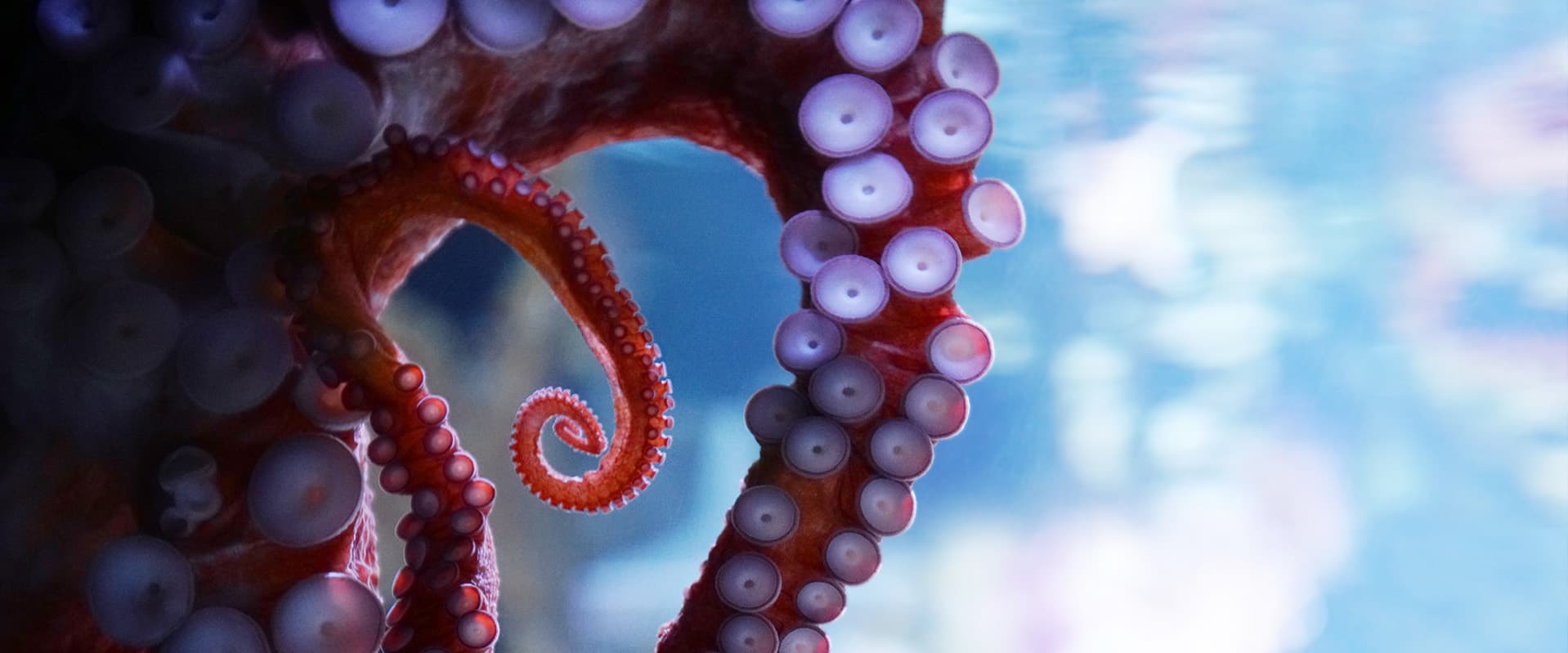
Image used under license from Shutterstock.com
We explore the fascinating life and science of the giant Pacific octopus and we look at what it tells us about the Creator of All Things.
Description
The giant Pacific octopus and humans have been evolving separately for more than 500 million years, but still, we have a few things in common. We explore what this means about the octopus, what it means about humans, and what it tells us about the Creator of All Things. As we dive into the science of octopus cognition and behavior we find the questions get more and more interesting. To help us sort through it, we are joined by Sy Montgomery (author of Soul of an Octopus and Secrets of the Octopus) who introduced us to two giant Pacific Octopuses at the New England Aquarium.
Thanks to the New England Aquarium for hosting our visit.
Theme song and credits music by Breakmaster Cylinder. Other music in this episode by Evan MacDonald, Mattijs Muller, Titan Sound, Klimenko Music, Ricky Bombino, Sirius Music, Northern Points, and Paradiso Music courtesy of Shutterstock, Inc.
- Originally aired on March 13, 2025
- WithJim StumpandColin Hoogerwerf
Transcript
Stump:
Welcome to Language of God. I’m Jim Stump.
Hoogerwerf:
I’m Colin Hoogerwerf.
Stump:
Today we’re bringing you something a little bit new. A new episode segment which we hope to do more of. We’re calling it Cool Creatures.
Hoogerwerf:
The idea here is that we’re going to take a whole episode to focus on one piece of God’s creation.
Stump:
We think we’ve got pretty good justification to do this kind of thing, both from a scriptural basis and from the kinds of things we want to do with this podcast and at BioLogos. We get to know God through scripture, where we learn about God’s creativity and the love God has for all things in creation. Science gives us more tools to explore the creation, to expose with even greater clarity what was said to be ‘very good’.
Hoogerwerf:
Humans, of course, are creatures too. We happen to be an especially social kind of creature. We’ve evolved to be dependent on other humans and live in complex societies. And so it’s pretty natural to make connections with other people. But we’re also dependent on non-human life. Sometimes that’s really obvious, like the plants and animals that feed us. Sometimes it’s less obvious, like all the creatures that contribute to health sciences behind the scenes—
Stump:
Or all the creatures that decompose our waste on a daily basis…it would be pretty hard to live if we didn’t have worms and mushrooms to help break all that stuff down and turn it into soil.
Hoogerwerf:
But making a connection to non-human life is not only about appreciating the creatures that do some service for us. And it’s not just an intellectual exercise. It seems to go deeper than that.
Montgomery:
I think our brains tend to be more wired to connect to individuals than to connect to concepts. And I have a very strong concept that we need to protect the earth and all that is in it, and that we honor the Creator, and we honor our planet by doing this.
Stump:
This is Sy Montgomery, author of many popular books about animals and a champion of connecting with non-human creatures, so it’s natural that she would join us on this first creature meeting.
Montgomery:
But when you actually fall in love with somebody and their incredible beauty and their grace and their powers, and it touches every fiber of your being, and engages all of your senses, that connection, I think is extremely powerful. And we are hardwired for that kind of a connection. I think that’s a connection that then leads to conviction and action.
Hoogerwerf:
No matter what creature we meet in episodes like these, there will undoubtedly be interesting scientific questions about biology and ecology and evolution, and I’m sure those questions will lead us down all kinds of other scientific paths.
Stump:
And getting to know a creature is inherently theological. In the same way we might become more familiar with an artist by studying her paintings, becoming intimately familiar with the creation is one of the best ways to become more familiar with the creator. Furthermore, we might learn a little more about ourselves in this exercise. When we interact with others, human and non-human, there is always going to be a reflection back to ourselves. That may be especially the case with today’s creature, the Giant Pacific Octopus.
[music]
Montgomery:
Look at you, look at you. And see he’s changed colors, see below the eye, it’s gotten lighter. Hi, do you want to play with us? We would love to play with you.
Hoogerwerf:
That’s Sy Montgomery again, this time talking not to us but to a young Giant Pacific Octopus in a small tank in the back room at the New England Aquarium. This octopus was new to the aquarium at the time of our visit, and still not on display, but instead in a quarantine tank about the size of a college dorm mini-fridge.
Stump:
So how did we find ourselves standing there, pushing our sleeves back, ready to stick our arms into a tank of 40 degree water and reach down toward an eight-armed boneless creature? Well in one sense that is explained by the fact that we met Sy Montgomery when she came to speak at a BioLogos event a few years ago and became fast friends, and as we were dropping her off at the airport she said, “you guys need to come out to Boston and I’ll take you to the aquarium.”
Hoogerwerf:
Yeah, I think the exact words were “let’s get some suckers on you”
Stump:
And you and I looked at each other with wide eyes and said “yep…”
Hoogerwerf:
Yeah I think we’ve both been pretty fascinated by octopuses in the last few years.
Stump:
And it’s not just. It seems like there’s been an explosion of octopus interest in books and TV shows, and a lot of it seems to bring up some really interesting questions about what it means to be human too, and what it means to be intelligent. Octopuses seem to challenge some basic assumptions we make about how intelligence has evolved.
Hoogerwerf:
We’re pretty used to at least some level of intelligence in animals that are closely related to us and probably tend to think that intelligence goes down the further you get from humans. But Octopuses are not closely related to us. If we go back to when the last common ancestor between humans and octopuses was, we have to go back probably more than 500 million years. That’s 500 million years of separate evolutionary tracks.
Stump:
Yeah, so this was before vertebrates even evolved, so that last common ancestor is some kind of worm-like creature, essentially just a tube. After that vertebrates and invertebrates, including the cephalopods, evolved in really different ways. We know what happened with the vertebrates, developing internal skeletal systems and large brains to control them. The invertebrates went a different route.
Hoogerwerf:
And that’s not to say they weren’t successful. It’s tempting to define success in evolution as becoming human, or at least developing human-like traits. But success in evolution is really about how well a creature can occupy its niche. And invertebrates are incredibly successful from that standpoint even without bones or big brains. But then, out of one group of invertebrates—the mollusks—comes the octopus.
Mather:
They’re a mollusk. That’s really interesting because that means their closest relatives are snails and clams and they’re not at all like snails and clams. But because they’re a mollusk, they have the heritage of the mollusk.
Hoogerwerf:
This is Dr. Jennifer Mather.
Mather:
I’m a professor of psychology at the University of Lethbridge in Alberta, Canada.
Stump:
She’s one of the leading experts on octopus cognition and behavior.
Hoogerwerf:
Mollusks, while numerous and well adapted to their specific niches, are not typically held up as models of high intelligence.
Mather:
None of the other mollusks have anything that you would really call a brain, and the cephalopods do.
Stump:
Right. This is where the octopus took a really interesting turn. Somewhere along the way octopuses did invest in intelligence.
Hoogerwerf:
There are some theories for why this happened. Octopuses and their cephalopod cousins evolved from ancestors that had shells. And most of the cephalopods lost their shells. There is one cephalopod that still has a shell actually, the nautilus. But the rest of the cephalopods are in the Coleoids (coal-ee-oids). This includes squids, cuttlefish and octopuses. Without shells, these animals needed a different way to protect themselves and it seems intelligence might have been a pretty good alternative to a hard shell.
Stump:
Squids and cuttlefish are all really interesting and amazing too and share many traits with octopuses, but we’re going to focus on octopuses from here on out.
Hoogerwerf:
It turns out that one of the things that differentiates octopuses from squids and cuttlefish is that they have 8 arms. And they are not tentacles, contrary to popular terminology. Squid and cuttlefish also have 8 arms but they have 2 tentacles—I guess the main difference is that tentacles only have suckers near the ends.
Stump:
There are more than 300 different species of octopus. That number seems to be growing as people study them. It’s not all that long that we’ve had the technology to be able to study underwater creatures very well. Add in the fact that octopuses are masters of camouflage and you can start to understand how a lot of species could be missed. It’s really hard to identify a creature that can completely change its color and its shape depending on its mood.
Hoogerwerf:
And octopuses have occupied just about every part of the ocean and cover the globe from tropical coral reefs, to intertidal and coastal waters to the deep ocean.
Stump:
I’m pretty proud to say that on two occasions in very different parts of the globe, I’ve seen octopuses in the wild. Once in the Pacific ocean off the coast of Hawaii, and once in the Mediterranean Sea near Malta (though possibly that second one was a cuttlefish, not an octopus, as my guide wasn’t quite sure).
Hoogerwerf:
I have to say I’m a little jealous of those sightings. It’s still on my bucket list to see an octopus in the wild. We did look during some time we spent in Hawaii, and even had tips on where to look from an octopus scientist in the area. But when we were down in the water looking among the rocks and coral it was pretty clear to me just how hard it would be to see an octopus even if it was right in front of me.
Stump:
Yeah the one I saw was because the guide found it. It wasn’t me finding it myself. But I’ll still take it. And this brings us back to one of the most impressive features of Octopuses: their ability to camouflage themselves. This comes from the combination of being able to change color and to change shape.
Hoogerwerf:
Let’s start with the color changing. This is a pretty amazing biological process. Octopuses have three layers of skin that all have different color changing properties.
Mather:
So the basics of the color system are that there are little sacs in the skin called chromatophores, and they’re elastic, but they have muscles that pull them out. So when the muscles contract, the color shows, and when the muscles relax, the color doesn’t show.
Stump:
Think of a colored balloon and how that color changes when it is blown up. When it gets stretched out it brightens. That’s kind of what’s going on with octopus skin, and it can make these changes in milliseconds. And there’s more complexity because the different layers of skin have different properties that interact with each other.
Mather:
So you can see below there are what are called leucophores and iridophores. And the leucophores simply reflect whatever light it sees, okay, and the iridophores reflect blue, green, purplish, and they can change a little bit. So the result is a really a kaleidoscope of appearance.
Stump:
So an octopus is not the only animal that can change the color of its skin. A chameleon can do this too right?
Hoogerwerf:
Yeah, and it uses some similar processes to do it. But an octopus has a lot more control and can change colors a lot faster.
Stump:
And then it can also change its shape and even the texture of its skin, to look almost exactly like its surroundings. This ability to change itself to look like something else seems to speak to its intelligence.
Hoogerwerf:
I think it’s helpful to compare to other animals again. Lots of things camouflage themselves that we don’t typically think of as ultra intelligent. Walking sticks…
Stump:
Right, but that is a kind of camouflage that has evolved. A walking stick is not observing the world and then making changes to its body to blend in with the world that it observes.
Hoogerwerf:
So a chameleon again?
Stump:
Yeah, that that maybe gets closer. A chameleon color changing is probably a form of communication of some kind as well as camouflage, which is true for the octopus too. And so there is maybe some form of control with a chameleon. But it’s a pretty simple version right? It is changing color to reflect colors around it. But if you think about it in terms of resolution, then a chameleon is pretty low resolution camouflage. An octopus can achieve much higher resolution and to a much bigger range of contexts. Add in the ability to change the texture of its skin and it’s not even close.
Hoogerwerf:
Does this suggest then that an octopus might even have the ability to take the perspective of another creature? If an octopus is trying to make itself look like a piece of coral, can we say that it must be able to consider what the world looks like from a shark’s perspective? The problem is that they only have one color receptor in their eyes (we have three), and so they aren’t choosing how to look by replicating what they are seeing, at least in the case of color.
Stump:
Hmm… it’s still an interesting question about whether they can think about the way they look and the world itself from the perspective of another being. Philosophers and psychologists call this theory of mind. Which is the ability to understand that other individuals have conscious experience like you yourself do. And it takes some pretty advanced intelligence to have this. Only a handful of other creatures besides us are thought to have theory of mind. Chameleons are not one of those. I’d say what they do is just an automatic response. Whereas maybe with an octopus there is something more there… are they aware that other creatures are out there with intentions of trying to see them and eat them, and so their camouflage and shapeshifting is done intentionally to counter that? Maybe.
Hoogerwerf:
So if we want to explore intelligence in an octopus further, we might want to look at the nervous system. And for an octopus this is where things get even more interesting.
Mather:
So imagine your brain like a collar around your throat. That’s kind of funny.
Hoogerwerf:
It might be helpful to make a distinction between the brain and the nervous system. The brain is just what you think.
Chan-Devaere:
The sort of like, funky, squishy, slightly squishy organ that sits in our heads.
Hoogerwerf:
That’s Vanessa Chan-Devaere.
Chan-Devaere:
I’m an Assistant Teaching Professor of Psychology at the University of Notre Dame. My background is in cognitive neuroscience.
Hoogerwerf:
Which means she studies the brain and how it relates to how we think and behave.
Stump:
The nervous system includes the brain but also includes all the rest of the nerves that go out into the body.
Chan-Devaere:
So in humans and most other vertebrates, we distinguish between the central nervous system, which for humans, is the brain and the spinal cord, and the peripheral nervous system, which is all of the other nerves that extend out from the brain and the spinal cord to all other parts of the body.
Mather:
Now, the other thing that’s really interesting about the octopus nervous system is that the brain is two fifths of the nervous system. The other three fifths is out in the arms as chains of ganglia.
Stump:
This is really different from a human brain. While we do have neurons outside of our central brain, most of them are in our heads.
Chan-Devaere:
So that’s the way it is in a lot of creatures, and a lot of that central computing power happens in the central nervous system.
Hoogerwerf:
But for an octopus, with all that nervous system out in the arms, there is a lot of information processing that is located outside of the brain.
Mather:
So these ganglia, each ganglion, is actually above a sucker. And suckers have hundreds of tactile and chemical receptors, so the ganglion kind of controls what the sucker is doing, what the sucker is perceiving, and what the sucker should do because of it. And then the sum of all that information does indeed go back to the brain.
Stump:
This leads to a different way of being.
Mather:
When I want to talk about how to understand the parallel, I sometimes say, well, think of the vertebrate nervous system as like Putin. “I’m in charge and I will dictate everything, no matter what goes on.” And then think of the cephalopod nervous system as like Biden. “Yeah, I’m basically in charge, but I give this job to you, this job to you, and you have states rights.” So that’s sort of like the arms, so that it’s not that the octopus has nine brains. I get awfully tired of hearing that, but the octopus is a democracy in the sense that the brain tells the arm nervous system approximately what it wants to do, and the ganglia in the nervous system work out the details of how to do it.
Stump:
There are stories of octopus arms that have been severed from the body, continuing to crawl, but this is not just reflexive (the way frog legs can still twitch when severed). The severed arm will actually crawl in the right direction, and sometimes even continue hunting and trying to move food toward a mouth that no longer exists.
Hoogerwerf:
So reflexes…we have reflexes too. Not every action we make is a decision processed by our frontal lobe.
Chan-Devaere:
The doctor hits your knee to see whether it’ll move. Or your first response to touching something really hot, even before you realize that it’s really hot, you’ve already kind of started pulling away.
Stump:
Ok, a reflex like this might be a little bit like how an octopus’s distributed nervous system works. Our body is doing something without our centralized, conscious control of it. But it seems it’s still a long way off and probably much more complicated for an octopus and whatever its conscious experience is like, than the way we experience a knee jerk reaction.
Hoogerwerf:
Complexity is probably part of the reason for why octopuses developed this distributed nervous system. It turns out that bones are a much less complex way of being able to move, even if they do limit us from being able to squeeze through tiny gaps.
Mather:
Now the bones are what we use to articulate against, so that if you curl your arm with the biceps, you shorten a muscle, which is attached at the elbow of the shoulder. And if you don’t have something to move against, you can’t move. So the octopus doesn’t have that, it’s just got a bunch of muscles. And what it actually does is, when it makes any movement, it allocates one or two of the muscles to stiffen and be temporary bones, and then the others move against them. It’s extremely complicated. But it’s probably because that’s such an extremely complicated way to run movement that the octopuses ended up with all that nervous system out there in the arms,
Montgomery:
[sounds from aquarium] Can I stick my hand in there? Can I say Hello? Look at this arm coming over. And it really does make me think of that Sistine Chapel.
Stump:
Yes! When he reaches out an arm like that, to your reached out arm.
Hoogerwerf:
I had a lot of this research in mind as I was standing in front of the tank on a little foot stool pushing my sleeves back. When I put my hands down into the water the octopus was down in the corner and without moving its mantle, out came one long thin probing arm reaching out toward my fingers. I had been thinking about that moment for a long time. Sy Montgomery talks about her many experiences with octopuses, and sometimes an octopus will reach out with many arms, grab and pull, wanting to explore all of you from within its own tank. And even a small octopus has a lot of strength. But our octopus seemed to be a bit more shy than some of those descriptions I had read about.
Stump:
Eventually he did engage with us and at least start to explore. Those suckers Sy talked about started reaching out and tasting our arms; she calls this being kissed by an alien. And I was trying to get a gauge of how big this giant pacific octopus was by gently coaxing it to stretch out. But he didn’t really want to do that, and mostly stayed in the corner of his small tank. I’m guessing that it is fairly traumatic to be housed in a quarantine tank.
Hoogerwerf:
Yes, we should probably acknowledge that this octopus was taken from the pacific ocean and sent to the aquarium, which sounds a little cruel. But it’s really the only way to have an octopus in an aquarium. They don’t breed in captivity. We asked Sy about this, and she gave a really interesting answer.
Montgomery:
On a philosophical level, we should not have the right to kidnap and imprison those who have done no wrong to us. However, if you look at the real world and our real ocean and the real lives that octopuses have, we have so wrecked the wild that for many, many animals, life in captivity is better. Our oceans will have more plastic than fish by the year 2050. And humans are participating in a fishery for octopuses. Not only are they eaten by humans, but octopuses are used as live bait for they’ll cut off their arms and use the squirming arms to attract other animals. Even beyond that, a giant Pacific octopus lays 100,000 eggs. How many of those do you think survive to be able to reproduce? I mean, notice we are not up to our lips in octopuses, so your chances of surviving long enough to reproduce in the wild are, you know, one or two in 100,000. And what’s going to happen to you? Most likely, if you’re a wild octopus, you will be killed and eaten and torn limb from limb while you’re still alive.
Stump:
In that sense, maybe Murphy won the lottery by being captured and taken to live out his life at the New England Aquarium, where eventually he will get to live in a nice big tank with regular feeding, and medical care, and lots of enriching things for his life. And beyond his own comfort, it’s worth noting that his life at the aquarium does something important for us too.
Montgomery:
You know those individuals are going to have a good life, and beyond that, I think what they can share with us about their kind and about our responsibility for the oceans in the real world of today, where global warming is wiping out species left and right, and the ocean is warming faster than the air on the land and where most of life exists. It is so critically urgent that people care enough to change that I think morally, taking someone from the wild to live a good and interesting, long, healthy happy life to help us make that choice for so many other species, I think we’re on the right side.
Hoogerwerf:
One of the ways they try to make sure an octopus does have a healthy happy life in the aquarium is by making sure it has chances for enrichment and engagement, including with visitors like us. At one point we even threw a dog toy and some seashells into the tank to try to get him to play.. But he didn’t seem all that interested and we couldn’t really get him to play very much.
Stump:
Well let’s talk about play. We know that a lot of animals play and we expect some animals to play. Dogs and cats, most familiarly, but lots of other mammals. But at some point we kind of stop expecting play in animals. I don’t really think of fish as being playful and definitely not slugs or starfish, which are of course mollusks along with octopuses.
Hoogerwerf:
But there’s some pretty good evidence for octopus play. And Jennifer actually helped to design an experiment to test this along with her friend and colleague Roland Anderson.
Mather:
So we ended up doing this with six octopuses. And what we did is simply gave them an aquarium which had a couple of rocks at one corner, so the octopus would have a place to shelter and nothing else. And then we took a pill bottle and waited it a little bit so that it floated gently at the water surface. Now something we hadn’t planned turned out to be important, because it turned out that the water flow came in one end of this long tank, and the octopus was sitting at the other end, so anything that was floating freely would move from one end to the other
Hoogerwerf:
The first couple of trials all of the octopuses would reach out to explore the pill bottle and figure out if it was food or something dangerous. When they were satisfied after a trial or two they would simply ignore it.
Mather:
But then on the fourth trial, two of the octopuses did something interesting.
Stump:
An octopus breathes by taking water into their mantle and breathing it out through a funnel and they can direct the water through the funnel which they use to help them move and to send jets of water at other objects or creatures.
Mather:
What these two octopuses did is they shot a jet of water at the pill bottle, which sent it over to the water intake end, and it drifted slowly back to the octopus and they shot another jet of water at it.
Hoogerwerf:
Now one instance of this behavior could be explained by annoyance, just trying to get rid of it. But 8, 10, 12 times and it started to look like something else.
Mather:
And this was pre-email, by the way, and Roland phoned me in great excitement, and he says she’s bouncing the ball!
Stump:
So while Murphy wouldn’t really play with us there are probably some preconditions to play, like a feeling of safety and maybe a level of boredom, that might not have been met. We were new, strange smelling creatures after all, sticking our bony appendages into his tank.
Hoogerwerf:
So this brings up another really interesting aspect of octopuses. You say we were new creatures, and we were, but that assumes that octopuses really know the difference between you and me and the caretakers who are there everyday.
Stump:
I also said we were “strange smelling”. Smell for an octopus is a little different than smell for us but smell really is just the processing of chemical information. We do it through the air. Octopuses do it through touch and through chemicals in the water and they are probably much much more sensitive to those chemicals than we are.
Hoogerwerf:
So telling the difference between two humans chemically, through the water might not be all that surprising. But it seems that octopuses can actually tell the difference between different humans visually as well, which is shown in another experiment run by Roland and Jennifer.
Stump:
People who work with octopuses have a lot of anecdotal evidence of this. Stories of octopuses who always jet water at specific caretakers and not others. But they wanted to try something more data-driven.
Mather:
And what they did is they said Okay, we’re going to be good cop, bad cop. And then we’re going to see if, after several trials of being good cop, bad cop, the octopuses would react differently to us. Okay, so the person who was good cop fed the octopus, and the person who was bad cop came near equal frequency and had a test tube brush and pressed it gently but firmly against the side of the octopus.
Hoogerwerf:
So they got 8 giant pacific octopuses and they put them to the test, using different people dressed the same and with different roles, feeder, that’s good cop, or irritator, which is the bad cop. They did that 10 times over the course of two weeks.
Mather:
And then they simply came and stood in front of the octopus and recorded its behavior to see if it reacted differently to them. And it did. In the case of the person with the food, it came out, took an arm or two out of the water and went, Okay, where’s my food? And in the case of the person who had the test tube brush—
Hoogerwerf:
The bad cop—remember this is a person dressed the same as the feeder but has spent two weeks annoying the octopus. When this person came they did a lot of the same kinds of things you might expect when a predator is nearby.
Mather:
They put on these, and I mentioned this eyebrow, there’s disguise, and they shrank away
Stump:
Lots of other animals can do this too, but for an octopus to be visually recognizing the difference between individuals of another species that aren’t even in the water with them, is pretty impressive.
Hoogerwerf:
I could go on and on with these experiments because I think they are a lot of fun. There are lots of studies about problem solving and personality and all kinds of other aspects of octopus life. And they all seem to add complexity to a creature so distant from us on the evolutionary line.
Stump:
There was another octopus at the aquarium we haven’t introduced yet. Sedna was also a Giant Pacific Octopus and had been at the aquarium for a while. When an octopus gets to a certain age it goes into what is called senescence.
Hoogerwerf:
This is sometimes described as being similar to dementia in humans.
Baker:
[sounds from aquarium] She has some spikes in activity where she’ll walk around as if nothing’s up.
Hoogerwerf:
That’s Jordan who was our guide at the aquarium.
Baker:
But most days she senescing pretty hard and doesn’t have much of an appetite.
Stump:
The thing is, Sedna is only a few years old. But this is normal. Giant Pacific Octopuses live only about 3 to 5 years, and that’s the longest living of octopus species.
Hoogerwerf:
Yeah this really kind of bothers me. Why would a creature that invested so heavily in intelligence, live such a short life?
Mather:
Well, it bothers us just as much as it bothers you.
Stump:
There’s no really good scientific answer to this paradox.
Mather:
Yeah, science doesn’t know all the answers. We know some of the answers. And we don’t even know all the questions. But then that’s what keeps me going.
Hoogerwerf:
Sedna was still in a big tank with the front open to the public part of the aquarium. We looked in from up top and after having met Murphy, Sedna was huge. 10 feet from arms to arms
Stump:
I wasn’t expecting much from Sedna, having read a bit about this stage where they are mostly inactive. But when I put my hands in she did reach an arm out, and then eventually she glided over and said hello in the octopus way.
Hoogerwerf:
Yeah, this was really cool, partly just because of how big she was. I have encountered some big imposing creatures, moose and bears and I used to feed a golden eagle with a 7 foot wingspan that would fly back and forth a few feet over my head. And Sedna ranks right up there with all of them, but also so different. And part of that maybe was a different expectation. I approached Sedna with more openness to there being a mind and experience behind those eyes and I wonder if every encounter with life would be different if I could approach it with the same kind of curiosity.
Stump:
It’s one of the coolest experiences I’ve ever had with a non-human. she’s so big, but also so graceful in a billowing, boneless way. Sedna had one of her arms around mine as she was tasting me, but we also made eye contact.
It’s a strange and humbling experience to lock eyes with a creature so utterly alien—especially one nearing the end of her life. I felt a spark of connection that made me think: She sees me. Maybe we were just two living organisms in that moment, each evaluating the other’s presence. But it felt like more than basic curiosity. I’m reading into it, I know, but it felt like she conveyed with her look, “I’m glad to know you. Thanks for coming to see me in my last days.” Then she glided away, back to the other side of the tank.
Thinking about it later, I remembered Jane Goodall’s words about looking into the eyes of a chimpanzee: “I reached out my hand, and he reached back to hold it. It was a gesture of trust, something that passed between us that seemed to transcend the barriers of species.”
If there is a barrier of species between us and a chimpanzee, with whom we have common ancestors just six or seven million years ago, how much more of a barrier is there between us and an octopus, where we have to go back 500 million years to find common ancestors? And yet those eyes!
Hoogerwerf:
If this were just an ordinary science podcast, we could probably end here. But that’s not entirely satisfying for me. I want to know what to do with this glimpse into the octopus world and how it relates to my own creatureliness. What are the big questions this all exposed for you?
Stump:
Well of course it brings us back to our ongoing debate about the difference between humans and non-humans.
Hoogerwerf:
Yeah. So there’s this tendency to use science, and especially this study of animal behavior to either prove somehow that humans really are superior beings, or maybe to disprove that. In the case of octopuses we learn that a lot of traits we thought were only human traits, are shared with other creatures. We already know that about a lot of animals, but in so many of those cases we can say that it’s because they are evolutionarily close to us. The octopus kind of ruins that.
Stump:
Yeah. That’s really interesting. We can talk about spectrums of behaviors. And octopuses still don’t problem solve or communicate to the extent that humans do. But the fact that those tendencies evolved convergently, I guess should at least lead us to wonder about how unique those traits are to us. Maybe curiosity, intelligence, and even theory of mind are much more widely distributed and don’t necessarily speak to what it means to be human, as much as they speak to what it means to be alive.
Hoogerwerf:
And that should probably have us wonder about how we treat such creatures.
Mather:
Given all the kinds of things that I’ve told you about how they’re intelligent, they’re sensitive, they can think about what’s going on in the future, they can store information from the past, they can play, they can program different responses that are appropriate to different situations, I guess I would to say you have a complex, sensitive animal, you don’t treat it like junk.
Hoogerwerf:
I got in touch with Dr Mather because she is one of the top experts on octopus behavior and cognition. And when I told her about the podcast she was a little concerned because she is not a Christian and didn’t want to be misconstrued. She has actually done some writing on ethical treatment of invertebrates and she has some critiques of how religious ideas have led us to a place where many creatures aren’t given the same kind of ethical consideration.
Stump:
And she may have a fair point there. Human superiority has been tied to the doctrine of the image of God and to the great chain of being where humans are placed just below the angels, and below humans are the rest of the animals, plants, and minerals down at the bottom.
Hoogerwerf:
Invertebrates fall pretty far down that list.
Stump:
Yeah and that kind of theology has given justification for a lot of harmful behavior toward the non-human world. But I would argue that it wasn’t religion that led people in that direction, rather it was people that led religion in that direction. And Christianity certainly doesn’t have to lead to mistreatment of other creatures. Take Sy Montgomery for example. We asked her, at one point, if spending her time traveling around encountering animals ever gets old.
Montgomery:
It so doesn’t get old. I mean, prayer doesn’t get old. Wonder doesn’t get old. Awe doesn’t get old. It’s what we’re made for. And being able to commune with somebody like, I’m just so—Jim, I’m so glad that you had this experience, Colin, I’m so glad that you had this experience.
Hoogerwerf:
And that’s partly why we wanted to go, to have this experience of communing with another living creature and to pass on some of the knowledge and the awe and wonder of it. We hope this can be a small part of shifting the narrative that religion leads only to human domination of the world. Wouldn’t it be cool if whenever non-christians thought of Christians, alongside caring for the poor, they also thought, “oh those are those people who care about octopuses and stop to help turtles cross the road.”
Stump:
It wouldn’t be such a stretch for us to think about our neighbors as including a wider range of lifeforms including octopuses.
Montgomery:
I mean, we last shared a common ancestor with an octopus half a billion years ago, back when everyone was a tube. But we do share a common ancestor. And that is why you can look in the eyes of an octopus that can look back at you, and you can make friends with an octopus.
[music]
Stump:
Well that’s our show. But there’s something we want help with. We’re going to do some more of these Cool Creatures episodes and we’ve already started on a few of them, but we want to hear from you. What creature encounters have you had that have reoriented the way you look at the world or have deepened your understanding of God or God’s creation? Email them to us at podcast@biologos.org. Maybe your story will make it into a future episode.
Credits
Language for God is produced by BioLogos. BioLogos is supported by individual donors and listeners like you. If you’d like to help keep this conversation going on the podcast and elsewhere, you can find ways to contribute at BioLogos.org. You’ll find lots of other great resources on science and faith there as well. Language of God is produced and mixed by Colin Hoogerwerf, that’s me. Our theme song is by Breakmaster Cylinder. BioLogos offices are located in Grand Rapids, Michigan in the Grand River Watershed. Thanks for listening.
Featured guests

Sy Montgomery
Jennifer Mather
Dr. Jennifer Mather is a Professor of Psychology at the University of Lethbridge and a leading expert on octopus behavior and cognition.
Vanessa Chan-Devaere
Vanessa Chan-Devaere is an Assistant Teaching Professor of Psychology at the University of Notre Dame.