[sounds of walking through brush]
Gonzalez-Socoloske
So what I look for is, I look for any kind of movement, and then I look for something that breaks the pattern of the ground, right?
Stump:
Welcome to Language of God. I’m Jim Stump.
Gonzalez-Socoloske
Yep, it’s subtle, though.
Hoogerwerf:
I’m Colin Hoogerwerf.
Hall:
It’s very, very subtle that once you get one or two…then you start to see it.
Hoogerwerf:
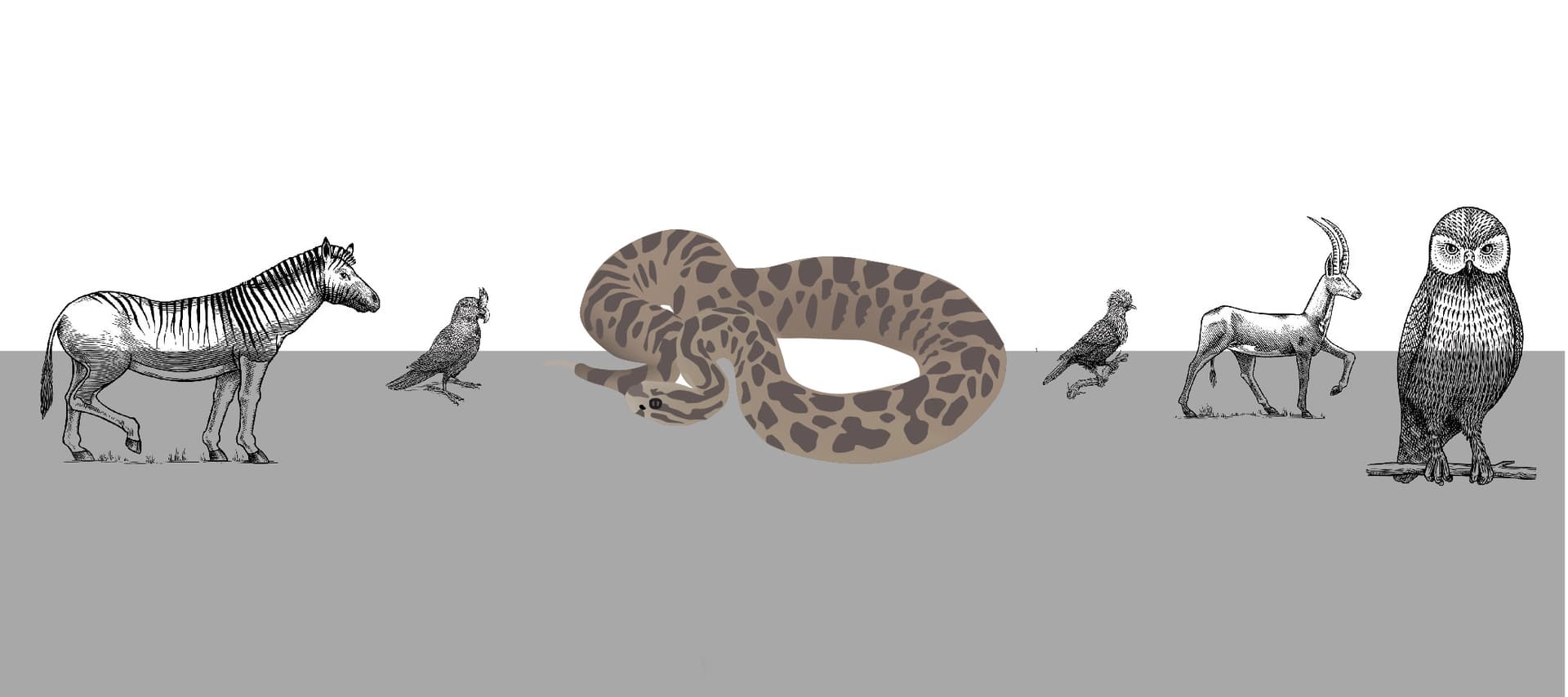
This is our third and final episode of this series on extinction and we’re starting in Southwest Michigan deep in a wetlands looking for a very hard to find, imperiled snake.
Hall:
But what’s crazy is the habitat can be so different depending upon what part of the range…
Hoogerwerf:
Those voices you hear are Daniel Gonzales-Socoloske, who has been with us through the series and Roshelle Hall, who studies eastern massasauga Rattlesnakes.
Stump:
I opted out of the trip you took looking for snakes. It sounds like it was no easy hike. But this had more of a purpose behind it than just spending some time outside right?
Hoogerwerf:
Well first, you’re right that it was not an easy walk in the woods. [sounds of walking through thick brush…voice says ”we could go around”] We spent a whole day tromping through mud and pushing our way through thickets and brambles and thorns and trying to avoid poison sumac
Field Recording:
This might be sumac, poison sumac. Oh, cool, I touched it.
Hoogerwerf:
Which wasn’t entirely successful, I should say.
Stump:
Sorry I missed it!
Hoogerwerf:
Well you also missed the main reason for going which went beyond just really wanting to see MIchigan’s only venomous snake. We’ve made a few comparisons here between the death of a species and the death of individual humans. And as I’ve been trying to figure out how to feel about biodiversity loss, to continue this question we’ve started asking, I realized that one of the problems is that all these creatures we hear about going extinct are pretty abstract. I’ve never seen many of them, don’t know where they live or how they live. And so there’s a comparison here again to humans.
Gonzalez-Socoloske
It’s like when a relative passes away, but you don’t know them, you don’t really feel anything. It’s very different from a relative passing away that you know, or even a friend or something, because then it’s like, oh, there’s a connection there. So the best thing that we can do is, before something goes extinct, is to try to make that connection, plant that seed, so that, if and when something disappears, then there is that emotional connection and that emotional tug.
Hoogerwerf:
So that was the goal here. To make some connections with some creatures and develop a relationship of some sort, specifically to some creatures that are facing some threats and aren’t guaranteed to be around forever.
Stump:
We recently spent some time with the bestselling author, Sy Montgomery. This kind of thing is her whole life. She develops relationships with animals so that she can bring what she learns to readers. But don’t take it from me. Here’s Sy:
Montgomery:
In most of my books, I’m actually in there to the degree that I’m the reader. I’m inviting the reader to be in my heart, you know, to reach out my hand and say, “Come with me. Let me introduce you to my friends,” in South America, or, you know, in the Mongolian desert, or Papua New Guinea, or wherever I happen to be. Come with me, and I want you to meet my friend.
Stump:
To care about something it’s important—at the very least—to know it exists! To love something, you have to know something about it. And having those relationships can be pretty profound.
Montgomery:
And when you have a friend who is a pink river dolphin, when you have a friend who is a snapping turtle, when you have a friend who’s a giant Pacific octopus, that changes the way you feel towards their family and their larger family and otherwise it’s just an idea.
Hoogerwerf:
We like this idea enough that we’re hoping to do occasional episodes where we get to know a creature—here’s a teaser to look forward to one of those episodes in the coming months, where we’ll tell you about getting to meet a great Pacific octopus with Sy Montgomery.
Meet the Massasauga
Stump:
But that’s later. We’re here now to meet a snake. What led you to snakes?
Hoogerwerf:
To this particular snake. The eastern massasauga rattlesnake. One of the things I thought was interesting about the massasauga compared to some of the other animals we’ve talked about is that it’s not a particularly well-liked creature, potentially even dangerous. And it’s not a very visible creature. A lot of people don’t know they exist and are surprised when they learn there is a venomous snake in the Midwest.
Stump:
I, for one, wasn’t aware there is a venomous snake in my neighborhood. Snakes in general have a pretty bad reputation. Maybe that even goes all the way back to the garden of Eden.
Hoogerwerf:
Well fortunately, at least for the snakes I guess, not everyone hates snakes.
Hall:
I have loved snakes my whole life [laughs].
Hoogerwerf:
This is Roshelle.
Hall:
I’m the assistant curator at the Museum of Nature and Science at Andrews University.
Hoogerwerf:
There are, as you can imagine, a few barriers to protecting a venomous snake—the main one being that people don’t like them and people are afraid of them. But eastern massasaugas are also pretty hard to find.
Gonzalez-Socoloske
I have had situations where we’re all going in single file and the first three step over it. And the last pearson is like, “are you gonna, are we gonna deal with that right there?” [laughter]
Hoogerwerf:
People aren’t running into them very often and don’t even know about them.
Hall:
They’re a very cryptic snake. They are not aggressive. They hide.
Hoogerwerf:
So it’s hard to build a lot of public support around something people don’t know about, and if they did know about, might not be inclined to protect.
Stump:
Sounds like they might be in the category of what the bible sometimes calls “the least of these.” So you made your best imitation of Sy Montgomery and went to try and go make friends with an eastern massasauga?
Hoogerwerf:
Yeah. I wanted to see if I could get to know these cryptic creatures. So for one thing we can say a little bit about what they are like.
Hall:
They are a small snake. They’re only about three feet at the biggest.
Hoogerwerf:
They are brown and mottled, probably like most people imagine the pattern of a rattlesnake. And they play an important role in the habitats where they live.
Hall:
They are a sentinel species. So they’re important in letting us know the health of the environment of the habitat where they are, so that’s one thing to think about. The other is they are both predator and prey. So they’re very important in the whole life cycle and the food chain. They eat a lot of the rodents. So their main diet are the small rodents. So their main diet are small mammals, which you know we don’t have something to eat those small mammals, we’re in trouble in that area.
Hoogerwerf:
They are eaten by things like hawks and other raptors, other snakes, and even possums. And like many of the creatures we’ve talked about in this series, they are facing several threats. They are currently listed as threatened on the US Endangered Species Act.
Hall:
Their main threat is their habitat loss and their habitat fragmentation And I guess climate change also. But our populations are becoming super rare because they’re losing their habitat, their habitats are being very fragmented.
Hoogerwerf:
It also doesn’t help that often when people do see them, they kill them.
Stump:
So you found some eastern massasaugas?
Hoogerwerf:
Well… no. We spent hours and hours walking through wetlands. And we know they are cryptic and good at hiding, but Roshelle and Daniel went to places where we know they are. But we didn’t see any. And I was pretty disappointed. As our time was winding down I was practically begging a snake to appear, partly because I thought the whole thing might be waste of time for this goal of getting to know a species to tell all our listeners about it. But after the disappointment wore off I came to a more positive conclusion. I do feel like I got to know something about the snakes by spending so much time and effort looking for them. I got to know where they live. I got to see their neighborhood, even met some of their neighbors. We found three box turtles, another species that is threatened in Michigan as well as lots of cool plants and insects. And I got to know something about their shyness. And I did see two massasaugas at the local zoo, so there’s that.
Stump:
And you must have learned something just by spending time with some scientists who have chosen a career trying to get to know these snakes.
Hoogerwerf:
Yeah and their work is really important for the future of the snakes.
Hall:
We have research groups in every single state where the massasauga exists working on behavioral ecology, the microhabitat use, thermoregulation patterns, responses to human management—so how we can manage each of those habitats properly without hurting them—the eating habits of the neonates versus the adults, the brood sizes, the male and female activity, the body size, all of these things are being looked at. And these basic questions have to be answered in order for us to know how to then go back and manage the habitat and manage the species.
Hoogerwerf:
And both Daniel and Roshelle are people of faith as well, which brings a different motivation to their work of protecting wildlife.
Hall:
And as a Christian, I also, first and foremost, God created them. And if God created them, then I need to protect them. Animals give me joy, and all animals give me joy. And so I want to teach people that joy, to have that joy.
Meet the Manatees
Hoogerwerf:
This brings us to the second creature we’re going to meet.
Gonzalez-Socoloske
For someone who doesn’t have any context, like oftentimes I’ll speak to Europeans and they have no context of what a manatee is. So they’ll say like, “well, is it like a walrus?” And I get that, I mean, it’s a big looking, aquatic mammal with whiskers, with thick facial whiskers.
Hoogerwerf:
It turns out the snakes are actually not Daniel’s main specialty. He has studied many animals, but one he has spent a lot of time with is the manatee. And I, sadly, didn’t get to actually go see or spend time with any manatees, but Daniel has spent a lot of time learning about these creatures so we’re going to meet them through his experience.
Gonzalez-Socoloske
But you’re talking about a sparsely haired, large, rotund kind of cylindrically shaped that tapers off on both ends, marine mammal with a very complex oral region we call the oral disc that has various different types of sensory hairs, which give the face that kind of a unique look. And then a flattened sort of broad beaver-like tail that it uses to propulse itself.
Stump:
So moving from a creature that is universally despised, manatees are pretty well loved. I’ve seen them in their natural habitat in Florida a few times. They’re pretty remarkable to see floating through the water. They are harmless to humans. They are mammals, so much more closely related to us. But I can’t say I know all that much about them besides these few fleeting glimpses.
Hoogerwerf:
Well we could start with some general characteristics.
Gonzalez-Socoloske
Yeah, so people describe them as kind of the gentle giant. I mean, Manatees are mammals, and they will have personalities much like any other mammal. I would say the general sort of characterization is that they tend to be, in my opinion, curious animals. And we’re learning that they’re much more social than we initially thought.
Hoogerwerf:
They live in fairly shallow water where they eat plants. And they spend time in both fresh and salt water, but they do need to drink fresh water so they have to have access to fresh water periodically.
Stump:
And how are the manatees doing?
Hoogerwerf:
Well scientists group manatees into three different species all of which are listed as either threatened or endangered. One of those species, the West Indian manatee, is divided into two sub-species—I know, species are messy—the Florida manatee is one of those subspecies. They are listed as threatened but there’s been some effort recently to upgrade that to list it as endangered.
Gonzalez-Socoloske
Part of being a manatee in Florida is being run over by a boat. I mean, we estimate—so there’s papers that have shown that statistically, if a manatee lives to be 15 years old—which is young for a manatee, they can live 60, 70 years—they will be on average hit by a boat three times. So we actually use the scars on their back ironically to identify them because all of them, over 90% of the manatees in Florida have scars. And so this is something that is just part of life in Florida.
Hoogerwerf:
Of course, habitat loss is also a major factor. Similar to the massasaugas, one of the hard parts of studying manatees is just being able to count them. For Florida manatees, this is actually a little easier. The Florida manatee lives at the northern part of the range of manatees. And when the temperature dips below a certain point manatees need to be able to find warm enough water. And in the United States we know where those warm water locations are where they gather on cold days.
Gonzalez-Socoloske
And then the other massive advantage with a lot of these locations is that the water is relatively clear. So we combine those two advantages that we don’t have anywhere else: they aggregate naturally, at a predictable time, in waters that we can see them. And we’re able to do pretty accurate counts. Now there is still some wiggle room but we have been able to show that the populations in Florida since we enacted strong protection for them in the 60s and 70s has grown from about, you know 2000 to over 6000, which it is now.
Hoogerwerf:
But that situation changes a lot outside of Florida.
Gonzalez-Socoloske
In rivers and lakes where I work in Tabasco, Mexico or in you know, Panama or Costa Rica or in the Amazon, aerial surveys do nothing for you, because the visibility is very, very poor, the chances of you seeing a manatee, as it’s surfacing, is next to nil.
Hoogerwerf:
Daniel has done some really interesting work to use something called side-scan sonar that has proved to be a helpful tool in studying manatees in murky water in places like the Amazon. But I think more interestingly, Daniel has worked with local people to learn more about these creatures.
Gonzalez-Socoloske
These are local inhabitants that have been there for a long time, and they’re hunting with the same techniques—that is harpoon and buoy—-they’re hunting manatees with the same techniques that the indigenous tribes have used for 1000s of years.
Stump:
The fact that people are hunting and killing manatees, could feel like they don’t care about them, but in fact they care deeply about them and about the sustainability of the populations and whether the tradition will be able to continue in the future as it has for 1000s of years. And they know things about manatees that scientists struggle to know.
Gonzalez-Socoloske
And so I worked with one particular hunter that was, I want to say in his like maybe late 50s, that started hunting, taught by his father, manatees, when he was like 12.
Hoogerwerf:
Over the time working together, Daniel was able to build some trust with this hunter and learn a lot about where manatees are, in this place where they are so hard to study.
Gonzalez-Socoloske
At the end of the five months, not only did we exchange hugs, and laughter, and joy, I gave him one of my knives that I have, that he really enjoyed. And in exchange, he gave me his harpoon, his traditional harpoon. And it was just a very bonding situation. And he also shared a lot of knowledge with me, which I think he would only do that with someone that he had confidence, including knowledge about how they hunt these animals, knowledge about where they discard some of the bones, and he helped me recover some of the bones for the museum down there. So that was a very meaningful experience.
Stump:
This is a really cool story. It would have been easy for Daniel, as a scientist, to go into that place admonishing the hunters and dismissing the knowledge they have because it doesn’t come through the standard experimental methods and publications in journals. And it begins to show this complicated web of interaction between humans and other creatures. The hunters rely on the manatees and a relationship is developed. When the manatee populations start to dwindle they notice and fear the loss of the relationship for future generations.
Hoogerwerf:
That kind of reliance on another creature and the relationship that comes from it is something that is harder to find in many modern cultures. The relationship we used to have with food animals, with medicinal plants, with other creatures we relied on, have all but disappeared from our consciousness. And so we either don’t notice or don’t care when these creatures are imperiled or disappear completely.
Stump:
But there is a way to rebuild those relationships.
Gonzalez-Socoloske
If I know nothing about massasaugas or manatees, and I meet someone that is deeply passionate about them and educates me on all these cool things and shows them and introduces them to me, like any kid that is taught something new, or that is shown something new, you learn to love that as well. So it’s that old adage of you can’t love what you don’t know. So I think our role as Christians, to other Christians, those of us that accept this responsibility is exactly what you’ve said, avoid the stick, and be the life witness. Show them why the natural world is important.
Montgomery:
I’ve seen this. I’ve seen this happen. Just recently—
Hoogerwerf:
This is Sy Montgomery again. Sy wrote a book recently about turtles called Of Time and Turtles and she’s been introducing people to turtles and sometimes she shows people how to help turtles cross roads so they don’t get hit by cars.
Montgomery:
And I just heard of somebody who was crossing a turtle, someone else pulled over, asked them, “how do you know which side to take the turtle to?” You take them the direction they’re going! Okay, did that. Then that person, having crossed the turtle, went driving, saw that car that belonged to that guy ahead. And what was he doing? He pulled over and he was crossing a turtle, in the direction it was going. There was that instant transfer of caring and information just from that one little interaction on the road. And once you’re connected in that way, even if it’s just for a few minutes, you actually go forth and do stuff that causes animals to be able to live longer. So, and that’s just with a common animal that all of us can recognize and all of us see. And I think that is just wonderful. And then you hope, in addition to helping a turtle get across the road, it helps people realize, you know, what the wetlands is where these turtles live. I’m going to do everything I can to protect the wetlands in my area, because I know someone who lives there, that’s her life. So let’s not build that shopping center over there, you know. And your curiosity blossoms. Your compassion deepens. And you become a happier person. Because what we seek, what we want in our lives, is connection. We’re hungry for it. We’re made for it.
[musical interlude]
What Can We Do? What Should We Do?
Stump:
Well now that we have developed some relationships, or at least heard from some passionate people and maybe can learn to love a little more by knowing a little more, it’s time to talk about what we can do about the loss of biodiversity we’re facing and maybe also what we’re obligated to do about it.
Hoogerwerf:
Well let’s start with that first one. We know that conservation efforts can be pretty effective at stopping extinctions. And we know there are more places that need to be protected, specifically corridors between already conserved land. These kinds of efforts are important but a lot of this kind of protection will require large-scale policy, local and national governments to make decisions and probably a significant amount of money. Those are things that can feel hard to participate in. But there are ways individuals can make a difference.
Stump:
For one thing, there are many organizations who work at a bigger scale, working on large conservation projects and some of them do it from a Christian perspective. Organizations like A Rocha and Plant with Purpose come to mind. They have opportunities for individuals to get involved and volunteer. Both those organizations are linked in the shownotes and many more can be found.
Hoogerwerf:
There are other decisions individuals make which are more under our control. Being aware of how the chemicals we use in our yards affect insects, or the food we choose to eat, the animal products we purchase or choose not to, these decisions can have real effects on biodiversity and in that way we can really take part in nurturing the richness of creation that could exist for us and the generations that come after us.
Stump:
There are also some ways anyone can actually contribute to the scientific knowledge we have about imperiled creatures. Apps like eBird and iNaturalist do more than just help you identify what you see…they also add a log of sightings and that information is used by scientists, as Stuart Pimm told us.
Pimm:
And now you know, iNaturalist gets a million observations a month plus or minus. So, the data that have been collected are fantastic. It enables people like me and my organization to set priorities of where we ought to be protecting nature.
Hoogerwerf:
Yeah, using these apps not only builds some ecological knowledge on the part of the user, but since we talked to Stuart, I’ve used them differently, thinking about actually contributing data points that could be used for scientific investigation. So these are things people can do. But what about moral obligations? Are these actions more than just optional ways to be involved if that sparks your interest? Is there something about being a Christian that calls us, demands of us even, to protect the diversity of life on the planet?
Stump:
Clearly, humans have played a major role in causing extinctions to happen at a rate that’s faster than new species are being born. But even then, we don’t hold volcanoes or asteroids morally responsible when they cause extinctions.
Hoogerwerf:
Or Bethany Sollereder made the distinction between humans and other living things that have caused extinction.
Sollereder:
I mean, the very first time there was sort of the threat of mass extinction, which actually was a lot worse than what we’re doing, was when cyanobacteria kept releasing this really toxic gas into the atmosphere, right? And it was absolutely toxic to everything living and it increased it from 0% of the atmosphere to 20%. And of course, the rest of the story is that was oxygen and became the basis for aerobic life and all the majority of the life as we know it on Earth today. So I think there is a difference in what we’re doing compared to the cyanobacteria, because they were just living and flourishing and doing all their things and had no self-awareness of it.
Hoogerwerf:
And last episode we even wondered whether we should hold early humans responsible for what seems like a role in the extinction of many large animals.
Stump:
Moral responsibility isn’t a simple binary. I think there are degrees of moral responsibility. We clearly see this in our kids, when we hold 20-year-olds responsible for things that we wouldn’t hold 10-year-olds responsible for, and the same for 6-year-olds or 2-year-olds. I think that might apply to species too, and certainly it did to our early ancestors. Those early humans who were hunting mammoths and mastodons probably didn’t have the degree of moral awareness of what they were doing, at least that we do. But I think they had more than the cyanobacteria. I’m not so sure that I want to hold them responsible for biodiversity loss by hunting these megafauna into extinction. They were just doing what they could to survive and flourish.
Hoogerwerf:
But couldn’t we say that about what we’re doing today? We seek our flourishing in extracting oil and natural gas to heat our homes and power our cars, maybe even in building shopping malls where people will be employed and purchase goods they need to live a decent life.
Stump:
OK, but we know a lot more about the bigger implications of our choices now. And maybe in some ways, these choices aren’t as straightforward for us now that we know how they are connected to lots of other concerns. Moral obligations become a lot harder when you start to put a lot of competing values together. But even if we stick to our immediate needs, there is still a case to be made for care of other creatures. Because one of the things we need in order to flourish is a diversity of life surrounding us. Many of these creatures are essential for us to exist. If we don’t work to keep the bees and other pollinators around, things are going to get hard for us. Jeff Schloss pointed out this pragmatic kind of argument for keeping diversity around.
Schloss:
In many cases, the loss of species represents not just the loss of a single point of beauty, but the loss of a contributor to a functioning system, without which there may be systemic collapse.
Stump:
Maybe this is enough of a reason for protecting biodiversity. But it leaves me wanting more. It seems like we should find motivation that goes beyond only what directly benefits us humans. In a previous episode, we talked about all of life as a kind of symphony, and the loss of some of that might not directly affect our ability to keep playing our own instrument, but it definitely takes away from the overall beauty of the music.
Miller:
All of creation works together. It isn’t that creation is supporting humans or humans are impairing…it’s supposed to all be sort of working together in a mutually provisional system, is the way that I think about it.
Hoogerwerf:
This is Margaret Miller.
Miller:
And so all of that impairment, all of the things that prevent that are not as God intended and not as God commanded us as caretakers of creation. A lot of it does come back to humans because we are human. And humans are a part of that system. We’re created and placed within that same provisional life support system that that our planet provides. So we’re a part of that. And as we cause changes, as that biodiversity again, those pieces of the symphony disappear, it is humans that are affected, as well as other species and other systems that support that mutual life support system that our planet provides.
Copeland:
There’s the term solastalgia—
Hoogerwerf:
This is Rebecca Copeland.
Copeland:
—about living in a depleted home place, living in a degraded home place. And it is a feeling that so many people wrestle with, so many of my students are wrestling with. The fact that in your memory, there were more or more diverse birds in the town you live in. There were more species. There were more things that you could encounter than there are now. To see those kinds of losses is something that not only should be grieved, but I think should spur action.
Hoogerwerf:
For many reasons, the diminishment of the symphony, the loss of biodiversity, is our fault. And that ought to make us more than sad, it ought to make us repent and do what we can. At least if the alternative is to just give up.
Montgomery:
Sometimes you just kind of feel like, oh, time for the cyanide pill. It’s so it could be so depressing. But this is also the best time to be alive that I can use what little talent and treasure I have to be part of the movement to save God’s creation, to honor the creator in this way. And that makes me feel great, and that makes me feel brave, and that makes me feel powerful, and it makes me feel part of a community who I love and respect. So what a good use of a life. And the harder it is—bring it on. “Send me,” said Moses. And I’m not Moses. I’m certainly not doing anything of that magnitude, but I’m honored to be able to do this worthy thing with my one wild and precious life.
[musical interlude]
De-Extinction
Hoogerwerf:
I’m pretty well convinced that humans do have a responsibility to protect biodiversity. And Christians have a calling to do so that goes beyond just safeguarding our own existence. But there’s a really interesting place this could take us.
Church:
I often feel like a pioneer, but there’s almost always something before. And the probably most famous thing before our work was Jurassic Park.
Stump:
This is George Church.
Church:
Professor of genetics at Harvard Medical School and Health Sciences and Technology at MIT, and I work on technology development for medicine and conservation of ecosystems.
Stump:
Church is also one of the founders of a company called Colossal Laboratories, which has the goal of bringing back the woolly mammoth, along with other extinct species.
Hoogerwerf:
So it turns out that Micheal Crichton, the author of Jurassic Park, actually used some text of a DNA sequence in one of his Jurassic Park books and the sequence actually came from George Church’s PhD thesis. Obviously Jurassic Park is fiction even if it draws on some actual science. But this goal of bringing back woolly mammoths is not nearly so far from reality.
Church:
The way it works, in a certain sense, we’ve been through this process already, with pigs. So for completely different reasons…
Stump:
Engineered pigs have been used primarily as a way to grow organs for transplant to humans. And this has already been done. Organs from genetically engineered pigs have been transplanted into humans.
Hoogerwerf:
So getting back to how this actually works, sticking with pigs as the example.
Church:
We take any, almost any pig cell with, typically fetal fibroblasts, and grow them in a petri plate in the lab and introduce genetic changes via CRISPR or a variety of other methods. And the number of methods is growing. And then after making a few edits, the cells typically senesce, or if we’re using stem cells, then they don’t senesce, and we just keep editing until we’re done. But if they’re senesce, then we take them, we take the nucleus, the DNA part of the cell out and put it into a surrogate egg, and put that fertilized egg into a surrogate pig, and then you have a litter of engineered pigs.
Stump:
So for a mammoth, instead of using a pig, we’d be using an elephant, and the changes we’d be making to the genome would be things like longer fur and other adaptations to make it more cold tolerant.
Church:
So I think at least for our first phase, we’re not really trying to de-extinct every single base pair of the 3 billion base pairs in the mammoth genome. The mammoth is incredibly close to the elephant. I mean, they are so close, they probably could have fertile offspring. In fact, I’m kind of counting on them being—they’re kind of a hybrid of each other already, and we’re just going to continue to play with that hybridization.
Hoogerwerf:
This is a really interesting and I think important distinction to make. The goal, at least for this project, is not to make an exact replica of a creature from the past but really to engineer a new kind of elephant.
Church:
Well, I’m not going to call it a mammoth, even if we change every single base pair, it’s going to be something new.
Stump:
That even means giving some helpful traits like being resistant to some diseases and having shorter tusks so that poachers will be less interested in them.
Church:
If nothing else, it won’t be a mammoth because it’ll be resistant to the herpes virus, which was not true for any of the previous mammoths.
Stump:
There are still several major challenges ahead for this project, but many of the big roadblocks have already been removed. The CEO of Colossal, Ben Lamm, predicted six years for the first engineered elephant…
Church:
And that first engineered elephant will probably not even be cold resistant, much less a mammoth, but it won’t be long. I mean, I think will represent most of our bottlenecks and challenges have been met with that first elephant. I don’t know whether it’ll be six years. It’s now down to more like four years. We’re still kind of on track.We’ve knocked a few things off that I already mentioned.
Hoogerwerf:
I imagine that listeners are going to have a range of immediate responses to the idea of bringing back mammoths that might include everything from horror to excitement. I can say that my initial response to this project was pretty skeptical that this was a good idea. We heard a variety of responses in several of our conversations with other people about de-extinction.
Copeland:
We’re saying there’s a cool thing from the past that I’d really like to have in the world. I don’t know the repercussions of it, what it will kill off, and what it will promote and what might flourish with it that is destructive to everything else, but hey, I have the ability. I’m going to bring it back and stick it out there and see what happens. I find that terrifying.
Stump:
So we have some worry about unknown repercussions. We’ve all seen that movie, right? But Bethany has some other ethical concerns.
Bethany:
Would dinosaurs be next, you know, would be the next question. When really, we should just be focusing on keeping the bees alive, you know, and trying to enhance insect populations that are actually far more important for our survival than these sort of vanity projects.
Hoogerwerf:
Kyle Harper was more open to the scientific pursuit but brought a historian’s perspective that leads to a few questions.
Harper:
I do think history can tell us two things. One is that the ecosystems, the world of nature, and the way that humans interact with it, is very complex, which means there’s often unintended consequences. And secondly, more fundamentally, as a principle, what we should care about is systems. And so, you know, when we think about, could you bring an animal like a mammoth out of extinction, even if that were technically possible, an equally important question is, what ecosystem is it going to be a part of?
Stump:
Well let’s take some of these concerns. Starting with Bethany’s. Would dinosaurs be next?
Brusatte:
You know, I’m asked about this a lot because of Jurassic Park. I mean, everybody wants to know, what do you think? Could Jurassic Park happen?
Hoogerwerf:
This is Steve Brusatte. He happens to actually be the paleontology consultant for the Jurassic Film franchise.
Brusatte:
Could we bring back dinosaurs through DNA? That’s going to be tough, nobody’s ever found any dinosaur DNA. DNA doesn’t stay preserved very long once an organism dies. I mean, it’s a chemical that breaks down really quickly. The odds of getting 66 million year-old, or older, DNA is going to be really hard. The oldest DNA that’s ever been found is in a mammoth, that’s a bit over a million years old. I’m not saying it’s impossible. You never want to say something’s impossible in science, but it seems unlikely. So I don’t think we’re going to ever have to wrestle with that ethical conundrum of whether we bring back a T-rex.
Stump:
Why can’t we just find a mosquito that bit a T-rex and then was buried in amber for millions of years? It didn’t seem that hard in the movie.
Hoogerwerf:
Well maybe that’s why Steve is hesitant to say “impossible”. But according to both Steve and George, it sounds like dinosaurs are off the table for de-extinction. But what about some of the ethical concerns? We have so many extant creatures, species that are still around, and many of them are at risk of extinction. Shouldn’t we spend our time and money on those? And what ecological system would mammoths become a part of?
Stump:
Well when George Church first considered this project he had to decide whether it could be done—
Church:
And I decided we could…
Stump:
And then he needed to decide whether it should be done.
Church:
And I think what finally convinced me was a fairly unknown ecologist named Sergey Zimov, who had written a bunch of papers that everybody basically either ignored or criticized about why he thought that the reason that the Arctic—well, first of all, that the Arctic was screwed up, which nobody had really recognized until he pointed it out. And that why it was, is because it had lost some major herbivores, possibly due to human intervention, and they were the ones that kept the grasslands in good shape.
Hoogerwerf:
So a few points to make here. First, there is a large swath of Arctic that is already being protected with the hopes of introducing large herbivores—mammoths, if it’s up to George Church, or whatever he decides to call them—so to respond to Kyle’s question, there is a great deal of thought being given to where they would go, and what role they would play in the system and that all seems to be toward the goal of healthier systems and increased diversity.
Stump:
And the fact that mammoths are so closely related to elephants, which are endangered, only adds to the appeal for those working on this. By engineering what might amount to cold-resistant elephants, this project would be allowing elephants to expand the kinds of habitats where they could live.
Hoogerwerf:
That’s not so different from what is already happening with some coral species, where scientists are genetically engineering species to be able to survive warmer water temperatures. The only difference really being that those species aren’t extinct yet.
Stump:
And it’s also worth noting that huge scientific projects usually lead to unintended benefits with the development of new technologies. Church told us that this work of de-extincting mammoths has already led to some other scientific discoveries that are benefiting human health.
Hoogerwerf:
And we could push the ethical support for a project like this even a step further.
Brusatte:
It really does seem like humans played a big role in the death of lots of those large ice age mammals. So therefore, you might say, “well, is there an ethical imperative to bring them back if we can?” Can we atone for that sin, if you will? I don’t know. I don’t have any answer to that question. I think it’s almost theological in nature.
Hoogerwerf:
As I said, I came to this idea of de-extinction with a fair amount of skepticism. I think I still have some hesitation, but Church really seems to have good answers for a lot of the ethical questions around the mammoth project, so I think my hesitations are more theological. And, by the way, Colossal Labs is also working on de-extincting thylacines and dodo’s, though it’s maybe a lower priority.
Stump:
Those extinctions are even more clearly our fault, so perhaps there is a stronger ethical case to bring them back.
Hoogerwerf:
And if we could bring passenger pigeons back, or engineer some ivory billed woodpeckers, I would start to get pretty curious. Even for mammoths, this de-extinction work is an interesting scientific pursuit and there are clearly some good motivations and even some good unanticipated outcomes. But here’s, I think, the theological hesitation I still have…if we decide to solve the biodiversity crisis by engineering our way out of it, I worry that we might be focusing on a symptom but not doing anything to solve the root of the problem, which is that we haven’t cared for other creatures. It just allows us to go on with our destructive ways.
Stump:
That’s getting closer to a theological concern about all this, and perhaps gets to one of my concerns with developing technology: not so much whether it is being used for good or bad things, but what it does to us, to our character, to our image-bearing.
Schloss:
I want to be careful to not disconnect this discussion, which is, in one sense, appropriately, focused on the welfare of species other than our own. But I don’t think that that is disconnected from our own state of being. When we start out with, most people think, literally, billions of passenger pigeons in the 1800s that were hunted and shot and sold, to the point that the last passenger pigeon on Earth died in the early 1900s in a zoo—that says something about our social system. And many species extinctions now, I think, reflect the—I’ll just say it—reflect the state of our addictive consumerism. So aside from species extinctions, we need to take a look at ourselves here. And the structures of our society and even not society, each one of us. And these are questions I’m asking me. What are we filling our lives with? So, I think of Isaiah 55.
Hoogerwerf:
This is one of my favorite verses. Isaiah 55:2 from the NIV: “Why spend money on what is not bread, and your labor on what does not satisfy? Listen, listen to me, and eat what is good, and you will delight in the richest of fare.”
Schloss:
At the end it says the tree shall clap their hands and the hill shall sing with joy. There’s this jubilant ecological image, if we humans could recognize that what we’re consuming is not life giving. And that is to be found ultimately in relationship with the God who made the stuff we’re consuming.
[musical interlude]
Human Extinction?
Stump:
Well we’re coming to the end.
Hoogerwerf:
I think you mean we’re coming to the end of the episode. But there are some people who are wondering about what it might mean to come to the end of the human story on earth.
Sollereder:
I think there’s the question of human extinction…
Copeland:
I mean, one day the sun will burn out, right? One day this planet will not be able to sustain life in any way that we know of it, because everything is based off photosynthesis, and that will no longer happen. And so that’s just a thing that I agree with the scientists will probably happen.
Stump:
So our sun has about 4 billion good years left that can sustain life on Earth. And even if we can figure out in that amount of time how to colonize other star systems, that’s still just a temporary fix. According to our best scientific understanding right now, stars will stop forming in the galaxy after 50 billion years, and in 10^31 years all the protons and neutrons in the universe will have decayed, leaving behind no trace of anything that has ever existed. So yes, Homo sapiens are temporary from the perspective of science.
Hoogerwerf:
But there’s a growing number of people that are starting to worry about something a bit more immediately cataclysmic. In research for this series, I read a cheery little book called The Precipice, which goes through all the different ways the human race might cause our extinction and the likelihood of all of them. Disease, nuclear war, climate change, to name a few. I won’t go into detail except to say that it was pretty convincing that there are a lot of risks we face and also that we’re probably not responding to many of them with the urgency that they might deserve. Of course any of these could happen long before the sun dies out, or those other natural ends of the universe.
Stump:
There is even a small group of people who are starting to think that human extinction might be the best thing for the planet and are actually advocating for such things. But that’s a pretty extreme position, even among environmental activists.
Sollereder:
I think it’s too strong a thing to say that the whole world is only damaged by us. There is a great deal of creativity to our destruction as well.
Hoogerwerf:
Yeah, I kind of like humans, even if we’ve caused some harm to the planet. And yes, the planet and other lifeforms would continue on without us, but it’s not so simple to say that all life would thrive with our being gone. At least some creatures would also suffer in our absence. But there is a tendency for us to think that our species will last forever, and that is not a given, at least from a purely scientific perspective.
Stump:
Well at BioLogos we think science only tells part of the story. When we bring in theology, human extinction is going to be pretty challenging for some people to consider. It is challenging for me to square with my Christian theology, according to which God entered into relationship with us humans to be the divine image bearers to the rest of creation. Different theological traditions of sovereignty will come into play here about how much God is directly pulling the strings of everything that happens. I don’t think we can ultimately thwart God’s plans for the coming Kingdom of God as described in those verses from Isaiah.
But I think it’s worth considering that God has designed things so that there are natural consequences to actions (that’s a lot of what the book of Proverbs is about), and I suspect that we really could do some really stupid things that God had not intended, and could lead to the catastrophic end of our species. And if that were to occur, I guess I have to believe that God could make something good out of that too. It might not be what we thought it was, but that’s how many things worked in the scriptural narrative; it’s only in retrospect that it’s obvious what was going to happen.
Sollereder:
If humans do go extinct, what does that mean for the story of God, for the Incarnation, for the image of God? Can a future species, you know, descended to the cephalopod, a highly intelligent octopus, you know, 10 million years from now, will it become the new image of God, as it develops culture and becomes aware of God’s relationship to the world? I’m quite open to that in the same way that I’m quite open to the idea that if there’s sentient life on exoplanets that God will have revealed Himself to them as well. I don’t think we can screw up so badly that the story of creation comes to a premature end. But I do think we can screw up so badly that the human story ends in tragedy that will need to be redeemed through the creativity of God.
Stump:
I really like that, and I guess the question for me here is that if we do screw up so badly that the human story ends in tragedy, even if it is redeemed, how do we prepare ourselves and the next generation to live as followers of Christ in that world?
Copeland:
There is nothing in scripture that says your purpose is to extend your life or your species life, there’s nothing. It’s to serve and glorify God. It’s to be a good neighbor.
Hoogerwerf:
And being a good neighbor starts with developing a relationship. We can get to know the creatures that are around us. That means paying a certain kind of attention to life of all kinds, starting, maybe, with what is nearby: learn the names of your local plants, the songs of your local birds, maybe even the habits of your local insects or the variety of local mushrooms?
Stump:
Loving our neighbors means acting for their good. And we’re to love our neighbor as ourselves, which implies that there could be something in doing the right thing that is for our good too. I don’t mean that it simply benefits or prolongs our existence, but that it does something good for us, that our loving actions toward our neighbors help to make us who we are supposed to be.
Hoogerwerf:
It’s pretty hard to love what you don’t know, whether it’s a human or a rare species of warbler. So getting to know our neighbors is the first step. But it’s also true that as we become more aware of the life around us, that we’ll also become more aware of the loss of life around us and so along with love might come grief (those two often seem to come as a pair).
Stump:
The science around extinction and biodiversity loss helps to keep our feelings about things in line with what is happening in places that are hard to see and over time scales that are hard to imagine. Science makes clear that while extinction is a natural process, the current loss of diversity should alarm us. Science also reveals to us some amazing creatures of the past that deserve a bit of awe and wonder. But science can’t answer all the questions. It can’t even really give us a clear answer to what a species is, and therefore what an extinction is.
Hoogerwerf:
And there’s still the question of whether we should be aiming to preserve biodiversity exactly as it is now, or somehow allow for some change to happen. Or even more tricky is whether we should preserve biodiversity from some time in the past by bringing back some creatures that have gone extinct, maybe because of our actions.
Stump:
And then the biggest and hardest question of all: what will the story of our own species be in relation to the rest of life on our planet? How will we continue to influence the wellbeing of all life? Or in more explicitly theological terms, how will we fulfill our calling to bear the image of God, the God who let there be life and called all of it good?
Hoogerwerf:
It’s best to tackle hard questions in community, with friends.
Stump:
So you think we should hang out more and talk about these things?
Hoogerwerf:
I meant that I’m going back to the swamp to try again to make friends with a rattlesnake.
Stump:
Ah… In that case I’ll pray that you do not become extinct yourself in the process.
Credits:
Hoogerwerf:
Thanks to everyone who contributed to this series, to all our guests who were more than willing to go where we wanted to go, whether it was to a conversation about human extinction or to a swamp in search of venomous snakes.
Language of God is produced by BioLogos. BioLogos is supported by individual donors and listeners like you. If you’d like to help keep this conversation going on the podcast and elsewhere you can find ways to contribute at biologos.org. You’ll find lots of other great resources on science and faith there as well.
Language of God is produced and mixed by Colin Hoogerwerf. That’s me. Our theme song is by Breakmaster Cylinder. BioLogos offices are located in Grand Rapids, Michigan in the Grand River watershed. Thanks for listening.