Kizzmekia Corbett-Helaire & Francis Collins | Live from Faith & Science 2024
Francis Collins and Kizzmekia Corbett-Helaire share some key moments from behind the scenes of the COVID pandemic and vaccine development.
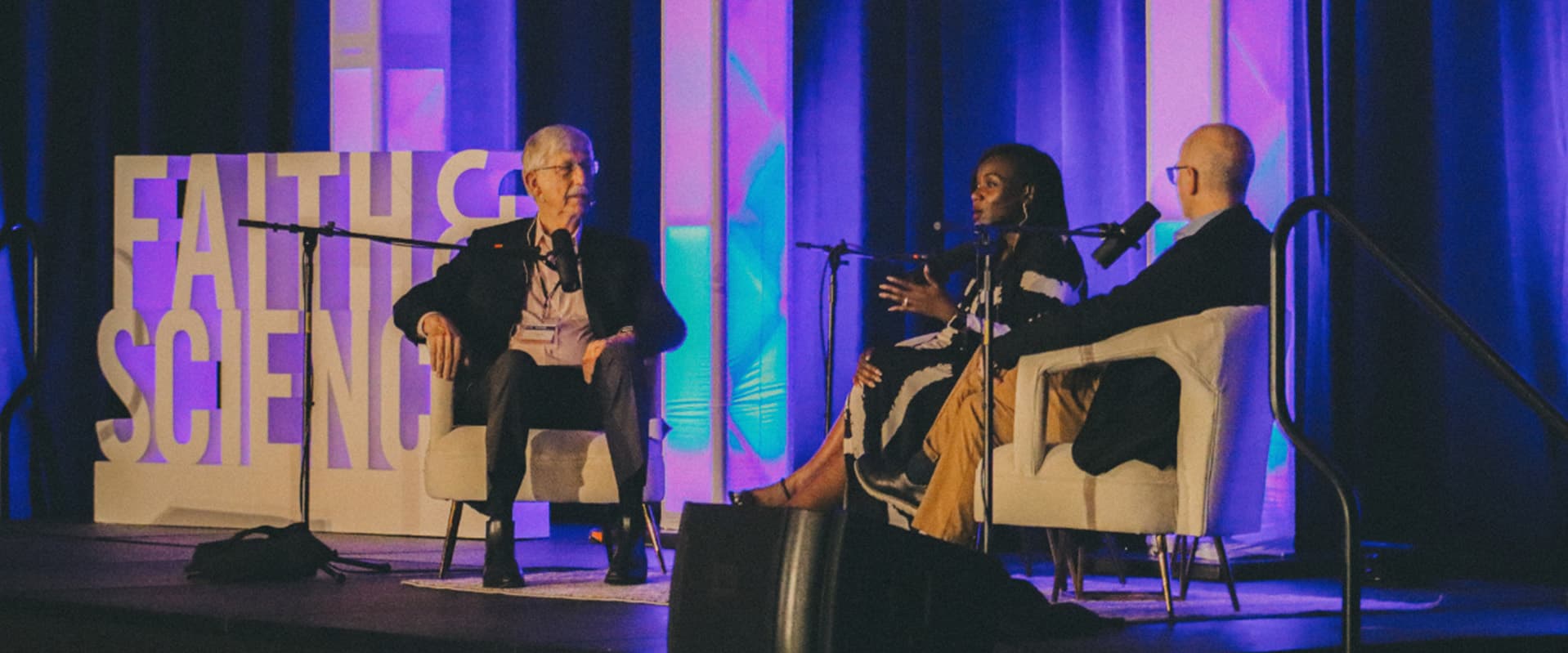
Photo by Kimanzi Shallom
Francis Collins and Kizzmekia Corbett-Helaire share some key moments from behind the scenes of the COVID pandemic and vaccine development.
Description
Francis Collins and Kizzmekia Corbett are both renowned scientists and both of them played special and important roles during the pandemic. The two of them share some of the key moments in the scientific development of the COVID vaccine and talk about the many years of scientific work that prepared the way. They also talk about how their faith plays a role in their motivation for doing science and Kizzmekia talks about what it takes to be a scientist as a woman, a person of color, and a mother.
This conversation was recorded live in Raleigh, North Carolina at our National Faith and Science Conference.
Theme song and credits music by Breakmaster Cylinder. Other music in this episode by Klimenko Music, courtesy of Shutterstock, Inc.
- Originally aired on April 25, 2024
- WithJim Stump
Transcript
Stump:
Welcome to Language of God. I’m your host, Jim Stump. This episode was recorded live in Raleigh, North Carolina at our National Faith and Science Conference. Sitting on stage with Francis Collins and Kizzmekia Corbett, two very distinguished scientists, was pretty special for me. In the episode, they’ll talk about some of the work they did behind the scenes during the pandemic, and even the work that was being done before the pandemic, which led to an incredibly effective and safe vaccine. I think a lot of us still don’t fully appreciate the scientific feat that was accomplished there. I hope it’s now far enough removed from those days of dread and uncertainty to be able to hear some of this with fresh and even curious ears.
We also hear a little bit more about the stories of both Francis and Kizzmekia, including talking a bit about Francis’s recent cancer diagnosis, which he went public with recently. As this episode is released, Francis is preparing for surgery and we pray for his health and for the doctors and nurses that will care for him. With that, let’s get to the conversation live from Raleigh.
[musical transition]
After more than 10 years of working for BioLogos, I’m still sometimes really surprised with the circles that I run in, the conversations that are in my email inbox, and this afternoon, by the people I’m sitting on stage with. I have here the leader of the Human Genome Project and the developer of the COVID mRNA vaccine.
In a little bit, I’m going to say thank you for being here. I don’t want to reduce you to one dimension, but there’s a thank you of a different order of magnitude in order for what you have done. It seems like there should be a different word for this, and I’d like to take the opportunity and the advantage of the fact that in recording this episode, we have a live studio audience. Would you help me in thanking these two for what they have done? Well, I’m not sure how that will translate onto an audio-only podcast episode, but really we’re super honored and thrilled that the two of you would join us here for this. Thank you for being here. [enthusiastic applause]
Kizzmekia Corbett. After a little bit, we’ll talk about the mRNA vaccine for the COVID virus during your time at the NIH. Then, even about what you’re doing now at that little school up north—I think they call it the Duke of the North—and the lab that you have going there. But first, we want to get to know you a little bit as a person. You grew up just up the road from here in Hillsborough, right? Tell us a little bit about that, what your family was like, what kind of kid were you growing up?
Corbett-Helaire:
Well, first of all, it’s a pleasure to be a guest here on the podcast and also here at the BioLogos Conference. It’s always an honor to be able to be invited to come home because you’re right, I grew up in Hillsborough, North Carolina. I am one of seven children, so I come from a very large southern family. Actually, my family is really unique because all of my siblings, we come from very mixed backgrounds. I have adopted siblings, foster siblings, a cousin who became a sister because her mom unfortunately passed away. But I like to think of my parents as, if you needed a home, they provided it. So, I picked up siblings along the way. Today we’re all adults and we still love each other and we still get back with each other back in Hillsborough all the time.
How was I as a kid? Oh, my. I’ve never gotten that question. I was a nerd. Then, when I was growing up in the ’90s, I guess it was not always easy to say that, but now after having accomplished what I have, I can proudly say I was a nerd and I’m very—
Collins:
It’s cool now.
Corbett-Helaire:
It’s so cool to be a nerd now.
Stump:
Own it. Own it. How do you think your interest in science got going? Tell us a little bit about that.
Corbett-Helaire:
My interest in science got going… Okay. I should say I was more interested in shoes. I say that and it’s funny, but really the way that I got interested in science is because I wanted a particular pair of shoes for back to school. My parents were like, “There’s no way we’re spending that much money on a pair of shoes. You got to get a job.” My mom said, “Well, you have to get a job that’s educational.” So, I found a job in a science lab at the University of North Carolina in Chapel Hill, and my life was changed forever.
Collins:
Did you get the shoes?
Corbett-Helaire:
I got the knockoff of the shoes because I still couldn’t afford the real ones.
Collins:
UNC doesn’t pay that well, yeah. [laughter]
Corbett-Helaire:
But you know what? I think that the company should send me those actually now. I told that story several times. I think I deserve a free pair. But the thing is that, I was 16 and like I said, I was “a nerd”, so I knew that I liked science from a classroom perspective. I like learning about science and biology and anatomy and all of these things that we learned about in high school. But it escaped me being from the school system that I was from in Orange County, that for every little fact in those textbooks, someone had to discover that. And so, I went to this lab this one summer in, I think, 2002, and realized that there were people working to discover these little facts day in and day out.
You got to really, every single day, learn something different about how the world works. It was so eye-opening and so cool to me, and I decided then that I wanted to do that for the rest of my life.
Stump:
Nice. Maybe give us a little bit of a flavor of the faith background that you came from as well, your church?
Corbett-Helaire:
Yeah. My home church, I should say, is Hester’s Grove Baptist Church in Hurdle Mills, North Carolina. It is two houses, so to speak, down from my grandmother’s house. The entire church is related to me. I think the membership probably is like a hundred people. The way that I grew up in church was thinking about church as extended family. I went to church with my family on Sundays and then after that, we had supper at my grandmother’s house. Everything I learned about God and how I grew my relationship with God was through the love of family. I think that really underpins the way that I think about my faith now.
I think about faith overarchingly, as this huge bubble of love and how can I extend that to everyone in this very familiar way. But, yeah, that was the church that I grew up in. Since then, I’ve obviously moved from North Carolina, so I haven’t found my home church in Boston just yet, but I still tend to lean towards those pretty small family-oriented churches.
Stump:
Nice. Well, Francis, we’ve heard your story a few times here.
Collins:
Probably, yes, at least a thousand times.
Stump:
Your life has taken a little different turn here lately though, and you’ve been very public about your prostate cancer diagnosis and treatment that’s coming up. Here at the conference we’ve heard about that but maybe for the sake of the podcast audience, could you share just a little bit of what that diagnosis has been and why you’ve decided to be so public about this?
Collins:
Well, I actually feel a lot of gratitude for the opportunity to learn about this. Prostate cancer, obviously, a pretty serious condition. It’s the second most common cause of cancer deaths in men. But our ability to detect it early while it’s still curable, has gotten a whole lot better with various screening tests. But frankly, a lot of men are squeamish about this. Men don’t want to talk about their prostates for some reason. And so, a lot of the screening opportunities go unused and particularly so during COVID where so much of the general attention towards regular caring for yourself, whether it was mammograms or colonoscopies or PSA tests for prostate slipped away.
I’ve actually been followed for this cancer for five years, but it was behaving like a very slow, indolent, nothing to see here, nothing to get excited about. Then, it changed about a month, six weeks ago, and now it looks much more aggressive and it’s time to take action, but it still seems to be completely limited to the prostate. It hasn’t spread elsewhere. A week from today, I will be going through that surgical procedure. I was trying to come up with an analogy: the horse hasn’t left the barn, the horse being the cancer, but I think just to be sure, we’re going to get rid of the horse and the barn. I will be minus a barn by a week from tonight. [laugher and applause from live audience]
Corbett-Helaire:
I think you can only say that kind of analogy in North Carolina. That doesn’t work in D.C.
Collins:
Or Boston, probably.
Corbett-Helaire:
Probably not.
Collins:
No, probably not. Well, okay. I grew up on a farm. I’m owning this analogy right now. I feel very much blessed by all the people that have responded since I wrote an essay about this and put it up on the internet and published it in the Washington Post. All kinds of people, including you two, wrote me wonderful notes. The other thing that has really touched me is how many people that I’ve known, some of them for 10 or 20 years, not only have responded but have done so very personally and have used the ‘L word’, love, in ways that we often don’t in our everyday correspondence with each other. We might say, I’m thinking about you, I’m caring about you. People are saying, I love you. That’s really awesome, and I’m saying it back to all of you.
Stump:
Well, thanks, Francis.
Corbett-Helaire:
You know what’s really odd about… Here, we can talk about this. I love this, right? I’m usually at science conferences where I can’t say God, but I can say God here, it’s great.
Collins:
Every sentence would be fine.
Corbett-Helaire:
God’s timing, right? I was actually at a meeting with one of your former trainees, I think, man, he founded africanancestry.com.
Collins:
Let’s see, African…
Corbett-Helaire:
Kettle?
Collins:
Rick Kittles?
Corbett-Helaire:
Kittles. Yes. Yes. Yes.
Collins:
Rick Kittles, of course.
Corbett-Helaire:
I was talking to him about Dr. Collins, who likes me to call him Francis, even though it’s very hard for me as a southern belle.
Collins:
Keep working on it.
Corbett-Helaire:
I get this bing to my text message with the essay that he’d written from the Washington Post. I read it and I read it again, and it was just so beautifully written. But you know what was interesting is because I met Dr. Collins when I was only 19. He probably doesn’t remember this, but this was around the beginning of the Human Genome. He was like a celebrity scientist at that point. He still is, but really at that point, he was like a celebrity scientist and I was coming out of high school working at the NIH. I remember him, number one, giving us his book, and I remember him just talking about his faith throughout this talk that he gave to these high school students from North Carolina.
We talk about science and we talk about the business of NIH, but we’d always end on a note about God or something super-churchy and whatever. When I sent the message to you after your essay, it was so refreshing, and not to take the spotlight away from that moment for you, but for me as a scientist who had trained at the NIH, it was so refreshing to be able to say, “I’m praying for you”, which you say all the time, and you really mean it as a Christian. This is a staple in the way that we live, asking God and thanking God via prayer is something that we do. But to be able to say that to a fellow scientist, and not only that, but Dr. Collins kind of scientist was so refreshing.
To me, it’s just a reminder, after writing that, to not have to delete that word or not have to mince words. A reminder of just how really faith and science come together in this very weird and odd way.
Collins:
That was sweet. The other part of that message that you put there, which also touched me a lot is, you did say, “Now you need to be absolutely sure you’re ready for this and take care of yourself.” You said, “Sometimes the mentee has to become the mentor. So, Francis, take care of yourself.”
Stump:
Maybe you should start calling her Dr. Corbett. Well, we had planned this interview before you had decided to come public on this, but I think this transitions pretty well talking about public health and into the main event here that we want to talk about. I hope it doesn’t invoke too much PTSD in the two of you, and I mean that literally, in talking about this COVID virus and where it came from and what you did with it. I’m going to try to just fade out of this conversation here and just let the rest of us eavesdrop on the two of you talking about this. I’ll lob a few questions out there to get you started, but would just really love to hear the two of you talking about this experience and what it was like.
How did you first hear about this? Where were you when you heard about this? What’s the playbook for how this happens and how Kizzmekia got involved with this, Francis? But then, just walk us through some of the background of that and then the process of what those early days were like and how it unfolded and how we got to the point we are now.
Collins:
I think you’re really unleashing the nerds now. You may regret this, but let’s go there.
Stump:
Let’s hear it. We want to hear it all.
Collins:
But, maybe, Kizzmekia, you should first say what were you doing that actually put you in a remarkable position in January 2020 to lead the effort that was going to save at least 3 million lives in the US alone? Because you didn’t come out of nowhere. You had this platform, this science that you were already doing, that, by God’s grace and a lot of smart people’s planning, turned out to be just critical. Yeah, back up a little bit from January 2020. Set the stage.
Corbett-Helaire:
Well, how far do I go? That’s the thing. Whenever I’m asked this question, I’m always thinking about how science and knowledge and all of the things that eventually become what your purpose is in science, they start… You never know when the beginning really is. But I will say when I heard about, we didn’t know that it was a coronavirus at the time, but when I heard about this mysterious virus that was circulating in China causing some respiratory illness and couple of deaths, I was actually on holiday, Christmas break, and I was sitting on my mom’s couch in Hillsborough, North Carolina. I got this email at 6:00 AM in the morning to let me know about this. The email was from my former boss, Dr. Barney Graham. He said, “Get ready for 2020.”
To me, what that signified was that, well, I worked at this institute called the Vaccine Research Center at the NIH, and generally, if there was an outbreak in something, the VRC or the Vaccine Research Center would have to respond. There were two vaccines that I was working on at the time. I was working on flu and I was working on a coronavirus. The thought was that it was going to be one of those, which are both respiratory viruses. What I had been doing at the Vaccine Research Center for what was then five years prior to that time when we heard about this mysterious virus in China, was really, really, really basic research on understanding coronavirus as a viral family.
In the same way that you have a sister and a brother and some cousins and aunts and uncles, viruses can be thought of in the same way. There’s a cousin to the coronavirus that causes COVID-19 called MERS that started to circulate right when I got my PhD in around 2013 and 2014. Because it was circulating and because we’d also seen another coronavirus previous to that about a decade earlier, it became pretty clear to most of us who weren’t in denial that at some point, a coronavirus could probably cause a pandemic. Because of that, we needed to study the viral family to some extent. My interests are understanding how the immune system sees viruses.
I’m trying to understand how when you get infected with something, how your immune cells see that virus and how it learns that virus and makes memory to that virus. This type of knowledge can help to inform how we can trick, so-called, or teach the immune system to do that without seeing the virus at all by way of vaccines. I did that for five years for the coronavirus family. I learned a lot about how the immune system learned or saw these viruses or particularly really the proteins on the top of the virus. When it became time to go into action, so to speak, to make a vaccine, we basically had a recipe.
Because for the past five years we’d been studying its cousin, we knew a lot about the protein that the immune system responded really well to make a good immune response.
Collins:
That’s spike protein.
Corbett-Helaire:
It’s called a spike protein. Because of that, we were able to look at when the sequence of the virus came out in January 2020, we were able to look at that sequence and basically make the right type of spike protein and make a vaccine.
Collins:
Where did the mRNA idea fit into this? Because that was a pretty critical event.
Corbett-Helaire:
Yeah, so the mRNA idea fit into this because there are several different ways that you can make vaccines. One of the most classic ways of making a vaccine is to make a virus that is not able to infect as well. This is generally called a live attenuated virus or vaccine, but that’s kind of old school. You don’t really have to take those kinds of approaches any more because of the type of technologies that we have. Another way that we have thought to make and have been making vaccines more recently is to, instead of giving you the whole virus, to just give you a piece of the virus, particularly the protein that’s most necessary for your immune response to make antibodies or T-cell responses to that virus.
In the case of coronavirus, that would be the spike protein. The problem with that kind of method, although it works well and probably would work very well for coronaviruses as well, is that you have to make a lot of protein in a factory somewhere and that takes a lot of time and a lot of optimization to get it right.
Collins:
Yeah, that’s the Novavax vaccine that’s finally out there now, but it sure wasn’t out there for a while.
Corbett-Helaire:
Right. Really the way that mRNA comes into play is that if you’re in a pandemic or you think you’re about to be in a pandemic, which was what we thought in January 2020, you need to be able to make a vaccine that is reliable and easily manufacturable. The mRNA technology basically allowed for us to, instead of making that spike protein, to basically put the code for that spike protein into a messenger RNA, and instead of having to have huge factories all over the world to make the protein, your body becomes a factory. What you get when you get an mRNA vaccine is a sequence or a message to tell your cells to make the spike protein, and then the spike protein is recognized by your immune system.
All of that type of technology had been in development for a couple of decades to that point, in various different ways. Actually, the company that we most closely worked with, Moderna, was really thinking about it mostly in the context of cancer therapeutics, which they’re still doing a large amount of. You could think about mRNA technology is for many things, but for us, it made a lot of sense to do an mRNA vaccine, particularly because we wanted to move fairly quickly.
Collins:
That’s really, I think, helpful background for everybody who’s maybe still not completely clear about why that technology was chosen. The cycle time was just really rapid. You could do this in a hurry and you didn’t even have to have the virus growing in the lab. You just need to know over the internet, the sequence of the virus’s genome. But let’s go back to the dramatic scene here. Let’s do the Discovery Channel version of this. Scene one, Kizzmekia sitting on the couch in Hillsborough getting this note at 6:00 A.M. saying, “Get ready for 2020.” Scene two is when you find out it really is a coronavirus. Scene three, is when the actual letters of the code appear on the internet. Walk us through what you were doing on those days.
Corbett-Helaire:
Oh, man. Okay. I actually don’t remember what I was doing. Between scene one, when I was sitting on the couch, I immediately got into my car and drove back to D.C.
Collins:
Bye, family. I’m out of here.
Corbett-Helaire:
Yeah, I got things to do.
Collins:
Have your own New Year’s party, I won’t be there.
Corbett-Helaire:
Then, we started to plan. When we found out it was a coronavirus, we sort of had a plan in action around what we would do for scene three, which is when the sequence came out. I believe the sequence came out on January 10th.
Collins:
That’s my recollection.
Corbett-Helaire:
It was a Saturday morning and I was in bed, but I had all of my alerts set up around this virus on my phone. My phone was constantly pinging. But Twitter was afire. This was back when Twitter was good. Twitter was afire. We recognized that the sequence was out. Immediately, we go to the lab, we download the sequence, and we send the sequence off to Moderna. It literally is that easy.
Collins:
You designed the virus vaccine in 24 hours.
Corbett-Helaire:
We told President Biden, over the weekend, we can stick with that. It really was probably more like 20 minutes once you really think about it. But over the weekend sounds good.
Collins:
But there was a lot of science in there also that was based on what you’d done previously with MERS and SARS and known about the spike protein and which part of it was most likely to be something the immune system would respond to. Anybody else just looking at the sequence of the spike protein wouldn’t have quite known exactly what to do. But you and Barney and the team there at the VRC, you were on it.
Corbett-Helaire:
Yeah, and our collaborators, right? We knew exactly what we wanted to do. I used to get a lot of flak, so to speak, when I would speak about the process as it was happening. I was so confident, I was so, so confident. I had lab notebooks full of data that suggested that what we were doing was the right thing. Also, my faith, which is completely a whole ‘nother level of confidence. But lab notebooks full of data that suggested we were doing the right thing. Because we’d been planning, so to speak, for this moment for the last five years, not that we wanted it to happen, but the part about preparedness is that you don’t have to get ready when it’s time.
We’d also, for the past 10 days, since the top of January in 2020, been thinking about, if this is a coronavirus, this is the drill. Essentially, what was happening after that we got that sequence was, we were running a drill. This is going to sound a little bit ridiculous now, given the times and retrospectively, but we weren’t trying to do anything in that moment other than prove to ourselves that we could do it because we prepared for so long and now, really, the universe was giving us this opportunity to prove ourselves. We didn’t know that we were going to have this global massive pandemic. Millions of people would die. We didn’t know any of these things.
All we knew is that we had this outbreak in China. Let’s pretend like it’s going to be a pandemic and make a vaccine go into human trial within a hundred days. All of that, what was happening in those very early days in January and February was around proving that we could do it based on the knowledge that we had.
Collins:
It’s like a drill, but the drill might need to be real.
Corbett-Helaire:
Oh, gosh. When it became real, it became real.
Collins:
Yeah. There was another important part of this that I think I’m going to have to make a little point here about basic science, that the very hard work that had been done over a couple of decades to prepare for this, all the work that went into developing the mRNA approach for vaccines, this thing that Barney Graham had worked out where, if you were going to make a vaccine that had part of the protein sequence of the spike protein and you made it exactly the way you read it on the computer printout, it would be okay. But if you actually changed two of those amino acids, stuck in a couple of prolines, you would cause that particular protein to fold up in a way that made it even better.
That trick, which ultimately, Pfizer also adopted when they were building their vaccine, I would guess, is part of the reason this ended up being such an incredibly effective vaccine. That was a basic science derived insight that made all the difference. Kizzmekia, in how you’ve done the design, the design has gone off to Moderna, but your work is not done, it’s just getting started. What was your next responsibility here? Well, you just said a hundred days to go into a human trial. That’s unprecedented. For a vaccine, that’s usually years. How are you going to do that?
Corbett-Helaire:
The one thing that became very clear is that the small team that I’d been working with for the past five years which, at best, got to seven people, but then I think was more like four, needed to expand. The entire hundred or so people in the Vaccine Research Center was all hands on deck, call to action. Our entire job was to make sure that the vaccine, or not make sure, but to test whether or not the vaccine worked in mice. That sounds very trivial, but over the course of the next several months, we immunized up to, I think, about 540 mice or something like that with different variations, different doses and different ways to understand how this vaccine would work in order to inform the clinical trial.
That was the beginning of a lot of work. We did a lot of other things, too, that are not always talked about.
Stump:
Let’s hear it.
Collins:
No one’s listening, go ahead tell us.
Corbett-Helaire:
At the same time that the vaccine was being made, I don’t know if you remember this, but Eli Lilly had some antibody therapies that came out. Those were also our inventions. At the same time that we were working on the vaccine, that spike protein that we keep talking about, we were using that spike protein to fish out really good antibodies from people who had gotten infected with the coronavirus. So, we got samples, I don’t think I can say from where, but from a particular hospital in the United States that had some coronavirus infections, and we were able to fish out antibodies and then use those antibodies as therapies.
We were having this vaccine run to glory in a hundred days and then we were also having this antibody development race at the same time with two separate company collaborations. And so, it was quite an experience.
Collins:
Yeah. Those are the so-called monoclonal antibodies, which actually were about the only therapeutic we had for people who got really sick for a long time.
Stump:
Can I ask you a little bit more about the mice? Not being in this field, so I assume you’ve got some live COVID-19 virus somewhere that you’re infecting mice with, giving them your vaccine. How effective was it? What were the results of the trial with mice?
Corbett-Helaire:
Whew. We did not have live coronavirus at the NIH because those types of live viruses have to be in very high containment. And so, we worked with a collaborator at the University of North Carolina, Chapel Hill, Ralph Baric, in order to test whether the vaccine worked to protect mice against coronavirus. Let’s see. I remember down to… Okay, so each of you, when you got your Moderna vaccine, for example, you got 100 micrograms. That’s a fairly modest dose of vaccine. We could protect a mouse, I believe, down to point… so that’s 0.1 micrograms. So, it was a sign to us that the vaccine was really good.
Stump:
You’re going to have to explain a little bit more here. You didn’t have the live virus to test this against, so how do you know if it’s actually working against that? Do you have a model of the virus? How does that work?
Corbett-Helaire:
Yeah, so we did actually, with Ralph Baric’s lab at UNC.
Stump:
Oh, you did.
Corbett-Helaire:
Right.
Stump:
So, not at the NIH?
Corbett-Helaire:
Yeah, yeah. We did it with our collaborators where we would send them the vaccine, they would vaccinate the mice, and then a month later or so, they would give the mice the live virus into their nose.
Stump:
Got you. Okay, so where are we in the timeline here now?
Collins:
Just to be clear, you could still vaccinate mice in your facility and see if they raised antibodies against the spike protein. That doesn’t require you to have a live virus. It tells you the immune system saw that particular vaccine and raised an appropriate response, which you would predict would be protective, but you got to have Ralph to help you make sure that it really was.
Corbett-Helaire:
Yes. These antibodies that you make, a mouse makes, anything, any animal would make to a vaccine, you can test these antibodies just by taking the blood and looking at the level of antibodies in that blood in most any lab. We did that very early on in the process. Even after two weeks after we gave one dose of the vaccine, we could see, at the NIH, that there was going to be an antibody response.
Collins:
Yeah. You could also make sure the mice didn’t all keel over like there was something toxic in the vaccine. I’m sure you were paying attention to that, too.
Corbett-Helaire:
That would be bad.
Stump:
How predictive is the success in mice though, in translating to success in humans?
Corbett-Helaire:
Oh, let me just tell you something. Last night when I got here, this is bad, I’m a procrastinator, but I had a grant due at midnight and one of the reviewers asked the same question.
Stump:
I can’t reveal my sources.
Corbett-Helaire:
Oh, my gosh. Actually, very predictive. Not down to the number, right? I can’t say that if I have a, they’re called titers. If I have a titer of 1000 in mice, it’s going to protect. But what I can say is that a high level of antibody is indicative of protection in humans. We know this because over time, since that moment, we’ve done what are called correlate of protection. These are studies where people will look at who’s protected versus who’s not protected and look at the differences in their immune responses. One of the key indicators of someone who is protected after getting a vaccine is the high level of antibodies that they have.
[musical transition]
Midroll Break
Stump:
Talk a little bit, Francis, about the public perception of all of this at that time. We’re still here fairly early in 2020 and hoping for a vaccine, wondering how bad this is going to get. My memory of this time, which I’ve learned not to trust quite as much anymore, but my memory of this time was, we didn’t know in the public that they just tested 500 mice and this looks fantastic, we’re going to be in great shape. It was a lot more fearful and unknown. Tell us a little bit about what you knew in all of this and the challenge of communicating accurately to the public of what we needed to know.
Collins:
Well, I guess everybody in the room probably thinks back on that and has a little bit of a jolt of PTSD because this was a really brutal time for our planet and certainly for our country. The spring and summer and fall of 2020 was so full of so many horrible, devastating outcomes. With this particular virus, although we were so fortunate that it was a virus in this family where a fair amount was known, there was still a lot that wasn’t known. We didn’t really know whether this was a virus that could be rapidly transmitted from person to person, even by people who weren’t sick, and that was a big issue. We weren’t actually getting as much information from China as we probably would’ve benefited from.
There was a big debate about it. There were certainly people saying, “Oh, this is just going to blow over.” Only the first case appeared in January, and it wasn’t really, I think, until late February that somebody at the CDC basically said, “It isn’t a matter of if, it’s a matter of when this virus hits the United States.” I think by then it was starting to hit Italy and not long after that, the UK. You could really get the sense that, oh, this is really the big one that we had hoped was not going to happen, that we haven’t seen for a century, and here it comes. But did anybody really know what was going on in the Vaccine Research Center in terms of developing this?
Only that, yeah, there were statements that the NIH and the companies are working on a vaccine, but most of the statements that were made, many of them by Tony Fauci, who was often pushed into making promises that this will be here right away was like, whoa, wait a minute. You got to think about what the steps are here and recognize that the earliest we’ve ever been able to generate a vaccine that was shown to be safe and effective is about five years. We’re going to really put the accelerator down here and do as well as we can, but nobody should count on having this in less than a year, despite some other statements that were made by high-ranking people. That was the scientific fact of it.
Meanwhile, of course, for me as the NIH director, working intensively in the middle of all this with the people at the VRC, with Kizzmekia, with Barney Graham, with Tony Fauci, and with the companies, especially Moderna, we were trying to anticipate what would be the next step if everything went right, not knowing whether it was going to go right. This is about the point where the idea of Operation Warp Speed began to be discussed where, if it actually is possible for this to work. You don’t want to have a single day go by where you wasted time. You might even want to have a plan of manufacturing very large numbers of doses of a vaccine even before you’re quite sure whether it’s going to work and you might have to throw them all out.
But you don’t want to have a long gap there while you scale up your manufacturing. All that was going on in… I think we were all working 100-hour weeks. I bet you were working more than that, just trying to put this together. It was both incredibly exhausting, but it was also inspiring to see the way in which scientists in the public sector, the private sector, the government, the FDA, everybody basically saying, “I don’t care who gets the credit. People are dying. We have got to make this work.” But you must have been feeling, Kizzmekia, a lot of pressure from people saying, “Well, what’s the answer? What’s the answer?” Because nobody was going to volunteer.
It was time to start a human clinical trial, until the animal data was there to show that it looks like this is promising. Yeah, how many calls a day were you getting from people like Tony saying, “Okay, do you have an answer yet?”
Corbett-Helaire:
The truth of the matter is, I think we put more pressure on ourselves than the outside ever could. I have never seen so many people huddle around to watch a plate change colors. That’s how you can tell how much antibody is in a blood. This plate changes color from yellow to blue, and you can just see it. I’ve never seen such a huge group of people huddle around to see how much antibodies these mice were making. Every single thing that we did during that time, we were all like, what’s happening? What’s happening? Is it good? Is it bad? What’s happening? I think for me, the first time that I made any public statement around the vaccine was not until April.
That’s probably not until NIH decided it was clear for me to say anything. We were comfortable, the human trial had started, all of these things, and I remember being so taken aback as we think about the public’s response. I remember being so taken aback and even embarrassed, not because my appearance in CNN wasn’t great, it was great, but because people had no idea that any of this work existed before the pandemic. People had no idea that Katalin Kariko and Drew Weissman, who just won a Nobel Prize for mRNA technology, were working on mRNA technology for decades. When we say the letters mRNA, it’s like, what’s that? Is this a new thing? Are you giving us some genetic DNA blah, blah, blah?
Or, when we say we’ve been working on coronaviruses since, at least since 2013, but even prior to that. “Oh, you knew the coronavirus was coming?” The most embarrassing part about this entire story to me is that despite all of the triumph that came from the science and all of the things that we get really excited about as scientists, seeing a plate change color right before our eyes with antibodies, we had not done the best job of making sure that the public was aware of the science to come. One of the things that I think about in this time right now as we… The thing that people hear about from a science perspective a lot, day in and day out, is AI.
Sure, we can get a little caught up in the hoopla of AI. I can be one of the first to admit that. But the one really, really exciting thing for me is that it opens the doors in a way that we haven’t seen before to talk about what is to come. Because people are intrigued about, so-called AI, I can talk about the way that we can transform vaccine technology and people will be excited about it and hear it, or it actually could be a slot on ABC as opposed to previously when no one cared about what was to come, it was only when we were in a dire need for something that we were able to vocalize medical technology in that way.
The other thing that I’ve come out of the moment, out of the 100-hour work weeks and really realized about the public response is that a lot of it was fair. Could you imagine? Well, many of us are scientists here, but being lay, being someone who’s not a scientist and you… First of all, you’re waking up top of January after you’re about to renew, refresh, got your New Year’s resolutions going, hit the gym, eat right, all these things, and darn, there’s a virus in China that no one has ever seen before. We don’t even have a name for it yet. Then, when it does get a name, it’s called novel coronavirus, which was like, wow, we even named it that?
So now it’s called novel coronavirus, and then about a month later, the NIH, which happens to be the government, we can’t forget that, even though I love the NIH, happens to say, “Oh, we’re making a vaccine with this company, Moderna, and it’s an mRNA vaccine.” It’s so much new news that people are getting constantly day in and day out. Earlier, we were talking about skepticism of science, and the one thing that’s humbling as a scientist who engages in science communication quite often is that a lot of the skepticism is earned because we aren’t always doing the best job of communicating things in real-time like we should so, yeah.
Collins:
Yeah, I totally agree with what you’re saying. That’s one of the important lessons, I think, from this really painful experience, especially when it led to a lot of people deciding not to trust the vaccine. Kizzmekia, you and I, I think have this particular heartbroken feeling about that after all of the science that went into that and all the data that supported the safety and the efficacy, that 50 million Americans basically said, “No thanks.” The best estimate is that something like 230,000 people died of COVID-19 because of that resistance to embracing what could have been life-saving. That’s just a horrendous number to think about.
You got involved, I think, a lot as it was becoming more and more clear that there was a significant distrust of the vaccine out there and put yourself out there in every possible venue to try to explain, as somebody who had worked on it, why people should have a greater sense of trust in what was behind this. What was that experience like? Because I know you were doing a lot of this and it probably wasn’t always being received with warm applause.
Corbett-Helaire:
What was that experience like? I felt like I was doing the science by day, and then I was teaching the science at night, and not like how I would teach a class at Harvard now, for example, but teaching it to people who were just like my aunts, uncles, neighbors, the community really. The one thing that it was, is it was exhausting, not sustainable to every single day. I was joining mega church Bible studies. This town hall or that town hall for congresswoman/man X, Y, and Z. I was doing a lot of that type of outreach. The one thing that is very clear from all of that bundled together, the major lesson is that most people just needed to hear from the source.
Not in the way that we have thought about being the source in science. I was so proud, I had all of these publications, but no one in the public cared because I hadn’t talked to them particularly about what was going on. A lot of people just wanted to hear from the source. The other thing that became very clear is that a lot of people’s, even if they didn’t necessarily get the answer that they were looking for around their question, they wanted to have the opportunity to just ask it. So, opening up the lines of communication, not for me to talk to them, but really also to listen was very important as well.
Collins:
There’s a lot of lessons that I think we should be reflecting on that experience because, folks, this is not the last pandemic.
Kizmekia Corbett:
Oh, gosh.
Collins:
I’m sorry if that’s news to you, but I think we can all basically expect that some time in the next 10, 20 years, we’re going to have something. Maybe it’ll be influenza the next time, the other thing that you were ready for but didn’t have to deal with this time. But if you had to make a bet, I guess influenza would probably be at the top of the list for most people. We’re overdue for one of those. That’s really awful and it spreads really rapidly, and that also infects very seriously very young people. Here we are at a point where, because of the aftermath of all of the experience that people have with COVID-19, the trust in science, or at least in scientists, has taken a downward slide just at the point where science probably did one of the most amazing things that has happened in the course of humanity, coming up with something that saved about 3.2 million lives in the US alone.
Yet, coming to that next pandemic, I fear we’ll be in even more trouble with people’s willingness to believe what they’re being told. I fear that our science communication effort hasn’t fully embraced the lessons there. We may end up with a similar circumstance where the information people are getting doesn’t sound like it’s reliable, doesn’t sound like it’s coming from the source. It sounds like it’s coming from a talking head somewhere on some TV screen. It seems to me, I’m curious to know if you’d agree, that what we need to do is to get science communication much more distributed so that it is not coming from a few sources that look like they might be government people from CDC or NIH, but actually somebody in your own community.
I have this dream—I’ll try my dream out on you—that we would find somebody who had a deep pocket, it shouldn’t be the government, to support a science communication corps. We would enlist all of the science majors in colleges and universities and community colleges and all of the high school science teachers and all the members of any science organization that supports science, and we would give them the kind of support they need to be well-informed, some training about how to do this effectively, have materials that are already vetted and you know are going to be effective in conveying information. When something needs to be distributed, unleash the corps.
Then, it comes at you from your neighbors, or at least people that you can relate to in a certain way instead of something that feels like maybe it’s not got your best interest at heart. What do you think?
Corbett-Helaire:
I think that’s a great… Who has the pockets? I don’t know.
Collins:
Yeah. I think I asked if there are any billionaires in the room, and I didn’t get any answers so far, but maybe you’re just sitting on your hand, so talk to me later.
Stump:
We should take an offering at least. Let me pull you back to, I’m not sure which scene we’re in now in your Discovery Channel version of this story, but we’ve gone through the mice, we’re into human trials. Francis, I’ve heard you tell this story several times then, of hoping and praying that this virus would turn out to be, I don’t know, maybe 50 or 60% effective. When it turned about to be so much higher, it was this really profound moment. Kizzmekia, it sounded like that’s what you thought was going to happen all the way along? Talk a little bit about your experience then when these double-blind trials were finally unveiled and we found what these numbers were. Where were you when that happened and you heard the results?
Corbett-Helaire:
Oh, I was home. I think I heard about Pfizer’s results came out first.
Stump:
Yes, a week ahead.
Corbett-Helaire:
I heard about them. I can’t remember if it was the night before or the day before the public but still… You know what happened is, number one, it’s beyond anyone’s wildest dreams that you would have something that would be 94% effective against disease. It’s like almost unheard of for vaccine. So, I was very happy about the percentage of efficacy, but for me, I felt such relief. I think a lot of us during that, over the course of that year, we were holding in so much grief. For me, having to see the numbers, I think at one point in the United States, we had a thousand people dying every two minutes. It was becoming crazy. Having to watch the numbers and then to be isolated in the way that we were was also something that…
We grieve really what was the loss and separation of our family and our friends. I cried. When I look at the videos, I’m like, was I crying because the vaccine worked or was I crying for all the tears I couldn’t cry because I was so hard at work over that time? The first thing that I wanted to make sure was relayed, I guess, to the general public around the vaccine, especially because at that point, we didn’t necessarily have enough vaccine to go around. There was a reason for the system that was at play. Now we’d been working to communicate, you should get this vaccine, this vaccine’s going to be great. For the people that we had on board like, yay, they’re ready to get the vaccine.
But there was a line and so, we stripped away a little bit of trust in that moment because people had to wait and they’re wondering, why did I have to wait? At each turn, no matter what the data was or whatever was happening with the science, the communication was different.
Collins:
Yeah, and that was a serious issue. Even with the efforts through Operation Warp Speed to do this at-risk manufacturing, the number of doses, once you knew how good this was, was far short of what it would need. It was really not until May or June of 2021 that there was enough doses for anybody who wanted one, and that was a tough period as well for people who were waiting. Yeah, I also cried the night that the results, the double-blind trial were unblinded because it was so much better than I thought possible. I don’t know about you, Kizzmekia, that was a year of a lot of prayer and a specific prayer for something that would turn out to be protective against all the lives that were being lost.
Most of what I was doing that whole year, sitting at my small desk in my home office, taped up next to me, Scripture verses that I had to rotate through when it was looking like things weren’t going very well. There was always Psalm 46, I never took that one down. God is our refuge and strength and ever-present help in trouble. Boy, were we in trouble that year. Yet, God was our refuge and strength. I certainly felt that on those dark days. Then, to have the prayers answered this way seemed like both a scientific triumph, but also a sense of incredible spiritual gratitude. I don’t know how that was playing out in your life, trying to be a 20-hour a week scientist and also a person of faith, and just putting that all together. That really becomes about the most intense experience I’ve had.
Corbett-Helaire:
Yeah. For me, it was an extremely intense experience. Actually, I reconnected with church in a different way during the pandemic. One of the reasons was because the church was one of the few places that invited me to speak. Actually, my first conversation or talk, so to speak, about COVID-19 was at, I forget the Baptist Church in Rockville, early on, like March of 2020, very early on in the pandemic. I got so many invitations from churches during that time. I’d been in this space where I pray, I always prayed, but if I missed church on Sundays, it’s fine. I would go to lab and I’d have an excuse. For me, over the course of… as I was going into an adult, it’s fine.
But the pandemic and the reminder that, almost like the church had my back, was a reminder that maybe it’s not fine. Maybe I still owe my Sunday mornings to the church in a way. I don’t know if it’s Discovery Channel, but there is a particular documentary where the film crew was coming, they were coming and they were setting up, and I was watching church virtually. I had my family on the iPad Zoom, and I had the church up on the screen and I was like, okay, you’ll just have to watch this while I… They aired it and everyone was so surprised like, what? This coronavirus vaccine girl watch church?
Collins:
That’s great.
Corbett-Helaire:
The moment of those results was… Prayers answered is just the beginning of the feeling of how we felt. We talk about the next pandemic, which will undoubtedly happen. This is how the world turns. This is what viruses do. It is actually a virus’s job to… if it’s hanging out in some what we call reservoir or animal somewhere, it is actually in the virus’s best interest to find a new host and to set up shop in that host and to begin to transmit in that host. Sometimes that takes a hundred years. Sometimes that takes 10 years. But the more and more this is happening, the more and more we’re realizing that it’s going to happen. I think about what types of expectations we’ve set in the moment of COVID.
So, in the next pandemic, what are people going to expect from science? The one thing that I think people will expect that may not be the best expectation, quite frankly, is a vaccine will come in a year.
Collins:
Yeah, because it happened once before. “What’s the matter with you?”
Corbett-Helaire:
Because it happened once before. The other thing that people are going to expect is that we are going to be able to teach publicly in the same way that we were before. People might expect, “Oh, the last time there was this girl who came to my church and told us about this. Last time there was this person who got on CNN and did this or that.” Also, that’s not a given. We have to frame our expectations both as scientists, but then also as just people in the community around what to expect around this next pandemic, for sure. He has his money on flu.
Collins:
What’s your money on, Kizzmekia?
Corbett-Helaire:
Well, I don’t have much money, so we start there. If I lose, it’s fine. Whoa, man. I don’t know.
Collins:
I don’t really know either. I’m just guessing.
Corbett-Helaire:
I don’t know. It’s always going to be… Definitely, yeah, flu would be a good bet.
Stump:
Let’s finish and wrap up here in about 10 minutes by transitioning to what you’re doing now. You have opened a lab up at Harvard. Tell us a little bit about how that’s going. But then, I’d really like it if you’d pay some special attention to one of the questions that several people I had talked to before this said, “Oh, make sure you ask her about this.” And that’s, you’re a woman, you’re a person of color, you’re a mother, and you’re opening a lab at Harvard right now. How are you managing that? How do you juggle those things? How can you inspire others to follow in your footsteps of what has not, as of yet, been a real common experience in this high-powered field of medical research like this? Tell us a little bit about what you’re doing and how you’ve navigated all of those things.
Corbett-Helaire:
I’m still working on coronaviruses. My lab, which is now about nine people, which is pretty big, I guess, for lab in its second year. We work largely on coronaviruses. We dabble in other viruses that are really cool as well, that might cause pandemics, by the way.
Collins:
That makes them really cool.
Stump:
They’re cool?
Corbett-Helaire:
Our angle to how we understand coronaviruses is similar to how I spoke about it before. We are always interested in understanding what the immune response sees and how can we make that immune response better. So, now we do that thinking not just about one particular virus, but about different sub-families within that family tree. We don’t just think about the spike protein, but we think about many other proteins that are on the surface of the virus as well. What was the other part?
Stump:
How you’ve navigated?
Corbett-Helaire:
Oh, yeah. I don’t. No, I’m being a little bit facetious but… I transitioned to Harvard from the NIH and started—
Collins:
After turning me down for a wonderful offer to stay, I might point out.
Corbett-Helaire:
I didn’t know that should be public. [laughs]
Stump:
Let’s hear more about that. Let’s turn this into the Maury Povich show. [laughter]
Corbett-Helaire:
Anyway, I went to Harvard from the NIH. You know what advice I got? Actually, this is for anyone who’s made transition jobs one day. The best advice that I think I’ve gotten so far in my career is the best thing you can do is leave a place and have them beg you back. So, NIH can always call me.
Collins:
Okay, next week or…
Corbett-Helaire:
No, no, no. I’m joking. So, I did that. That was 2021. My now-husband, he proposed two weeks after we moved to Boston. Then, I got married last year, and I had a baby last year. My lab officially opened in February of last year because there was lots of renovations. So, 2023 was a time for me.
Stump:
More than 2020?
Corbett-Helaire:
You know what? What made it such a time, and almost… I can be frank here and say nearly unbearable, quite frankly, all that was happening, was the residual effects of 2020. I will tell you this, which is to advice what not to do, is that I took my last meeting from NIH as I was driving in the U-Haul to Boston. I moved into my apartment in Boston, that was a Friday. I started working at Harvard, trying to recruit people, all of these things, on Monday, with no break, forgetting that I had just did this entire pandemic exercise, so to speak. I didn’t rest until my honeymoon, which was in December of last year. I was going full speed from January 2020 until December 2023 without much rest.
The things that come from that are, especially now having a child, is that I’m re-learning what productivity is. The truth of the matter is that if any job consistently requires 80 and 90 hours of you, then that means they probably need to hire two people.
Collins:
Yes.
Corbett-Helaire:
I’m re-learning that what is the maximum productivity of my lab is me working maximum 60 hours. 40 is a little… I chose science, so here we are, but maximum of 60 hours. I’m re-learning. I used to do this thing where I would do the experiment and pack up my laptop and go to my apartment as a single person, eat cheese and crackers for dinner and analyze data all night, send my boss the slide or the graph the next morning. But I’m re-learning that that’s not possible with a child. Science stops at 6:00 P.M. and that’s okay. The data will be there when I analyze it later.
I am also in this space where, when you have your own lab, there are a lot of things that you have to re-learn or just start to learn, begin to learn about the individual needs of different people that you manage. Learning how to manage a family and manage a lab at the same time has been extremely difficult. But I will say, even though sometimes these spaces, oftentimes these spaces are not necessarily built, or usually women are not in these types of positions, I think that the best thing that I bring to my experience as the lead investigator of a lab at Harvard is that I am a woman, is that I carry this level of tenderness, is that I understand the dynamics of different relationships in a way that is just empathetic.
It helps with the management of my lab team, but also it helps with the output of our science. Our science oftentimes has even an empathetic slant to it. I think that there are glass ceilings that I continue to hit because I’m a woman in different spaces that I’ve worked. The one piece of advice that I have is that the best way to break through those glass ceilings is by allowing a taller man to take the hit first. I know that sounds ridiculous, and it sounds like, oh, my God, no. What I mean is, this is like the advocate. This is the mentor. This is the person who says to you, “If you need me throughout your career, I’m a call away.”
We oftentimes will have that person and we’ll kind of shrug it off because you think they’re just saying that in passing. They don’t really mean it. But you’ll get to, I at least have gotten to a point where there’s been a couple of times where I had to make that call and it makes for breaking through the glass ceiling a little bit easier. In the situation where you don’t have that person to call and you feel like you’ve hit this glass ceiling, then you have to ask yourself, “Is it worth you alone changing the system or working within the confines of how the system are to do what is best for you?”
Okay, so one example is that there’s a particular class that I might teach that is later than I would like to teach in a class as I would like to get home. It’s like, is it worth me complaining about this late class or not teaching this class rather than working around how my schedule is, or maybe leaving a little bit later or a little later in the morning? You start to figure out what is your work-life balance. It’s not necessarily easy, and I don’t think that it’s something that any of us really ever figures out, but it’s about boundaries and attaching yourself to a mentor that’s very helpful.
Stump:
Nice.
Corbett-Helaire:
Oh, and saying no. Saying no is… Yeah.
Stump:
Last question. Maybe both of you could answer this, is how can the church better support you? The you there, I mean you particularly as well as you for all of whom you represent as scientists in this field. How can we do, we as people of faith, do a better job in helping and assisting you in what is very directly the healing mission of Christ that you’re involved in, in laboratories?
Collins:
I think the church can help us most by accepting who we are and not asking a scientist because they’re in church, to put that all aside and stop living the full life that they are part of. More than that, maybe to welcome and celebrate the fact that science is after all a gift, that we are talking about God’s world as well as God’s Word, and the scientists may have something really helpful to contribute to those conversations. Some churches do that really well. I’ve talked to people at this meeting who are part of churches where science is just embraced and the scientists feel they can be themselves and they can completely talk about what they’re working on and it’s all good and it’s positive. But it’s not that way everywhere.
Certainly to the degree, that kind of welcoming, loving response to what a scientist is doing, even if it sounds a little bit abstract, gets deep into some details and maybe even sounds like something they’re a little worried about. This is an opportunity for everybody to learn, but not to wall off that part of who that person is.
Corbett-Helaire:
I would say similarly, the biggest thing I think that the church can do for me and the type of work that I do is just aid in the communication. Open the doors to scientists when there is science or health communication that needs to get out. In the same way that you have your church announcements, include those things and helping the members of your congregation prioritize their health in a way that is evidence-driven is really, really, really important.
Collins:
Indeed.
Stump:
Well, audience, we have some marching orders there. Let me encourage you, both of you here in the live audience as well as those listening online to find a scientist and thank them, find a scientist and tell them how much their work is appreciated and valued by all of us. In a least symbolic show of support, would you join me here in thanking Francis and Kizzmekia again?
Corbett-Helaire:
Thanks, Dr. Collins.
Credits
Hoogerwerf:
Language of God is produced by BioLogos. It has been funded in part by the Fetzer Institute. Fetzer supports a movement of organizations who are applying spiritual solutions to society’s toughest problems. Get involved at fetzer.org. And by the John Templeton Foundation, which funds research and catalyzes conversations that inspire people with awe and wonder. BioLogos is also supported by individual donors and listeners like you, who contribute to BioLogos. Language of God is produced and mixed by Colin Hoogerwerf. That’s me. Our theme song is by Breakmaster Cylinder.
BioLogos offices are located in Grand Rapids, Michigan in the Grand River Watershed. If you have questions or want to join in a conversation about this episode, find the link in the show notes for the BioLogos Forum, or visit our website, biologos.org, where you’ll find articles, videos, and other resources on faith and science. Thanks for listening.
Featured guests

Kizzmekia Corbett-Helaire
Dr. Corbett-Helaire uses her viral immunology expertise to propel novel vaccine development for pandemic preparedness, including mRNA-1273, a leading vaccine against SARS-CoV-2. The vaccine concept incorporated in mRNA-1273 was designed by Dr. Corbett-Helaire’s NIH team from viral sequence and rapidly deployed to industry partner, Moderna, Inc., for Phase 1 clinical trial, which unprecedently began only 66 days from viral sequence release. mRNA-1273 was shown to be 94.1% effective in Phase 3 trial and is authorized for use in multiple countries. Alongside mRNA-1273, Dr. Corbett-Helaire boasts a patent portfolio which also includes universal coronavirus and influenza vaccine concepts and novel therapeutic antibodies. In all, she has over 15 years of experience studying dengue virus, respiratory syncytial virus, influenza virus, and coronaviruses, garnering several prestigious awards, such as the Benjamin Franklin Next Gen Award and the Salzman Memorial Award in Virology. Combining her research goals with her knack for mentorship, Dr. Corbett-Helaire invests much of her time in underserved communities as an advocator of STEM education and vaccine awareness.

Francis Collins
Join the conversation on the BioLogos forum
At BioLogos, “gracious dialogue” means demonstrating the grace of Christ as we dialogue together about the tough issues of science and faith.