In a Universe So Vast, Do We Still Matter?
The Webb Space Telescope has revealed a universe more expansive than we imagined—making it all the more remarkable that its Creator knows and loves us.
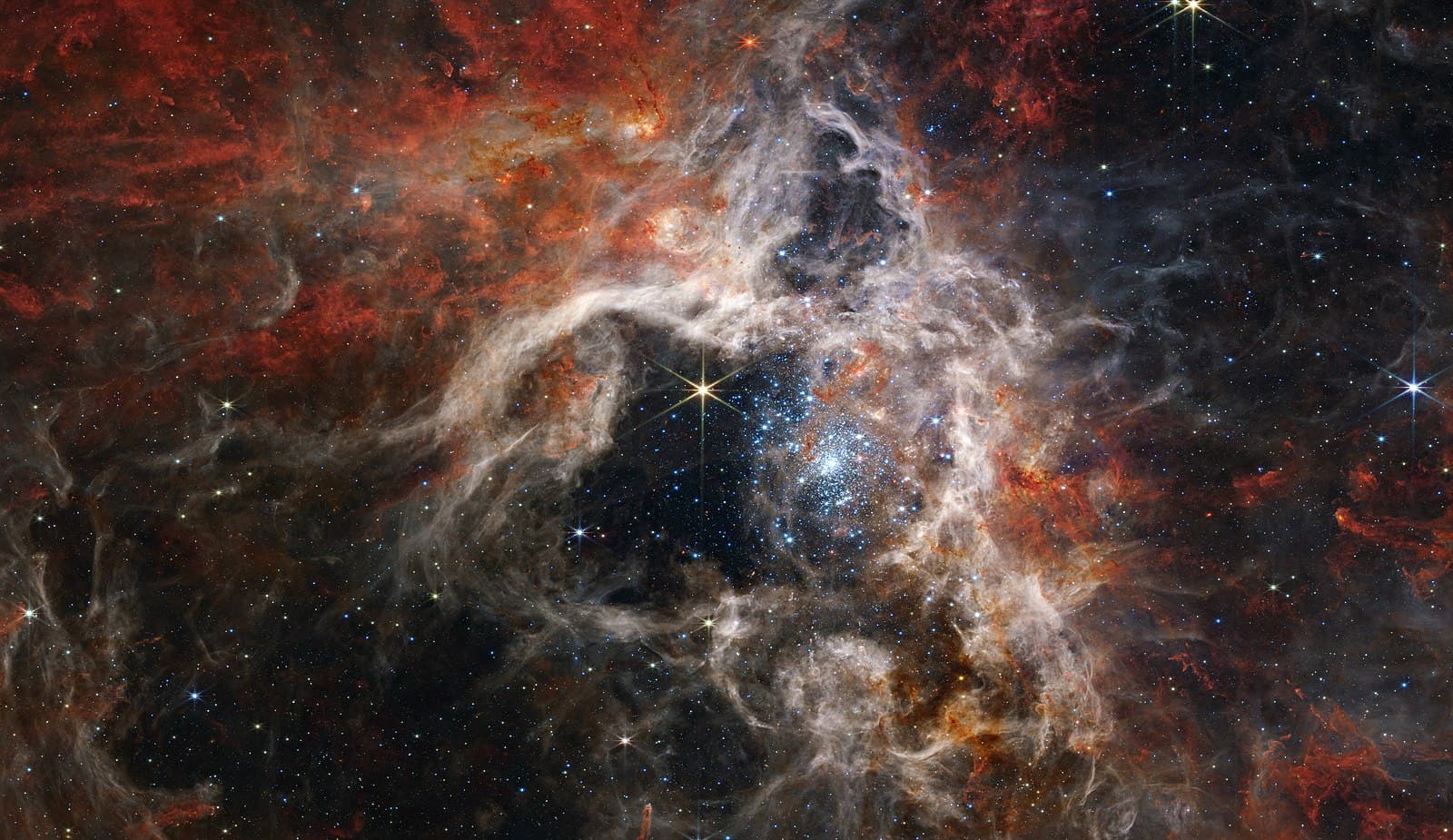
NASA, ESA, CSA, STScI, Webb ERO Production Team, Public domain, via Wikimedia Commons
Curious to hear more? This reflection explores the same question at the heart of the first episode of Wonderology, a new podcast from Christianity Today and BioLogos. Click here to listen.
What do you feel when you look at a starry night sky, or peer through a telescope at another planet?
Perhaps awe, wonder, and bewilderment. What about smallness, or insignificance?
All these feelings multiply when we see photos from the James Webb Space Telescope (JWST). Webb’s observations have revealed a universe more intricate and expansive than we imagined—far more galaxies, supermassive black holes forming earlier, and worlds with hints of habitability.
These surprises reshape our perception of the cosmos, and our place within it. Indeed, they magnify the fact that our very presence in this massive universe depends on a small, vulnerable planet orbiting a pretty average star.
Our cosmic context creates a profound theological paradox: How can an infinite God, capable of sustaining this sprawling universe, also concern himself with a personal love for humanity?
I contend that the vastness of the universe—far from diminishing our importance—actually makes God’s lavish, detailed, and reconciling love for us even more remarkable.
When the Universe Defies Our Expectations
Observations from JWST have challenged our theories. For instance, it has found supermassive black holes that formed earlier than thought possible in current cosmological models.
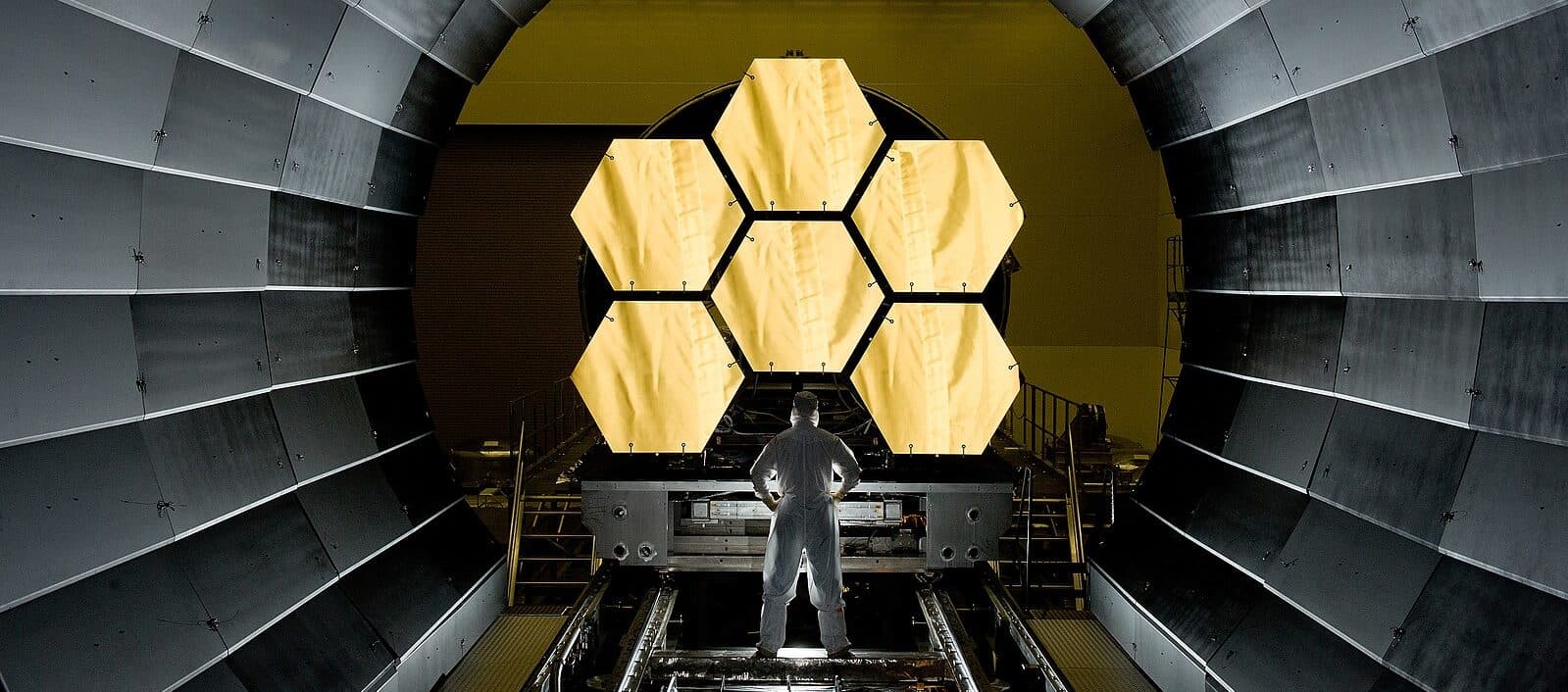
JWST’s primary mirror segments. The telescope’s observations have consistently challenged current scientific theories. NASA/MSFC/David Higginbotham, Public domain, via Wikimedia Commons
That’s the nature of science. No sooner do we think we’ve got some aspect of the universe figured out than what we observe with new technologies sets us back a step.
As Sir Isaac Newton wrote, “I do not know what I may appear to the world, but to myself I seem to have been only like a boy playing on the seashore, and diverting myself in now and then finding a smoother pebble or a prettier shell than ordinary, whilst the great ocean of truth lay all undiscovered before me.”
The way science progresses tends to have a humbling effect on most practitioners. For those of us who are spiritually inclined, that humility turns to awe—directing our focus toward the wise Creator who is the source of all these wonders.
Our best scientific work has merely begun to scratch the surface of what God has wrought.
Seeing Our Smallness in the Vast Universe
The unveiling of JWST’s first deep-field images fundamentally shifted our perception of cosmic scale.
The telescope peers far back through cosmic time, capturing light from galaxies that formed barely 300 million years after the Big Bang, essentially allowing us to witness the universe near the dawn of creation.
These images—whether showing the staggering detail of the Carina Nebula’s “Cosmic Cliffs” or the countless pinpricks of light that represent entire distant galaxies—elicit primal awe at the boundless complexity of creation.
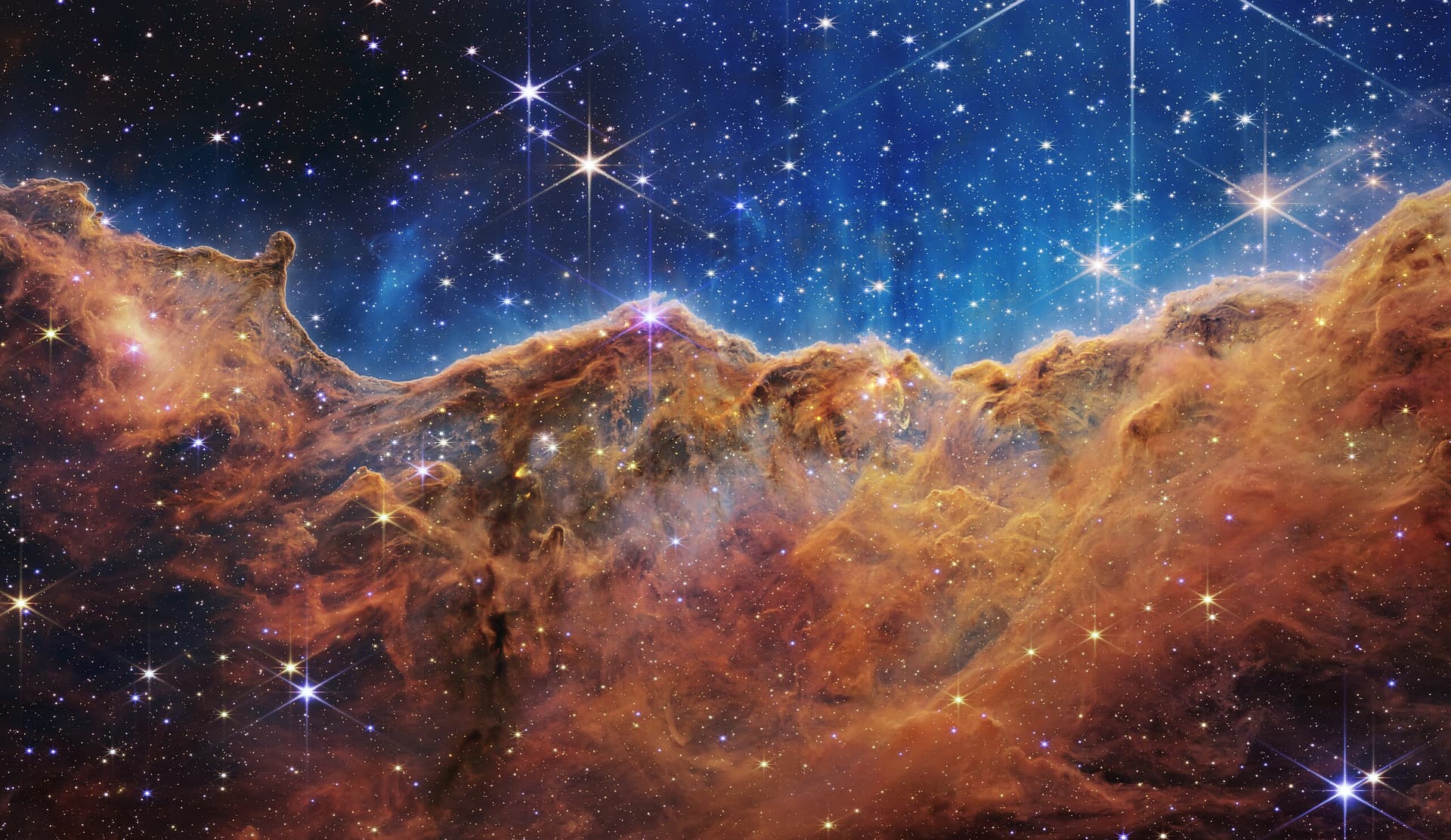
The Carina Nebula’s “Cosmic Cliffs,” as captured by the James Webb Space Telescope. Image: National Aeronautics and Space Administration, European Space Agency, Canadian Space Agency, Space Telescope Science Institute , Public domain, via Wikimedia Commons
Yet, this transcendent beauty comes with a humbling realization. The images remind us that our Sun is merely one star in our galaxy, which is, in turn, one of an estimated two trillion galaxies in the observable universe.
In this context, Earth is reduced to an unnoticeable speck, a single pebble suspended in a vast ocean of space and time.
This daunting scale evokes not just wonder but an acute feeling of cosmic smallness. JWST’s images force us to wrestle with the idea that our world is an ephemeral, momentary flicker against an expansive and, from our perspective, seemingly timeless galactic backdrop.
Do We Matter in the Universe?
For the believer, a feeling of cosmic insignificance cannot be the final word.
While the JWST more accurately locates us in the history and physical hierarchy of the universe, it offers no direct insight into the spiritual or moral dimension.
The night sky, captured in photos like those taken by both the James Webb and Hubble Space Telescopes, has always inspired awe and wonder in observers. When King David looked at the night sky with a naked eye, he posed a fundamental existential question:
When I consider your heavens,
the work of your fingers,
the moon and the stars,
which you have set in place,
what is mankind that you are mindful of them,
human beings that you care for them?
You have made them a little lower than the angels
and crowned them with glory and honor.
You made them rulers over the works of your hands;
you put everything under their feet:
all flocks and herds,
and the animals of the wild,
the birds in the sky,
and the fish in the sea,
all that swim the paths of the seas.
Today this question might be posed as, “If God is the Creator of a universe so immense, how can that same God maintain a deep personal relationship with a single, fragile individual?”
It is a question not about human size, strength or capabilities, but of divine intention. God is not constrained by the limitations of time and space, so we must move beyond viewing his attention as a finite resource stretched thin by the universe’s enormity.
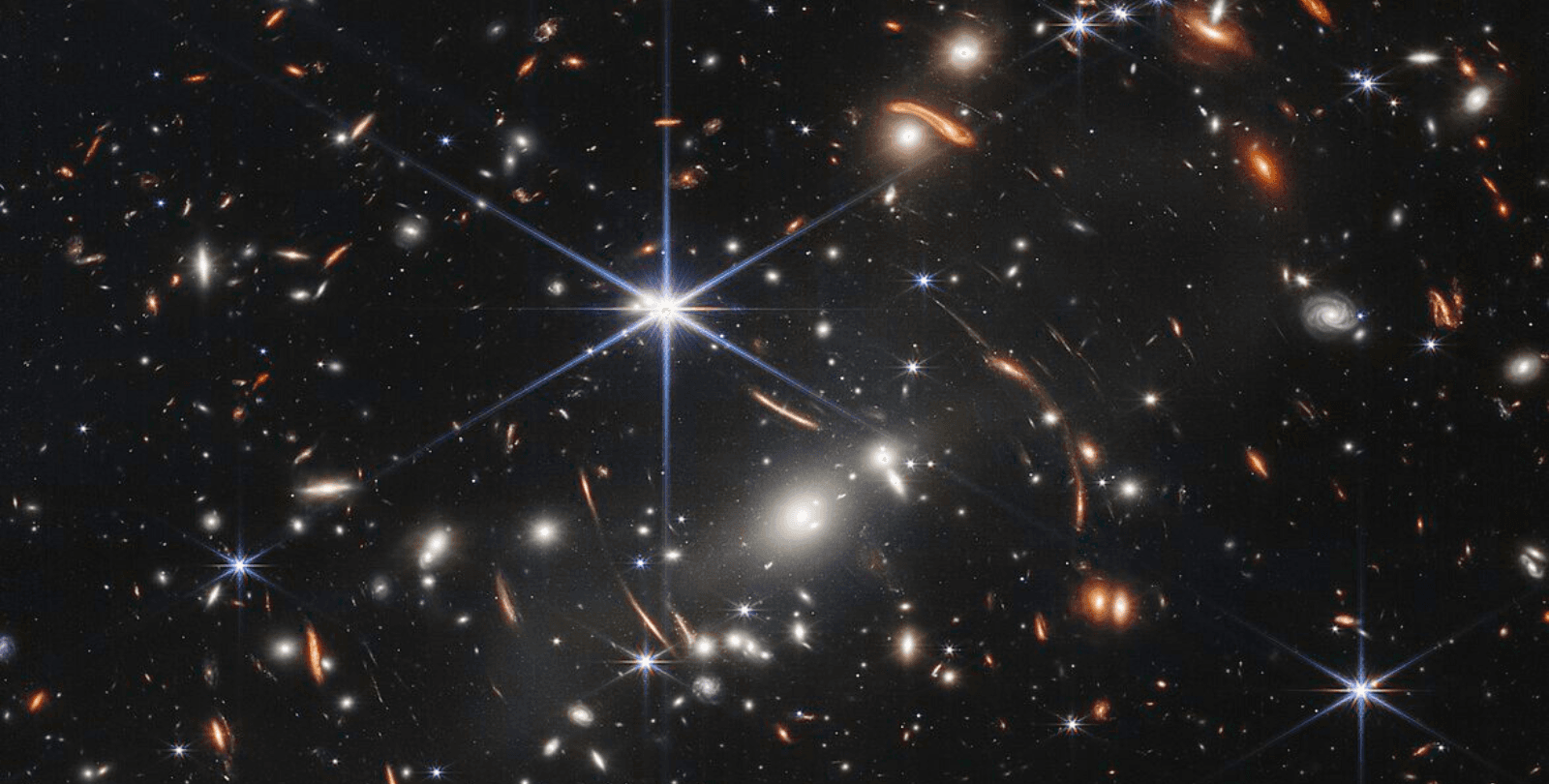
A portion of the James Webb Space Telescope’s first deep field image. NASA, ESA, CSA, and STScI, Public domain, via Wikimedia Commons
Instead, we must recognize that the Creator’s unlimited power—glimpsed at every frontier of scientific inquiry—mirrors the boundlessness of his love, a love that transcends all physical limitations and is defined by a willful, personal connection to his creation.
Also read:
- The Webb Telescope and God’s Evolving Universe
- Christmas and God’s Nearness in a Vast Universe
- Deb Haarsma | James Webb Space Telescope
- What the Webb Telescope Image Didn’t Capture
- Jennifer Wiseman | Light in Space
Rather than diminishing God’s concern for humanity, the scale of the cosmos enhances the character of divine love. The undeniable power required to architect and maintain such a vast, intricate system governed by physical laws makes God’s focus on our small sphere an act of truly amazing grace.
The universe reveals God’s power and might; His desire for relationship with us reveals His heart.
In an Unfathomably Large Universe, God’s Love is a Miracle
The real miracle is not that the universe is so big, but that the Creator of something so complex and large chooses to ascribe infinite worth to something so small.
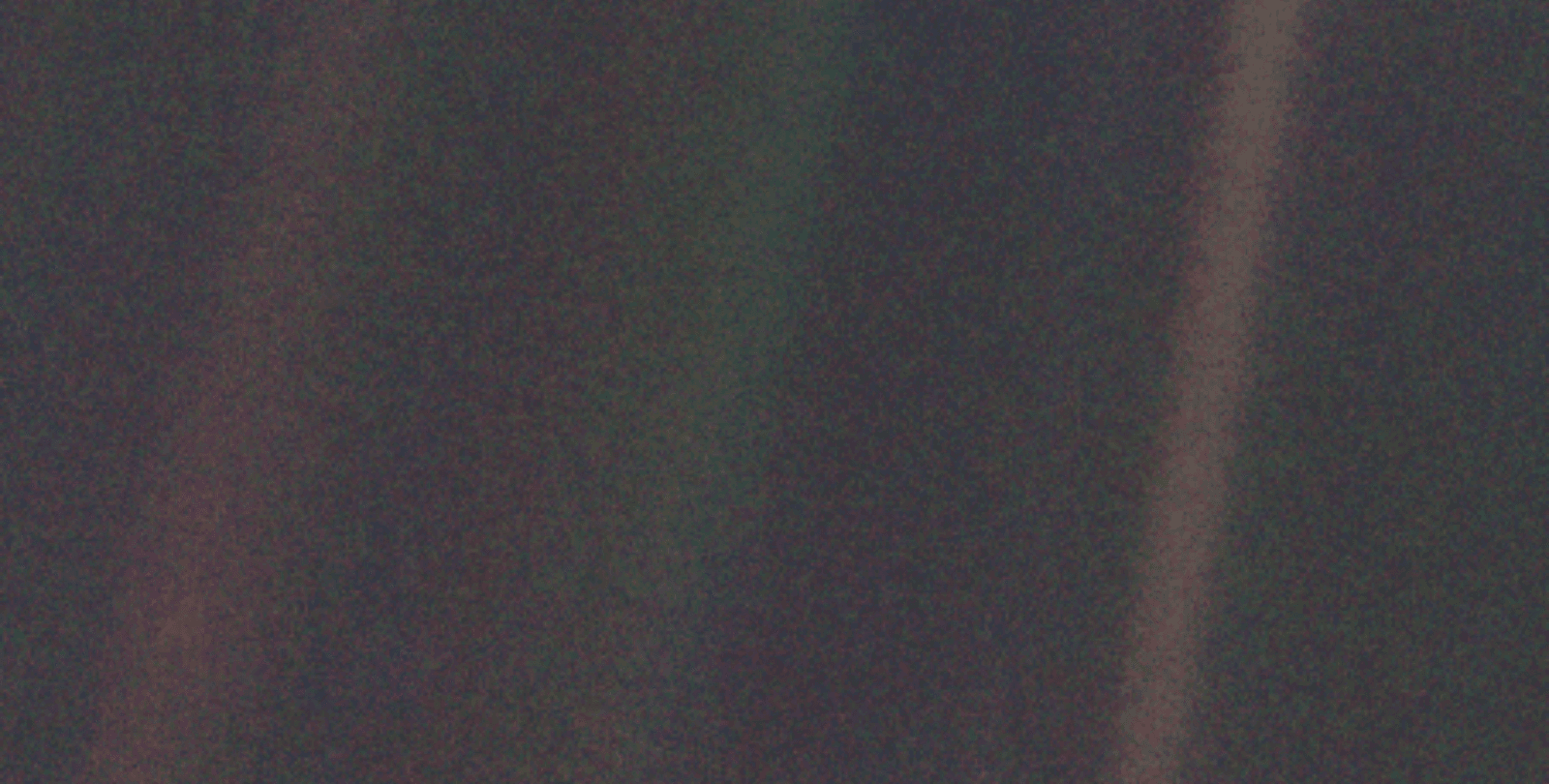
The “Pale Blue Dot” image taken of Earth from nearly four billion miles away. Earth is the small dot in the band of light toward the right of the image. Voyager 1, Public domain, via Wikimedia Commons
The incarnation of Christ is the ultimate evidence of the value God places on humanity. The Creator of the vast cosmos confined himself to the time, space, and frailty of a human life on our little planet. His willing descent in the person of Jesus shows that God’s love is not abstract, but an active, intentional provision for our shortcomings.
The JWST may reveal our physical smallness, but the cross reveals our spiritual significance, showing that God’s desire for our reconciliation transcends the grandeur of the entire cosmos.
Living in Wonder of God’s Vast Universe
The James Webb Space Telescope has given us a new window into the history and scale of creation. In capturing the endless procession of galaxies and the sheer immensity of space, it deepens our wonder at the universe.
Its insights also encourage a profound sense of spiritual humility, reminding us that our understanding of the universe, as well as its Creator, is an ever-unfolding mystery.
The paradox of the cosmic scale is not meant to render us insignificant; rather, it is the backdrop against which God’s personal, intimate love for us is revealed as an even greater miracle. We may be small, but we are not insignificant, for we are loved by the infinite Creator who made us in His image, uniquely capable of both reflecting and reciprocating that love.

No Dark Sky | Wonderology
The James Webb Space Telescope captured ten thousand galaxies in a single image. The first episode of Wonderology asks: In such a vast universe, do we matter?
JWST’s observations reveal a God of both infinite power and immeasurable love, whose creative expression is extravagant in providing for his beloved creatures.
It invites us to approach the world with a posture of curiosity, seeing in the distant nebulae and early galaxies not just scientific data, but a testament to the divine love that transcends all space and time.
The God who orchestrates the birth of stars across the universe is the same God who intimately cares for each of us. The JWST serves as a modern-day icon, illuminating the ancient truth that “the heavens declare the glory of God” (Psalm 19:1) and confirming that in our exploration of the cosmos, we find deeper reverence for the one who spoke it all into existence.
About the author

Leslie Wickman
Related Resources

Podcast Episode
No Dark Sky | Wonderology

Podcast Episode
Deb Haarsma | James Webb Space Telescope
Podcast Episode
Jennifer Wiseman | Light in Space