Ancient Humans | Becoming spiritual (Neolithic)
Part Two - From the Paleolithic to the Neolithic, this two-part series explores the development of both the physical and spiritual aspects of humanity.
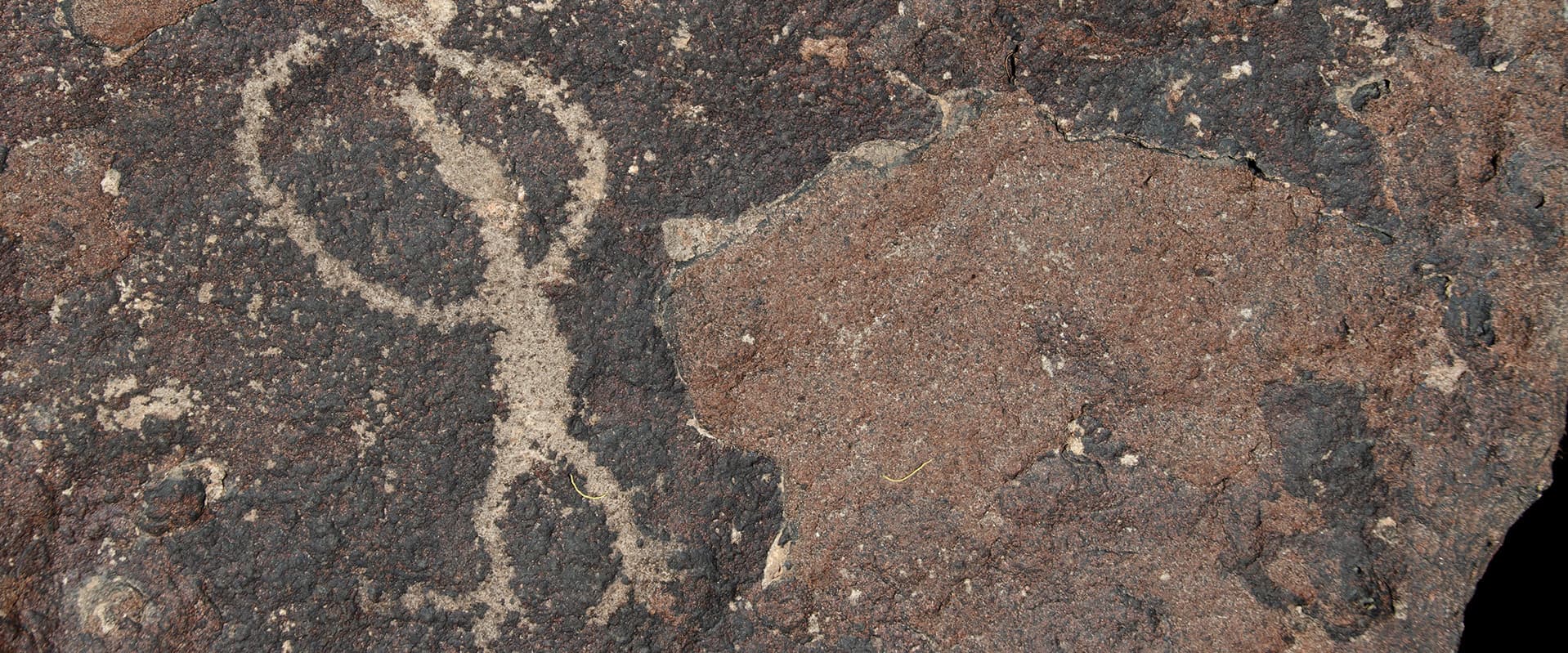
Photo by Colin Hoogerwerf
Part Two - From the Paleolithic to the Neolithic, this two-part series explores the development of both the physical and spiritual aspects of humanity.
Description
From the earliest bipedal ancestors to the dawn of spiritual awareness, we delve into the archaeological, anthropological, and theological questions surrounding our shared past. Join us over two episodes as we uncover the blurred lines between ancient hominins and modern humans, and ponder the moments that shaped our anatomy, behavior, and spirit.
Building on our journey through the Paleolithic, this second episode explores the profound spiritual developments that occurred as Homo sapiens became the sole surviving species in our genus. We seek to understand the emergence of uniquely human spiritual tendencies and our ongoing relationship with the Divine with some stops at ancient sites in Orkney, Scotland and the American Southwest, to examine the rise of symbolic thought, the earliest cave paintings, and the beginnings of agriculture in the Neolithic period. These sacred landscapes offer tangible glimpses into the spiritual lives of our ancient ancestors.
- Originally aired on June 19, 2025
- WithJim StumpandColin Hoogerwerf
Transcript
Stump:
Welcome to Language of God. I’m Jim Stump
Hoogerwerf:
And I’m Colin Hoogerwerf.
Stump:
We’re back here continuing on with the second half of this series we’re calling ancient humans. In the last episode we saw several species within a group of hominins start to walk on two feet, grow big brains, and adopt a bunch of new social behaviors, including wide-scale cooperation. Out of this came, among other species, the neanderthals, which started to do a lot of things that look pretty human, even if many of them are still up for debate. But by the end of the paleolithic period there was only one species in our genus—and that was homo sapiens.
Hoogerwerf:
There is no question—the homo sapiens we see at the end of the paleolithic are clearly modern humans, both anatomically and behaviorally, even if they haven’t developed the same technology we have today. If you could somehow adopt a baby born 12,000 years ago, and it grew up in our world today, probably, no one would be able to tell any difference.
Stump:
But there are still some really interesting changes happening, especially as we start to look toward the development of the spiritual tendencies that we’re interested in, which were built upon changes that had been happening since the split from chimpanzees, especially this new found ability to think symbolically.
Wall-Scheffler:
At some point, we see something among homo sapiens that we don’t see in anybody else, which is that they take two things—two things that they have observed in real life— and they put them together.
Tattersall:
What we seem to do is to sort of disassociate or deconstruct the world around us into a vocabulary of discrete symbols, and we give things names. Once we’ve given things names, we can move those names around in our heads and imagine other kinds of worlds in a way in which I don’t think is possible to do strictly intuitively.
Carpenter:
Certainly the capacity to have symbolic thought, to think of something representing something else, meaning making—a lot of the less satisfying work on the evolution of religion focuses so much on instrumental value—like, why could this have been beneficial for human beings—and leaves out the question of creatures just thinking about meaning and significance, because that’s a huge part of religious experience today.
Hoogerwerf:
That was Cara Wall-Scheffler, Ian Tattersall and Angela Carpenter, all guests we met in the last episode.
Stump:
The best evidence we have for the development of symbolic thinking probably comes from the art that was left behind. Art spans quite a long time. The earliest examples of drawing go back maybe 75 to 100 thousand years ago in Blombos Cave in South Africa. The oldest pictorial art dates to about 51,000 years ago in a cave in Indonesia; it’s a picture of a pig. Then by 40,000 years ago there begin to be lots of examples in many places around the world. Some of the most famous are in Spain and France, and I had a chance to see some of these. Many of them are protected from visitors now, and you can only see the replicas in Lascaux and Altamira, which I did and they are still really amazing. But in another place in France you can still see the original. It’s called the Grotto of Rouffignac.
I had rented a car in Bordeaux and drove a couple of hours out into the countryside and stayed at a cute Airbnb, and the next morning I drove out even further and after a few wrong turns, finally found the entrance to the cave. It didn’t look like much on the outside, but there was a little office right at the mouth of the cave where you buy a ticket and then wait. I had to wait quite a while because there was a school group going through that morning. But then I finally got my turn with about 15 other people. We were taken through a door in a wall and boarded a little tram that kind of felt like a ride at Walt Disney world. And the tram took off, and started going down into the cave. The guide pointed out some scratches on the wall that were made by cave bears thousands of years ago who hibernated in the cave. That’s kind of cool, but not what I was hoping to see. We went a full kilometer down, and then came to a stop, and the guide pressed a button that turned on the lights. We found ourselves surrounded by mammoths that seemed to leap off the walls of the chamber all around us. It was really remarkable that people probably 15,000 years ago went down into this cave, with torches of reindeer fat, just to draw these pictures of animals so far from the surface. And they were not just some quick sketches; they had been carefully planned and executed with skill far surpassing what I could do. This kind of art speaks directly to the kinds of minds these people had, so long ago and so removed from our civilization and religion today.
Hoogerwerf:
Most of those examples are from within the last 20,000 years, at the end of paleolithic. We also got to see some artwork during our visit to Baku, Azerbaijan when we were there to make an episode about the UN climate change conference. That artwork spanned several thousand years going back to the upper paleolithic and all the way up to the Middle ages. It’s pretty incredible that people all over the world were doing this same kind of artwork and even using some of the same symbols. This was clearly not just some cultural phenomenon that came out of one particular place.
When you start to get to the end of the paleolithic, around 11,000 years ago, besides just the artwork there are many other archeological remains, structures built and signs of burial ritual, and ornaments, that all start to tell a story about a developing sense of a spiritual relationship to the world.
Foster:
There was a perception that there were spheres other than this one, worlds over the other side of the cave wall. Sometimes those ideas are hinted at by cave paintings where half of the beautifully drawn animal is missing because it’s on the other side of the membrane which separates this world from the other.
Hoogerwerf:
This is Charles Foster. He’s been on the podcast a couple of times and has had a long interest in the story of how humans have become what we are. That eventually led him to write a book called Being A Human where he actually went and tried to live for a time like a person from the Paleolithic and he spent a lot of time trying to figure out what it would mean to live in the world without the ability to think symbolically. Well you can imagine it’s pretty hard to be able to try giving up symbolic thought even for a short time.
Foster:
As soon as you get clear signs and the archaeological record of individual consciousness of self, of personal pronouns, you necessarily have the eruption into the archaeological record of the notion of you. You have your Martin Buber, the I and thou. And if you have I and thou, you have, first of all, an absolute necessity to connect them by a story. And secondly, you have the generation of obligations. And I think if you have those two things, story and obligations, you have the core parts of any spirituality. So the story is a story which makes sense of your place in the world, and your relationships in the world. And if you have obligations to this “thou”, you have ethics. So spiritual, explanatory stories, going to our ontology and ethics. There, you’ve got the core elements of the religious package.
Hoogerwerf:
And so that’s about the time period where we ended last time, with the gradual development of a bipedal, large brained mammal that had developed symbolic thinking and the idea of a self.
Foster:
Then comes the Neolithic.
Tattersall:
Once you have the first evidence of symbolism in what is, evolutionarily speaking, the blink of an eye, you know, you have a fully formed modern symbolic sensibility, and then you’re into the Neolithic, into sedentary life. You’re into the first villages, and then incredibly fast, into the first towns and the first cities.
Stump:
That’s Ian Tattersall again. So what is the neolithic exactly? This is another archaeological period?
Hoogerwerf:
Right this is a period defined by the kinds of archeological stuff that is left behind, and the archeological remains show a big cultural shift around this time. Darrell Rohl gives a bit more of a technical definition.
Rohl:
Neolithic is this period of prehistory, when the primary tools remain stone tools, but human beings have begun agriculture and more permanent settlements.
Hoogerwerf:
Now, interestingly, this archeological transition also corresponds with another geological change, from the Pleistocene to the Holocene, which is when glaciers retreated from the continents and sea levels rose, which is a good reminder that environmental conditions play a role in cultural conditions and that geology and culture are always going to be in a kind of dance with each other.
Stump:
This change from hunting and gathering in the paleolithic to agriculture and more permanent settlements in the neolithic is a really profound cultural shift. All kinds of things happen when people start to stay in one place. The way our species related to the natural world changed and the way we related to other members of our own species changed.
Foster:
And in the Neolithic, of course, we have the birth of sky gods. Usually male, not always, but Gods who are up there rather than all around.
Hoogerwerf:
Ok, so we need to stay here for a moment. I think this is a really interesting idea, but we probably need to analyze it a bit. Charles is contrasting ‘sky gods’ with the kind of shamanism he was mentioning earlier, the kind that comes from the cave art disappearing into the wall.
Foster:
It was thought that spirits hunched in every stone and every mushroom.
Stump:
There’s a lot of speculation happening here about what this spiritual worldview might have been. It’s not entirely without evidence or justification, but, as we’ve heard from archeologists, it isn’t as clear cut as anything that we could learn from a written record. But when he talks about sky gods, he’s talking about the development of religion in times that preceded any of the major religions we have today. In our tradition, this was long before Moses received the 10 Commandments, and even before Abraham or any of the stories in the Old Testament that have historical grounding. But part of our interest in this pre-history time period is that our religion didn’t pop out of nowhere. They may not have had direct revelation from God the way we think Abraham did, but clearly they had some vague religious impulses. They had developed an idea that there is something divine, non-human, non-animal, and worth worshipping…and maybe also fearing…the sky gods. We can think about the Greek and Roman gods or the Norse gods as a later development of this.
Hoogerwerf:
We’ve had the chance, over the past couple of years, to see some of the archeological remains from several different neolithic sites in some different parts of the world that showcase some of this development of the spiritual life of neolithic humans.
Part Four: Orkney Islands
Hoogerwerf:
One of the interesting things about dividing the past up by the different cultural shifts that happen is that those changes tend to happen at different times in different places. So while the first people were experimenting with agriculture in the near east, it would still be thousands of years for people in Europe to enter into the Neolithic.
Rohl:
So it happens really quite early in the Near East. A little bit later it begins happening in Egypt, a little bit later over in the Indus Valley. So the Neolithic Revolution in the Near East, maybe we could say about 8000 BCE in the Near East, about 6500 In continental Europe, 5000 ish in China. In Britain, I believe the Neolithic begins somewhere around 3000-3500 BC, something like that. And this is where you’ve got these great remains from Orkney that you’ve visited.
Stump:
We found our way to Orkney on a fall day a couple of years ago, after a live podcast event we did in Cambridge.
Hoogerwerf:
We ended up only having about 12 hours to explore Orkney, which was enough to see quite a lot in our rental car that you drove on the wrong side of the road.
Stump:
“wrong side” is a matter of context, right?
Hoogerwerf:
Well usually, but I’m pretty sure I said a couple of times, “Jim you’re on the wrong side of the road”…before you realized and went back over to the left side. But for some context for that adventure, Orkney is a group of Islands off the Northern tip of Scotland. And the islands are covered with spectacular archeological sites going back 5000 years. Why there are so many well preserved neolithic sites on these islands probably has something to do with the fact that this was a place with lots of good stone for building, as opposed to many other places in Europe where wood the main source of building material—
Stump:
And wood doesn’t preserve as well as stone.
Hoogerwerf:
So that’s one factor. Also Orkney is pretty remote. So in the last 5000 years there just haven’t been as many chances for these sites to be destroyed or developed over or vandalized.
Stump:
So after collecting our tiny little car from a tiny little shop in a tiny little town, we drove out — mostly on the left side of the road — along the shoreline and came to our first stop. [sounds of arriving]
Hoogerwerf:
Cuween-hill chambered cairn.
Stump:
Walking up, it was just a green grassy hill, but when we got close, we could see along one side there was a dark doorway into the hill. We were prepared with our own torches—as they call flashlights over there—and we got down on our hands and knees and crawled into a small tunnel. [sounds of crawling into tomb] Probably about 2 and a half feet tall and 2 feet wide and 18 feet long, made completely of perfectly fitting stacked stones, which had been gathered and transported and expertly constructed by humans 5000 years ago, to create a place to bring their dead.
Hoogerwerf:
Right. This was a tomb. When they first discovered it in the early 1900s there were bones from at least 8 different human individuals and lots of animals, mostly dogs. To be clear, those remains have all been removed and it is now open to the public. We just drove up and parked, no tickets, no guides, just a little gate and an informational sign. After crawling through the passageway the space opened up into a decently sized room, enough room for you and me and Faith and Allison, our colleagues who were travelling with us, to sit and even stand in there comfortably and talk about what this place tells us about what these people thought about the afterlife. [sounds of talking in the tomb]
Stump:
Cuween Hill isn’t the only tomb we visited. We stopped at two others, including one that is probably one of the more famous ancient tombs, called Maeshowe. This one was much larger than the others we visited, and was a part of a more regulated tour where, unfortunately we weren’t allowed to record. A group of about 15 of us easily fit in this tomb after crouching and walking through the 30 foot passageway. The stone work in Maeshowe is really incredible, even before considering that this was all done without pulleys, or wheeled carts, or even paper to write down a plan. There are some really large pieces of stone here too, some weighing several tons which had to be transported many miles. And it seems that the entire structure was built in a way that shows an advanced understanding of astronomy.
Rohl:
it is built purposely, it seems, or at least we’ve interpreted purposely, so that in the winter solstice, the sun will hit the back wall directly.
Hoogerwerf:
Remember, that’s through a narrow 30ft long passageway.
Rohl:
That doesn’t seem to be an accident, right? That doesn’t seem to be coincidental.
Stump:
And the astronomical orientation goes beyond even just this one structure. There is a standing stone, called the Barnhouse stone, almost a half a mile away that is in perfect line with the sunlight on the winter solstice, through the passageway. This points to there being some intentional design to structures in the wider landscape.
Hoogerwerf:
So we’ve got to start asking, what does all this mean about the kinds of spiritual beliefs these people might have held?
Rohl:
Now, what do they believe about the sun? What do they believe about the planet? We don’t know for sure, right. But we know that they are recognizing something. They are paying attention. And as a community, they are investing quite often immense person-power, right, immense amounts of labor, to build these monuments over generations sometimes, and maintaining these monuments and maintaining activity in them.
Stump:
The tombs themselves also say something about the beliefs of these people. It is easy though to start to speculate and to start to interpret these things in ways that might go beyond the evidence. Do the tombs show that these people thought there was an afterlife? I’m not sure it has to go that far. It sure seems to show that they had some kind of respect for the dead.
Rohl:
When we take into account the scale of the tomb, the architecture of the tomb, the careful orientation to the winter solstice, when we look at the maintenance of the tomb, when we look at burials across this world and see that there are intentional burials, accompanied by ritual activity with careful grave goods and orientation of bodies and these types of things, the totality of the evidence is really indicating they aren’t just chucking bodies somewhere to get rid of them. They are respecting the bodies, they are participating in behaviors that indicate something other than just practical purposes.
Hoogerwerf:
The buildings themselves seem to say something about what was going on with these people. As you know, Jim, I’m all for trying to find similarities between animals and humans instead of trying to find differences, but I was really struck by seeing these places and these early attempts to build and change the landscape in really profound ways. And when we follow this journey of human development we get to this point when humans are first exploring some of the things that really do seem different from animals. Sure beavers build dams, but they are completely functional things. Here I saw attempts that would have involved a huge sacrifice of time and effort, projects that might have spanned multiple generations of builders, to make something that really didn’t have a functional purpose. If this was just a place to keep predators away from dead bodies, simply dragging the dead bodies a ways out from the village or spending a couple hours digging a hole would have been just fine.
Stump:
There’s some remarkable change in that regard within our species. We’d been living without such structures for a couple hundred thousand years. I don’t think beavers ever lived without building dams— creatures that kind of looked like beavers but didn’t build dams were a different species. So there’s something going on within our species in this transition to agriculture and more permanent settlements, that then gives rise to these projects that span centuries.
Hoogerwerf:
Tombs aren’t the only structures we saw on Orkney. Another place we visited was Skara Brae. This is a 5000 year old village site and was really cool to see. The site has been excavated so that you can walk around on paths at about where the ceiling height would have been of a series of dwellings, all made of precisely stacked stone slabs. The single dwellings are all connected by paths to each other to make a village where 50 to 100 people might have lived. In the best preserved of them you can still see all the necessities of home life, beds and shelves and a hearth where they would cook and gather, large stones carved out like bowls where perhaps water was stored. It all looked very livable, if a bit rustic.
Stump:
We also saw a bunch of standing stones—the most famous version of standing stones that people will know about is Stonehenge, which is back down in the Southern part of England and started about 5000 years ago. But probably even older are the impressive stone rings in Orkney: The Ring of Brodgar and the Stones of Stenness are two examples of what seem like large gathering places. Each has a circle of tall stones standing up on end. The circle would have originally had a deep ditch and berm, made from the excavated material of the ditch, surrounding it. When you put all of these sites together you can begin to imagine scenes of people gathering there for what might have looked to us like religious ritual.
Rohl:
They are building structures that don’t seem to have any practical function. They aren’t serving as houses, they aren’t serving as food processing facilities. These seem to be gathering places, and places where certain practices and activities happen.
Stump:
This is all very speculative still. There is another site in southwestern France, Bruniquel Cave, where there is a circle of stalagmites deep in a cave, in a way that must have been intentionally placed, and we know that it would have been done by neanderthals because the construction is dated to over 175kya, and they were the only human species in the area at the time. We don’t know any more about it, but that’s a long time further back. We need to be careful not to speculate too much or over-interpret. Maybe they were just places the locals gathered to play games? I don’t really think that, and our visiting of them felt sacred. But just because we can tell a story about how these places might have been religious gathering grounds, doesn’t mean that’s how the original people there would have understood them.
Rohl:
So while we have very, very little definitive, you know, explicit “I am worshipping a deity here”, in some cases, by the time we hit the Neolithic, where we’re definitely in some communities starting to have clear signs of religion. Religion, organized religion, develops during the Neolithic.
Stump:
There is actually another place I went to that gets a lot closer to the explicit religious ritual and worshipping of a deity.
On the islands of Malta in the middle of the Mediterranean, there are a number of very old structures. It was a kind of crossroads for sailors in the ancient world. And on the island of Gozo, there is what is currently the second-oldest human-made structure we know of (the oldest being Gobekli Tepe in Turkey). But the one I saw in Malta. dated to about 5500 years ago, and it is clearly a temple. Again, massive stones transported from miles away, and arranged into different rooms. One of those has an altar that animals were sacrificed upon.
Hoogerwerf:
So this is actually quite a bit before our Orkney sites were made, before the Pyramids of Egypt were built and still before Abraham and Moses. But it sounds a lot more like some of the rituals you see in the Old testament.
Stump:
Yes, so again, those sacrificial practices we’re more familiar with from scripture didn’t spring out of nowhere. Even if they became imbued with some different meaning, it seems that the practices themselves had precedents. It is entirely possible — maybe even plausible — that there were other kinds of ritual at the standing stones too, which if they were able to tell us what they were thinking, we’d say, “Oh yeah, that’s religion too.”
Hoogerwerf:
Well we’ve got one more part of the world to visit, this one a bit closer to home.
Part Five: Southwest US Rock Art
Forton:
We know that they climbed up this hill. They stood here, they looked at the same mountains.
Hoogerwerf:
This is Maxwell Forton.
Forton:
And I’m a professional archaeologist. I’ve worked for the Forest Service, National Park Service, and I’m a PhD candidate at Binghamton University.
Stump:
Max is talking about the Hohokam people that lived in the Southwest United States in a culture that lasted for over 1000 years before the Spanish explorers first made contact. Even more specifically he’s talking about the individuals who covered the rocks on a hill we were walking to with something like 11,000 petroglyphs.
Hoogerwerf:
As Darrell mentioned earlier, we need to remember that these big cultural shifts in how societies and cultures were organized happened in different ways and at different times in different parts of the world. It is generally accepted that humans found their way to the American continents somewhere between 18,000 to 25,000 years ago. This date has been pushed back over the years as new evidence is found and there is some evidence to suggest that it could go back much further, though that is still a rigorous debate. The beginnings of agriculture in the Southwest United States is thought to have begun around 4000 years ago, so a bit after the people of Orkney had already left their tombs and villages and standing stones to be weathered and covered by sand. By about 2000 years ago, right around the time of Christ, the Hohokam culture arose and started building extensive canal systems through the desert to help water their crops.
Forton:
By the time they’re making the majority of the petroglyphs that we see here, they were full time agriculturalist. So they are growing corn, squash, beans. Those are the three main crops, but continuing to use the wild desert plants too, a lot of which provide a bunch of really great food resources and can grow corn here. And what they did, they built a huge, elaborate canal system off of the rivers that runs through the modern day Phoenix and Tucson. And using those canals, they were able to irrigate huge fields.
Stump:
And this led to population growth.
Forton:
Communities of hundreds and some sites 1000s of people all interconnected, trading with each other, coming together at communal centers
Stump:
One of the places it seems like people might have gathered was at the hill where Max was leading us, through a sparse desert landscape covered with creosote and cactuses as the main vegetation.
[sounds of getting a cactus in the leg]
Hoogerwerf:
After extracting the cactus from my achilles we made it over to the bottom of a rocky hill.
Forton:
So the petroglyphs go all the way up to the top. I don’t know what your guys’s level of comfort is with. [Let’s go. It’s high] Love it. So, yeah, just some etiquette. Just watch where you put your step. There’s petroglyphs everywhere. And yeah, we don’t touch them. Oils in our skin can damage. And yeah, Some, most, 99% these boulders are stable, but this one isn’t. You found the 1%.
Stump:
This was pretty cool looking. We were about a mile away from the last road, and nothing resembling human civilization for as far as we could see. And then we come upon these hills, covered with rocks with what looked like graffiti all over them.
Hoogerwerf:
Some of the images were pretty clear to me. Human figures, essentially stick people, with their arms raised over their heads, or images that looked like the sun that a kid would draw. Others, probably most of the others, were more abstract, though it was easy to come up with ideas of what they could resemble. And there were other more geometric designs, circles within circles, or zigzags. I definitely felt a temptation to try and figure out what it all meant, and hoped that Max could interpret it all for me, but doing that kind of interpretation isn’t really the main goal of archeology, partly because the the intention behind this work just isn’t left over in the rock, it’s a question beyond what the evidence can give answers to.
Forton:
So it’s not so much important what this meant just knowing the fact that it did mean something, did have importance, and that this site, this place, was important to them somewhere that they repeatedly came to.
Hoogerwerf:
On the other side of trying to attach a meaning to each and every piece of imagery is maybe the temptation to think that there is no meaning behind these things and to think maybe they were the result of boredom. And, we can relate to this maybe, the classic bored kid in class takes the tools he or she has—a pen or pencil and the margins of a textbook—and does what comes naturally…doodling.
Forton:
These aren’t the equivalent of casual doodles.
Stump:
For one thing, they would have taken quite a bit more effort than drawing with a pencil. But also, even though we can’t say exactly what this imagery meant, there was clearly some meaning behind it.
Forton:
And they often don’t even—Hopi in particular have said, don’t refer to this as art, in the Western sense. This is something much more important, more sacred than just, kind of secular art, as we might describe it. Yeah, this is a message left by our ancestors.
Stump:
Maybe something more like iconography. I’ve read a book about the remarkable consistency of these ancient symbols across the world, and how they seem related to shamanic practices even in animistic tribes today. The hypothesis is that they were symbols that were believed to have spiritual significance to the people who made them.
Hoogerwerf:
The rock art at this site was all pretty accessible. There are lots of other instances where that is not the case and is another reason to think these aren’t just doodles.
Forton:
So this site, this is very publicly visible. Other sites you go to, it’s tucked away and very small, like in a small crevice in a cave with an entrance, very much more private.
Stump:
Right, that’s like the mammoth art at the cave in Rouffignac, a kilometer down from the cave opening.
Hoogerwerf:
And Max actually told us about another site not too far from where we were and gave us some basic directions. [sounds Jim and Colin hiking, talking over directions]
Stump:
This one took a bit more effort to get to. Hiking a couple miles down a main trail, and then down an unmarked spur trail off to the side, which our directions were a little fuzzy about. [sounds of excitement at finding the site]
Hoogerwerf:
We did eventually find it and this cave was really cool, maybe one of my favorite examples of archeological evidence of ancient humans that I’ve ever seen. The cave was pretty small, really just a rounded out space on the side of the hill, enough for a couple people to sit in, but it would keep you out of the elements, if you needed a break from the sun or the wind or the rain. And the art in here was an example of pictographs, pictures drawn with pigments on top of the rock, not carved into it.
Forton:
There’s petroglyphs, and that’s the process of removing the rock surface to make an image through scratching. Pictographs are when you are adding something to the rock surface. Typically paint. Could be something as simple as charcoal or just directly adding pigment to the rock surface.
Hoogerwerf:
The art in the cave was a line of deer or elk or some other ungulate, wrapping most of the way around the cave, in a way that made it look like a moving herd.
Stump:
So here again, we see some pretty sophisticated art, in a pretty inaccessible place. So the purpose of it was clearly not to showcase for the other people in the community how great of an artist they were, but maybe something more introspective and contemplative, that had a purpose more related to meaning-making of the things they experienced in their world.
Hoogerwerf:
Let’s get back to our first site with Max. Because beyond just the artwork left on the rock, there is another piece of archaeological evidence left that is pretty remarkable and adds to the idea that this site was something more than just a stopping place to bang out some pictures on the landscape.
Forton:
So one thing that’s really unique about this site there’s these features called Bell rocks.
Hoogerwerf:
These are rocks where you can see points on them where they have been hit over and over and when you hit them they make a resonating sound.
Forton:
So that one might be one, right in front of you.
Hoogerwerf:
After Max pointed one of these out, we started to see several more of them
Forton:
Let me try and get a piece of Ironwood here.
Hoogerwerf:
And sure enough, when we tapped a stick against it would resonate just like a bell ringing. [sound of bell rock]
Forton:
So you can imagine, it’s not just a visual importance here, but people are coming to this space now there’s going to be sound too.And typically that’s something that isn’t preserved and archeological record but in this case it is, which is pretty incredible.
Stump:
Once we add sound into the mix, it opens a door to use more of our senses to understand what this place would have been for the people who made these images 1000 years ago. Max points out that this hill of rocks only has rock art on one side.
Forton:
It’s showing when we see that there’s some intentionality to where they’re pointing them
Stump:
Must have been something to look at on this.
Forton:
Exactly. So maybe that mountain peak there or something on the horizon prior that had some significance to them in that this was the site where you could go in Look at that mountain, make an offer and do a ceremony, maybe then move on to another site doing the same thing.
Hoogerwerf:
With Max’s help we started to put together a picture that includes all the archeological remains— the art and the worn bell rocks, but also fragments of pottery that were scattered around the ground, the occasional beads and ornaments sometimes found, along with other information: knowledge about the plants that would have been here and how they might have been used and information passed down from descendant communities, and we can imagine a gathering of people here, some adding new images into the rock, others placed at bell rocks creating rhythm, others down on the ground, maybe around fires, dancing, singing, and all of them, doing this thing that people around the world seem to be unable to resist, contemplating and celebrating a world much bigger than themselves.
[musical interlude]
Part Six: What Does it all Mean?
Stump:
Ok, we’ve come a long way from the first hesitant steps on two feet, to ceremonial dancing, from the first crude, stone hand axes to intricately painted cave art. But the question behind all the stone tools and drawings on stone remains—-what was happening in the human spirit?
Hoogerwerf:
We started this episode by talking about the advent of the ‘sky gods’ as Charles Foster put it. When people, with the capability of symbolic thinking, started coming together in larger societies, they also started doing these things that look a lot like what we would call religious practice today. But what exactly was happening there? Was this the response to the first understandings of what it might mean to be an image bearer or was it just a way to manage social tensions?
Stump:
That second answer is one that has been put forward by a lot of prominent people. In the early 1990s a British anthropologist named Robin Dunbar found that across cultures humans are limited in the number of relationships that they can maintain, and that number is about 150.
Hoogerwerf:
Dunbar’s number.
Stump:
Yeah and there’s been lots of interesting spin off research from this, but it’s also been used as a way to explain the development of religion in early human societies. In the paleolithic, humans almost never came into a situation where they had to deal with any more than 150 other humans. But when population sizes started to grow and humans started living in settlements, they could no longer keep track of all the people and their reputations. That opens the door to freeloaders and others who aren’t helping the community as a whole. To keep things from getting out of control, some people claim that we invented religion and Gods who could step in as the invisible disciplinarian.
Hoogerwerf:
Right, so I’m all of a sudden living in a society that includes what essentially amounts to the first strangers, I might be tempted to steal their food, because, I don’t know them, they don’t know me, I’m probably not going to face any consequences…but then you bring in the ‘sky gods’ and all of a sudden my crops will fail if I steal from a stranger? And it keeps us all in line?
Stump:
Yes, or the gods might punish you in an afterlife. That’s the story put forward in Harari’s wildly popular book, Sapiens. And these days I’ve heard lots of people casting off their religious identities because of this idea that it’s all just made up to keep us nice. But I think there’s a slightly different way to tell the story that’s not just about social control; it is more about the innate human drive to connect with something beyond ourselves. And religion can still be adaptive even if it’s not about control. It also turns out to be really good at helping humans come together, share ideas, and build common beliefs. We’ve got really good evidence now of the positive community value of rituals that are practiced together — from choirs at church services to the soccer hooligans at football matches. When we sing together, we feel that we are one — even if I don’t know personally all the people involved. And I’m going to be more likely to care about the welfare of those people.
Hoogerwerf:
So that brings us back to the idea of being an “image bearer.” If humans are uniquely created in the image of God, then our spiritual development, even in its earliest forms, might be more than just a survival mechanism. It might be a fundamental part of our nature.
Stump:
Right. And our religious practices today are rooted in those deeper biological drives. That connection to something primal doesn’t have to take away from their legitimacy as part of our spiritual identity.
Hoogerwerf:
That primal stirring might even go back a lot longer than the time frame we’ve been looking at here. When we were talking to Angela she brought up a story that she heard
Carpenter:
By an anthropologist Agustín Fuentes.
Stump:
I’ve actually heard him tell this story too. Fuentes was collaborating on a project with National Geographic where they attached cameras to some macaques in Gibraltar. They got to see everywhere the monkeys went. And they were surprised at one particular macaque who would always go sit at the edge of a cliff around sunset.
Carpenter:
And at this point, the individual in the camera stops and pauses for a long time and just looks out over this vista. And of course, you know, this is speculative. But it’s suggestive of, perhaps very early beginnings of something like awe, something like wonder, perhaps a very, very incipient sense of a transcendent even in a non verbal kind of way.
Hoogerwerf:
We interviewed Agustín Fuentes way back in episode 66. While he didn’t tell us this particular story, here’s what he did say:
Fuentes:
And I think that capacity, particularly in primates, to experience a momen—a sunrise, a sunset, a looking at a jungle or seeing some colors or a waterfall—something that stimulates maybe a transcendent experience. I can’t tell because I’m not that individual, but they behave as if it does. And I think this is more widespread than humans like to admit, right, this capacity to experience awe and wonder. But humans don’t just experience awe and wonder, we turn it into things, right, and we let it drive our behavior and our ideas and our societies. And I think that’s the distinctive capacity for belief in humans.
Stump:
For a macaque to experience something like awe or wonder doesn’t mean it is the same thing as how we experience religious transcendance. And being different doesn’t make it any less significant either. Our point is that the story of our awareness of the divine is directly tied to our evolutionary story. Here’s Angela Carpenter again.
Carpenter:
God, even thinking about love of divine being as really being dependent on our human social capacities, and without those emerging, you don’t get a creature that is capable of relationship with divine being.
Hoogerwerf:
And here’s Cara Wall-Scheffler again.
Wall-Scheffler:
It shouldn’t surprise us that there would be strategies in place for thinking about things we cannot observe but want to be able to explain and or be in relationship with. Those mechanisms have been in place for thousands and thousands of years, because if we didn’t have those mechanisms in place that we couldn’t be in relationship with God today, and so the groundwork for them has to be there.
Stump:
And here’s Darrell Rohl.
Darrell Rohl:
if we want to understand God, and human beings are that image of God here on here on Earth, in in the earthly creation, then our best understanding of God’s image, our best understanding of the glory, the creativity, all those attributes of God will be best understood through this vast mosaic of the diversity of humanity across all time, and places.”
Hoogerwerf:
If we want to understand God, we need to look at the “vast mosaic of the diversity of humanity across all time and places.” It puts ancient human spiritual development in a completely different light. It’s not just about managing social tensions, but about how our inherent capacity for relationship with the Divine manifests itself across cultures and throughout history. And it gives us a good reason to lean into science as a way to better understand what it means to be human today.
Stump:
And it’s not just about how we understand God, but how we understand ourselves and our potential. As Angela Carpenter suggests:
Carpenter:
We become the kinds of creatures that we are in our particular context and environment, whether that’s creatures who are making stone tools a million and a half years ago, or creatures today living in a highly industrialized society, making podcasts, whatever, what have you we we become who we are based on our social niche, our culture. And so what I have found just theologically, really suggestive in that, is the possibility that we could become in relationship to the Divine, and that we could become something different.
Hoogerwerf:
So, our spiritual journey isn’t just a fixed thing, but something that evolves with us, shaped by our environment and our culture, and yet still points towards this relationship with the Divine. It’s about becoming something different, something more.
Stump:
It opens up the possibility that those early humans, looking up at the sky or creating those first cave paintings, were not just inventing gods to keep order, but were genuinely encountering something profound, something that began to shape them, and ultimately, us. It was another step on our spiritual journey that continues to this day.
Tattersall:
“And, you know, as they say, the rest is history…”
Hoogerwerf:
Literally [jim chuckles]
[music]
Credits:
Hoogerwerf:
Thanks to all our guests for this episodes, and especially for those who took the time to invite us into their offices, and their passions and into some really cool places.
Language of God is produced by BioLogos. BioLogos is supported by individual donors and listeners like you. If you’d like to help keep this conversation going on the podcast and elsewhere you can find ways to contribute at biologos.org. You’ll find lots of other great resources on science and faith there as well.
Language of God is produced and mixed by Colin Hoogerwerf. That’s me. Our theme song is by Breakmaster Cylinder. BioLogos offices are located in Grand Rapids, Michigan in the Grand River watershed. Thanks for listening.
Photos from the Episodes
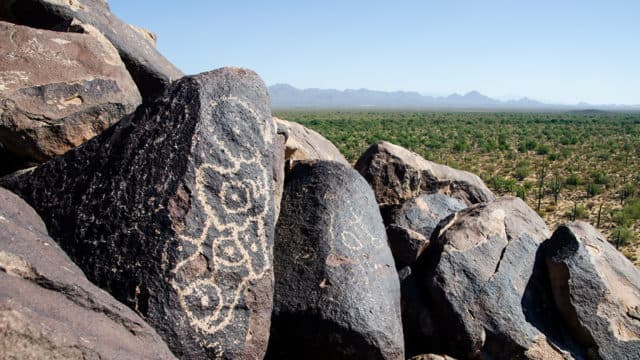
Petroglyphs, Southwestern US.
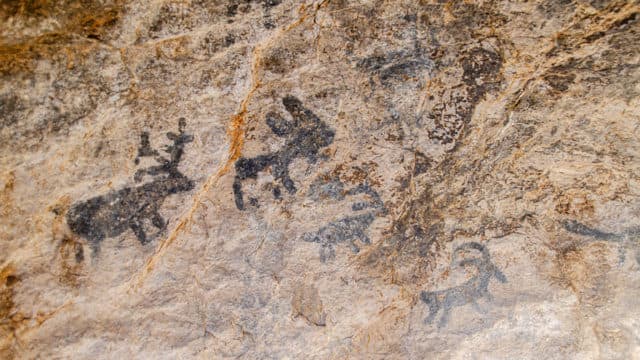
Pictrographs on cave wall, Southwestern US.
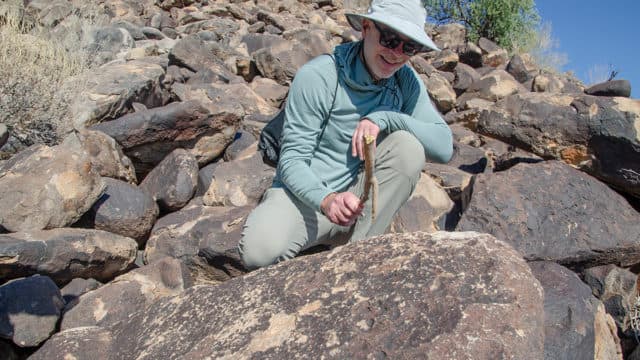
Jim hits a bell rock, Southwestern US.
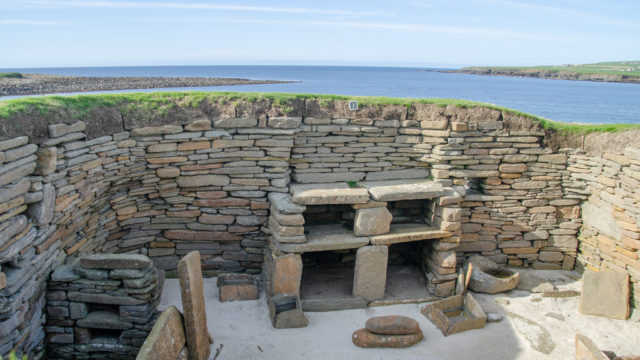
Skara Brae village site, Orkney.
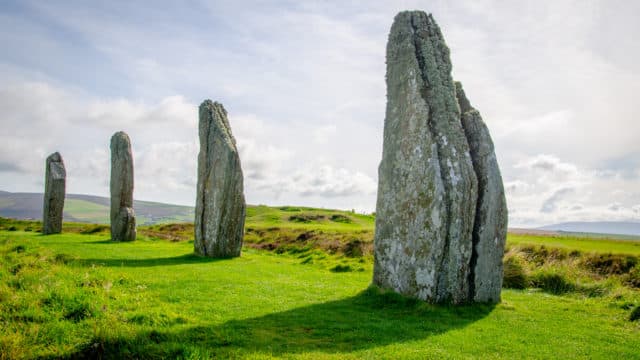
Standing stones, Orkney.
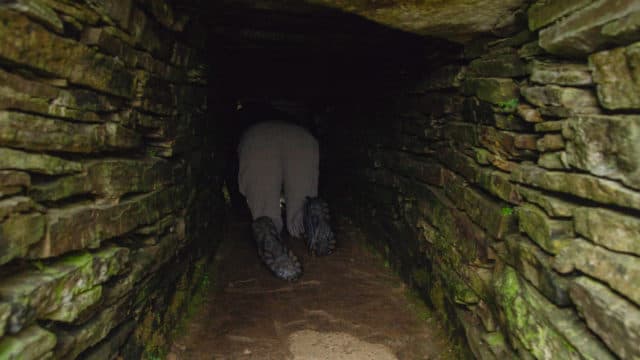
Jim crawls in Cuween Hill Chambered Carin, Orkney.
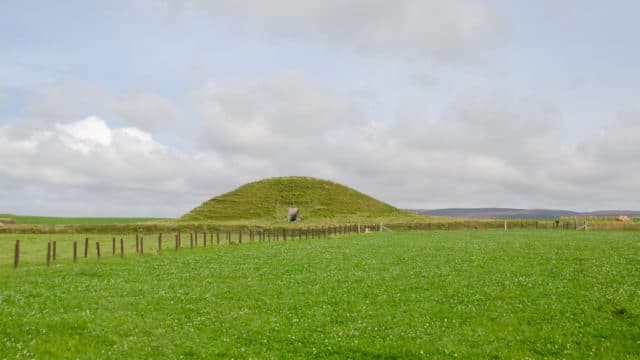
Maeshowe tomb, Orkney.
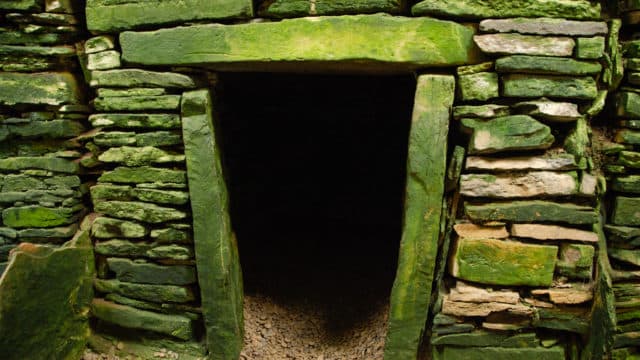
Inside an ancient tomb, Orkney.
Featured guests

Cara Wall-Scheffler
Ian Tattersall
Ian Tattersall is Curator Emeritus at the American Museum of Natural History on New York City and author of several popular books including Understanding Human Evolution (2022), Masters of the Planet: The Search for Our Human Origins (2012), and The World from Beginnings to 4000 BCE (2008).

Angela Carpenter

Charles Foster
Darrell Rohl
Darrell is Associate Professor of History and Director of the Archaeology Program at Calvin University.

Maxwell Forton
