Eubanks
January 1983. Shag carpet. Corduroy chair. You’re home sick. Watching TV. And in the 80s— that meant one thing.
ARCHIVE MEDIA — Johnny Olson
Judy Ridenour, come on down! You are the next contestant on The Price Is Right!
Eubanks
America’s favorite guessing game.
Stults
You guess the price of a blender. A sofa. A dining room set.
ARCHIVE MEDIA — Judy Ridenour
$651.
ARCHIVE MEDIA — Bob Barker
She says $651.
Stults
Closest without going over wins.
ARCHIVE MEDIA — Bob Barker
I say the actual retail price is $1021. Judy, you win!
Eubanks
That’s Judy. She’s bouncing towards Bob— Grinning. Shocked.
Stults
She leans in. Kisses him on the cheek.
ARCHIVE MEDIA — Bob Barker
Now, what can Judy win?
ARCHIVE MEDIA — Johnny Olson
A chance to win up to $25,000 in cash!
Stults
No one knows it yet, but they’re watching the birth of a legend.
ARCHIVE MEDIA — Bob Barker
That’s right! In our brand new game, let’s go right back here and play… PLINKO!
Eubanks
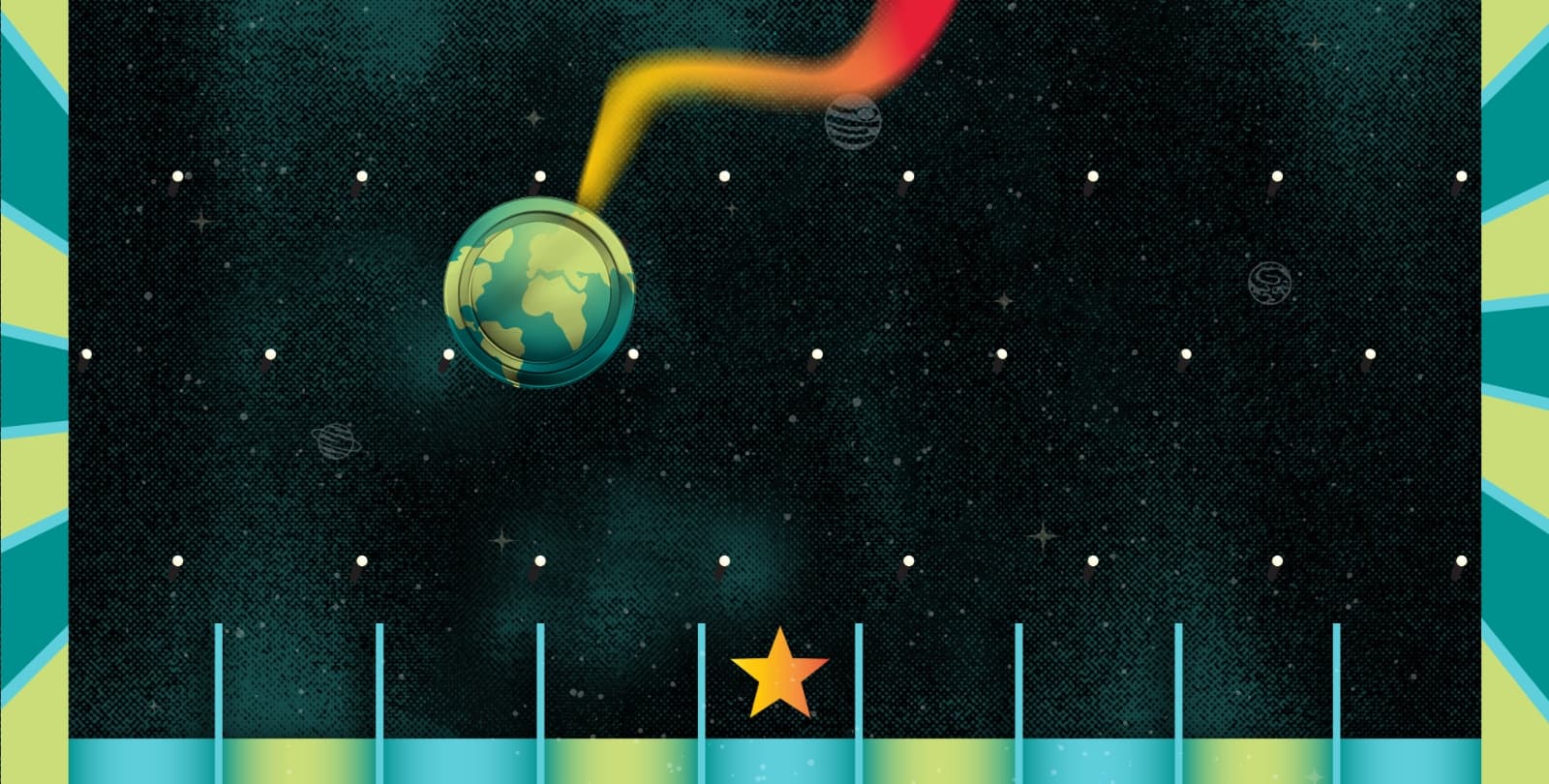
Plinko. A ten-foot board. Tilted back. Rows of silver pegs in a tight geometric grid.
Stults
A staircase to the top where you stand above the board. Holding your chips.
Eubanks
At the bottom: nine slots. Some worth a hundred. Some nothing. And one, dead center— five thousand dollars.
Stults
One at a time, Judy drops her first three chips. They bounce. They scatter. Together, she wins $1,500.
Eubanks
But then, she drops her final chip.
Eubanks
It hits one peg. Falls to the right. Then another. Falls to the right again. Then to the left. The right.
ARCHIVE MEDIA — Bob Barker
You did it! $5,000!
Eubanks
Her chip lands in the center slot.
Stults
Judy becomes the first winner in a game that feels unpredictable.
Eubanks
Now, imagine a different Plinko board. Not ten feet tall. But fourteen billion light-years wide.
Stults
At the bottom— not nine slots. But more empty slots than you could ever count. All zero. Except one. Land there— and you get everything. Galaxies. Gravity. Golden retrievers. You.
Eubanks
Miss— and there’s nothing. No stars. No life. You let your chip fall.
Stults
And somehow— in an endless sea of empty slots— it lands. You win existence itself. So was it luck? Or something else?
Eubanks
Tonight on Wonderology— we’re dropping the chip again.
Stults
We’re exploring the space between probability and destiny. Between accident and intention. We’re asking the question: Are we here by chance?
Eubanks
I’m Jesse Eubanks. A storyteller and journalist.
Stults
I’m Faith Stults. A science educator.
Eubanks
So… let’s get curious.
Stults
At its heart, science has one job. Create models that explain reality. What we can test. What we can repeat.
Eubanks
So what do you do when science says one thing— but reality says something else? That’s the problem keeping one man up at night.
ARCHIVE MEDIA — THE COSMOLOGISTS
Man has always gazed at the night sky in awe and wonder… Tonight, we meet Fred Hoyle of Cambridge University…
Eubanks
Fred Hoyle is a man who likes taking solitary hikes in the woods to think. Deeply loyal to his inner circle of friends. He writes science fiction with his son as a hobby.
Stults
But Hoyle is also an astrophysicist. A cosmologist. Sharp. Confident. Confrontational. And he’s not interested in explanations he can’t test.
ARCHIVE — Fred Hoyle
I don’t like the idea that something is dependent on a cause that I can never verify.
Eubanks
Hoyle loves a good fight. And he writes constantly. What you’re about to hear are his words— read for us.
Stults
He’ll fight scientists.
ARCHIVE — Hoyle
The reason why scientists like the ‘big bang’ is because they are overshadowed by the Book of Genesis.
Stults
He’ll fight religion.
ARCHIVE — Hoyle
Religion is but a desperate attempt to find an escape from the truly dreadful situation in which we find ourselves.
Eubanks
But what he’s about to find will give both sides something to argue about for the next seventy years. It’s the 1950s. Hoyle is standing at a chalkboard. The equations say something strange.
Stults
According to the math— the universe shouldn’t have much carbon. But everywhere he looks— there it is. Carbon in meteorites. In oceans. In every living cell.
Eubanks
Which creates a real problem. Because the model says this shouldn’t be happening.
Stults
Hoyle isn’t alone. Scientists around the world are wrestling with it.
Eubanks
Because this isn’t just about carbon. Given the physics we know— should complex life exist at all?
Stults
The math says no. We shouldn’t be here. Something is wrong with the science.
Eubanks
The puzzle starts inside a star.
Stults
Stars are chemical factories, building bigger elements from smaller ones. Atoms slam together, and step by step the periodic table grows.
Eubanks
But carbon— the element that binds complex life together— isn’t cooperating.
Stults
The atoms needed to build carbon won’t fuse consistently. They touch. Push back. Separate. No matter how many times they run the equations, the connection won’t hold.
Eubanks
Which means carbon should be rare. Complex organisms shouldn’t exist. Why does science say one thing while reality says something else? This is what Hoyle can’t shake.
Stults
Imagine the universe is a cake. You can see it. You can taste it. But every baker trying to copy the recipe fails. The cake always falls apart.
Eubanks
So the bakers assume the recipe must be wrong. Is the timing off? The portions?
Stults
But Hoyle asks a different question. What if the recipe is right— and the real problem is that we’re missing an ingredient?
Eubanks
The other bakers hate that idea. We know the ingredients. Fix the recipe.
Stults
But Hoyle goes looking for a missing piece anyway.
Eubanks
Back at the chalkboard, Hoyle spends months plugging numbers into the equation and running the reaction again and again. And then, one day, he finds it. One number makes the math work. A number that feels almost absurd.
ARCHIVE — Hoyle
…a rather precisely tuned resonance… about seven point six five million electron volts…
Stults
Hoyle proposes carbon has one exact setting where the reaction works.
Eubanks
A secret setting no one has ever observed.
Stults
The question is— Is Hoyle imagining something that doesn’t exist? Or is he discovering something real hiding inside every carbon atom?
Eubanks
Hoyle can’t test it himself. He’s a chalkboard guy. So he sends the prediction to a nuclear physics lab at Caltech. The atom smashers.
Stults
And essentially tells them— You should find something right here. Like sending someone to the grocery store to buy an ingredient no one has ever seen.
Eubanks
Hoyle is predicting something that no one thinks actually exists. (beat)
Stults
So the lab goes looking. They fire particles at carbon nuclei. Scanning energy level after energy level. Searching for the one Hoyle predicted. And then— they see it.
Eubanks
Exactly where Hoyle said it would be. Seven point six five million electron volts. Dead on. The missing ingredient is real.
Stults
Today scientists call it the Hoyle state. But here’s the strangest part. This energy level is incredibly precise. Move it even slightly— and the reaction fails. Think about baking a cake. The recipe works… but only if the oven temperature is exactly right.
Eubanks
And in this case, it’s like the recipe is calling for a temperature of 350.001 degrees.
Stults
Miss that setting— and the cake never forms.
Eubanks
And in this case… the cake is carbon. And without this cake— nobody ever will be celebrating a birthday. And once physicists see how delicate the carbon reaction is… they start asking a new question. If one setting has to be that precise— what else does?
Stults
So they start checking the other numbers that shape the universe. Gravity. The nuclear forces that hold atoms together. The rate the universe expands. And they discover the same thing again and again. Change them even a little— and the universe doesn’t run the same. Scientists call this fine-tuning. Not because the laws of physics would break— the universe would still run. But complex life only appears inside a very narrow range.
Eubanks
It’s like discovering the oven that baked the cake doesn’t have one dial. It has dozens.
Stults
And every one of them has to be set almost exactly right.
Eubanks
Miss even one— and life as we know it never happens And once we start seeing how narrow those ranges are, the question changes. It’s no longer just: How does the universe work? It becomes: What are we supposed to make of it? And for some, the conclusion is obvious.
ARCHIVE MEDIA
A very reasonable explanation is that there is a fine tuner or a mind who has said it that way.
ARCHIVE MEDIA
I think it actually glorifies God the most to see that how wonderfully constructed nature is that everything works.
ARCHIVE MEDIA
If somebody was going to convince me of the need for for a God, it would be
Eubanks
The Plinko chip could have landed in billions of empty slots. But somehow— it landed in the one place that hit the jackpot.
Stults
When something this unlikely happens— how do we explain it?
Eubanks
After the break— the Mayflower heads into a storm. And decides the fate of millions. We’ll be right back.
Welcome back to Wonderology. Jesse Eubanks.
Stults
Faith Stults.
Eubanks
We just watched scientists run into something unsettling. The universe doesn’t just sort of work. It works on a knife’s edge.
Stults
Change the wrong number even slightly, and life as we know it never gets a foothold.
Eubanks
So, what do we do with the long odds of fine-tuning?
Stults
When something wildly unlikely happens— we don’t stay neutral. We interpret it.
Eubanks
September. 1620. The Mayflower leaves England. Over a hundred passengers. Thirty crew. Wood groaning under strain. Salt air chewing at the beams.
Stults
They’re headed for Virginia. But…
Richard Pickering
they were going right into the stormy season.
Stults
This is Richard Pickering. Senior historian at Plimoth Patuxet (puh-TUK-et) Museums.
Pickering
The earliest weeks of the Mayflower voyage were fair and pleasant, and then all of a sudden they are caught in such horrific storms…
Eubanks
One of the passengers is a man named John Howland. We don’t have his own words. What you’re about to hear is a reconstruction from actor Sam Allen.
Sam Allen as John Howland
It was quite the storm. During the crossing, the sky was black as night for near a week and the ship did creak and groan and sway.
Eubanks
One night— the storm turns violent. The ship lurches.
Pickering
…the ship is suddenly dropping down, dropping over…
Stults
As the boat drops, a huge wave rises and slams the side of the boat.
Allen as Howland
The wave swept over the deck…
Eubanks
The seasoned sailors aboard know how to react.
Allen as Howland
…and all the sailors well braced for it— let it pass by them.
Stults
But Howland isn’t a sailor.
Allen as Howland
I did not see the wave as it came.
Pickering
John Howland is thrown into those churning waters.
Allen as Howland
…it took me and into the sea.
Eubanks
He’s overboard. English people in this period do not swim. His wool clothes instantly absorb water.
Allen as Howland
My clothing was sodden and as heavy as lead.
Pickering
A ship the size of the Mayflower, to save someone, it would have to turn around… It would take 90 minutes.
Eubanks
That can’t happen. Not at night. Not in a storm. Not in the middle of the Atlantic. He sinks.
Allen as Howland
I cannot tell you how deep I went, but enough that all was dark about me… The air in my lungs burned into fire.
Pickering
…he was fathoms below the ship.
Allen as Howland
So I offered unto God every sin I had ever committed for I thought I was soon to meet the man.
Eubanks
But as he falls— disoriented— he reaches out blindly. And grabs something.
Allen as Howland
I suppose God did fill my hands with a rope as I fell… Where the rope did come from, I cannot say.
Eubanks
A rope trailing from the ship. Still attached.
Allen as Howland
I clung to it…
Stults
From underwater, he climbs.
Allen as Howland
I broke the surface and that first breath was like manna from heaven.
Eubanks
He begins crying out.
Pickering
They use a boat hook… and pull him out.
Stults
Against every expectation— John Howland lives.
Eubanks
He makes it to land. He recovers. He marries. He has children. His children have children.
Stults
And that line doesn’t break. Generation after generation, it continues.
Eubanks
John Howland has millions of living descendants today— more than any other documented passenger on the Mayflower. Possibly more than anyone else in American history. One of which is…
Stults
Me. Thank God for ropes.
Eubanks
Go back to that night. Same storm. Same ship. Same wave. Remove one thing. The rope.
Stults
John Howland doesn’t make it back aboard. And in that instant— every life that follows disappears. Not just me. Every parent. Every child. Every generation in between. Change one moment— and everyone on the other end vanishes.
Eubanks
So when you ask, What are the odds that I exist? They’re staggering. Astronomical.
Stults
And when odds get that extreme— they stop feeling statistical. They start feeling personal.
Eubanks
That can’t be nothing. That can’t be pure accident. It almost feels like the rope was handed to him.
Stults
And this is where something interesting happens. Because once something feels personal— we don’t just want to observe it. We want to explain it.
Eubanks
And when we do, there are two ditches we often fall into.
Jennifer Wiseman
So there are people who really… are attracted to these arguments of fine tuning of the universe… like… how likely or unlikely it is that the universe would have just exactly the right fundamental constants to have developed the way that it did…
Eubanks
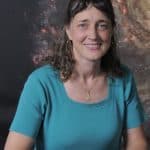
This is astronomer Jennifer Wiseman.
Wiseman
I work at the NASA Goddard Space Flight Center.
Eubanks
Senior Project Scientist for the Hubble Space Telescope.
Wiseman
And so this fine tuning is interesting and it is sometimes used beyond just the walls of scientific analysis to inform philosophical conclusions or even theological conclusions
Stults
She says people look at the constants— gravity, electromagnetism, the strong nuclear force, and say: If these were even slightly different, life couldn’t exist.
Eubanks
Which is true. But, speaking personally outside her role at NASA, Jennifer thinks we need to slow down.
Wiseman
My problem is when Christians take the fine-tuning theory and run with it as a strong apologetic, I would urge great caution.
Eubanks
She worries we see something astonishing or something we don’t fully understand and turn it into evidence for faith.
Stults
As if improbability itself is proof of God.
Eubanks
The problem with that is that science keeps moving.
Wiseman
So what if, just hypothetically, we find out next year that, lo and behold, these fundamental constants in the universe that we’re experiencing could be anything. They could be a wide range, and we’d still end up with stars and life bearing planets. Well, then, if that turns out to be the most likely case, what happened to our apologetic?
Stults
Her concern is simple. If faith is anchored to what science hasn’t explained then every new explanation can feel like a threat. If God is used to fill the gaps in our knowledge, what happens when the gaps close?
Wiseman
I don’t like that approach very much.
Stults
She’s not dismissing wonder. She’s resisting overreach.
Eubanks
Don’t baptize the numbers. Long odds aren’t the same thing as meaning.
Stults
Don’t turn “that’s unlikely” into “therefore, I know.”
Eubanks
So, that’s the first ditch. The rush to meaning. The second ditch?
Alister McGrath
When I look at the remarkable structure of our universe… the fine constants of our universe, the remarkable way in which they seem to be there in a way that encourages life to occur. I think I find that quite remarkable.
Eubanks
This is Alister McGrath.
McGrath
Senior Research Fellow at the Faculty of Theology at Oxford.
Eubanks
A theologian trained in molecular biophysics.
McGrath
The idea of chance is very interesting because very often people will say it all happened by chance but very often when you’re thinking about life events, when you talk about something happening by chance, when you look backwards, you suddenly realize, actually maybe that was meant to happen.
Stults
He says we’re quick to dismiss things as chance alone.
McGrath
Very often talking about chance is very much a matter of perspective. What for one person is chance, random, for another person is part of a bigger picture.
Eubanks
Sometimes chance just means, I don’t see the pattern. And because I don’t see the pattern, I assume there isn’t one.
Stults
To take something rare and flatten it. To move from It happened by chance to And that’s the end of the story.
McGrath
From some perspectives the world may seem to be random and meaningless. But we can see it in a different way.
Eubanks
We don’t have to see it as senseless.
Stults
That’s the second ditch. The rush to meaninglessness.
Eubanks
Two ditches. The rush to meaning. The rush to meaninglessness.
Stults
Rarity pushes us toward interpretation. One baptizes the moment. The other flattens it.
Eubanks
So what do we do? We live in a story. And stories force us to ask why. Not just why the Plinko chip falls the way it does— but also why there’s a Plinko board in the first place.
Stults
The rope was provision. Or it was chance.
Eubanks
The constants point. Or they don’t.
Stults
And that choice doesn’t just explain the moment. It shapes the kind of world you think you’re living in.
Eubanks
After the break— two people try to stay out of the ditches. They show us that however you interpret it, you gain something. But you also pay for the story you choose. Stay with us. Wonderology. Jesse.
Stults
Faith.
Eubanks
The universe holds together by a knife’s edge. Change the numbers and we don’t exist.
Stults
And once you see that, you can’t stay neutral. So are we here by chance?
Eubanks
Whatever answer you choose— it doesn’t stay in the stars. It lands on you.
Stults
And every explanation that gives you something will also cost you something.
Eubanks
Let’s start in a snowstorm.
Marcelo Gleiser
My daughter was about six years old, I was walking with her through a snowstorm in New Hampshire.
Eubanks
This is Marcelo Gleiser.
Gleiser
Appleton professor of natural philosophy at Dartmouth College.
Eubanks
Physicist. Cosmologist. But on this night— just a dad in the snow.
Gleiser
She was asking me about snowflakes.
Stults
They’re falling everywhere. A snow globe come to life. Magic to a six-year-old.
Gleiser
I was telling her that it’s amazing that no two snowflakes are alike.
Eubanks
Same storm. Different journeys.
Gleiser
There are so many processes that go into making a snowflake… temperature, pressure, wind speed.
Stults
Tiny shifts that make each of them unique.
Gleiser
And then I had this idea… look at our planets.
Eubanks
Venus. Mars. Earth. Same solar system. Each one-of-a-kind.
Gleiser
They were all born more or less at the same time… and they’re all different…
Eubanks
Just like snowflakes.
Stults
And one of those planets— ours— ended up with oceans. Atmosphere. Life.
Gleiser
There is no Earth 2.0.
Stults
Distinct.
Gleiser
There is nothing more important in the universe than life… hence, this is a sacred place…
Stults
Sacred. A religious word.
Gleiser
And so the question you have to ask yourself is what is making Earth such a special place?
Eubanks
But— as special as our planet is— Marcelo doesn’t see our home as a place of providence.
Gleiser
If I look at it from a strictly scientific perspective… I would say… it’s an accident. But that leaves me empty, emotionally.
Eubanks
So Marcelo has learned to sit with that feeling.
Gleiser
Then you have room for mystery. A mystery that makes living worthwhile. And embracing this mystery of existence is a wonderful way to kind of celebrate, you know, the fact that we are here to try to make sense of who we are.
Eubanks
Because if this explanation is true— nothing in the universe was trying to make you.
Stults
Life happened. Consciousness happened. You happened.
Gleiser
I always define myself as an agnostic… because… as far as we know, we don’t see any signs of major purpose in the universe yet. There is no path that is laid ahead of us. We make the path by walking on it.
Eubanks
If meaning is something we create— what makes it binding? What makes it more than preference?
Eubanks
There’s another story too.
Wiseman
I grew up in rural Arkansas on a small family farm.
Eubanks
This is Jennifer Wiseman again. Growing up on a farm meant dark skies. No streetlights. Just stars.
Stults
And it was the 1970s. Which meant outer space was everywhere.
Wiseman
Fantastic movies about space science fiction were coming out. So the first Star Wars movies…
MEDIA — STAR WARS
*Lightsaber sound*
Wiseman
The first Star Trek movies…
MEDIA — STAR TREK
Kirk to Enterprise
Wiseman
…the movie called The Black Hole, you know, my science fair project in junior high was to build a black hole.
Eubanks
Jennifer wanted to understand the sky above her.
Wiseman
We were starting to get these first images from the outer parts of our solar system.
MEDIA — THE VOYAGERS 1977 VIDEO
Jupiter and Saturn. These giant planets and the moons surrounding them will be looked at close up by two 1,800 pound spacecraft loaded with cameras and scientific instruments.
Stults
We began sending probes out into the solar system.
MEDIA — BBC 1979
It wasn’t originally intended to photograph Saturn but it’s done so and it’s sent back pictures which are surprisingly good.
MEDIA — VOYAGER 1 EARLY RESULTS
…so it was really a first look and a very very good first look.
Stults
A universe that was no longer far away.
Wiseman
I thought it was the greatest thing humans had ever done. I still do.
Eubanks
So she became an astronomer. She wanted to know how the universe works. We asked Jennifer: Are we here by chance?
Wiseman
You should not have waited till the very end of this conversation to ask that question. I could answer that question with, as a true scientist would, with a no and a yes.
Stults
Yes— because chance is real.
Wiseman
In all of the natural world, we see random processes.
Eubanks
Asteroids hit planets. Environments change. Life adapts.
Wiseman
There were some chance things in the development of the universe and the development history of our planet Earth that affected life.
Stults
But randomness does not mean meaningless.
Wiseman
I think God does use random processes to bring about results that… in the bigger, larger spiritual sense… were always intended.
Stults
So are we here by chance?
Wiseman
In the big picture, I would say no. The universe we’re in was endowed with just what we need so that life could eventually come about.
Eubanks
Because eventually, in this universe, a specific type of life appeared that could ask the question.
Wiseman
Having a life form… that can actually relate to one another and relate to God…I think shows that we at least spiritually are the purpose of God.
Stults
But Jennifer is careful here.
Wiseman
The purpose of the universe is not us. The purpose of the universe is to glorify God.
Eubanks
Jennifer’s explanation gives purpose. But it also asks a person to accept something difficult. Because if life was intended— then the road that led to life was not incidental.
Stults
It includes extinction. Pain. Suffering.
Eubanks
If the universe was aimed— then the suffering is not just noise. It belongs to the same story.
Stults
So if this was purpose— why does so much of it feel so painful and costly?
Ard Louis
Science is our most powerful way of getting reliable knowledge about the natural world. Now, unfortunately, I don’t think it answers any of our existential questions.
Eubanks
This is Ard Louis. Physicist. Oxford University.
Louis
And I don’t think that any advance of science is going to allow it to answer those questions.
Stults
Because eventually the question pushes further back. Not just: Why life? But— why anything at all?
Eubanks
And when Ard follows that question all the way down— he says we’re left with only a few possibilities.
Louis
One option is that our current laws of physics were caused by a previous set of laws of physics… which were caused by another set… and another… all the way back… So you get this infinite regress of causes… It’s a philosophical idea. And it’s strange.
Eubanks
Or—
Louis
There was nothing… and then suddenly the laws of nature popped into being… That includes the laws of logic… the laws of mathematics… That’s extremely strange.
Stults
Or—
Louis
There exists something outside of space and time… A first cause… A being who cannot not exist… And that’s strange too.
Eubanks
Three explanations.
Louis
All three of them are— in one way or the other— strange.
Stults
Which means you are not choosing between mystery and no mystery. You are choosing which mystery you can live with.
Eubanks
After his discovery, Fred Hoyle thought about these ideas too.
ARCHIVE — Hoyle
A common sense interpretation of the facts suggests that a superintellect has monkeyed with physics.
Stults
A mind behind the laws of nature.
Eubanks
But Hoyle chose not to follow that thought to its end.
ARCHIVE — Hoyle
I keep every one of my problems in a watertight compartment.
Eubanks
The discovery in one compartment. The implications in another.
ARCHIVE — Hoyle
If you try to make everything consistent, the penalty is that you might be wrong in everything. So I keep everything watertight.
Eubanks
But one way or another, the question does demand an answer. A chip drops. Peg. Then another. Then another.
Stults
Physics can describe the bounces. Gravity. Motion. Angle.
Eubanks
Every deflection. Every turn.
Stults
Science can tell us how the chip moved.
Eubanks
But eventually you notice something. The chip is not the only mystery. There is also the board.
Stults
The laws of physics. The constants of nature. The stage where every bounce happens.
Eubanks
Explain the bounce— and you argue about chance or intention. Explain the board— and things get strange.
Stults
Yesterday I was playing with my kids. We were building LEGOs. And I had this sudden thought. I’m really glad that rope was there. Because if John Howland doesn’t grab that rope… none of this exists.
Stults
Not me. Not them.
Eubanks
One rope. One storm. One moment that could have gone another way. But it didn’t.
Stults
So was it intention? Or accident?
Gleiser
Science is a very powerful tool to unveil perhaps some of the workings of the universe and of our human body, and perhaps even our brains, but it stops very short of understanding questions related to meaning and values.
Wiseman
Science is designed to work best when we’re asking very specific questions… but if we want to know whether there’s a God behind it or purpose, those are philosophical concepts…
McGrath
And for me, Christianity provides a bigger picture… We can see it as having potential. And we can see it as having meaning.
Stults
Different ways to see the same universe.
Eubanks
Ard Louis has a phrase for it.
Louis
Pick your strange, right? Everybody has to recognize that they’ve gotta pick a strange.