Stump:
Welcome to Language of God. I’m Jim Stump.
Hoogerwerf:
And I’m Colin Hoogerwerf. [bird song, sounds of walking] Alright, here’s your reference.
Stump:
That’s the bush we’re looking for?
Hoogerwerf:
Franciscan Manzanita. [back to studio] We’re starting this episode, the first of this series, in the hills of the Presidio, a park at the base of the Golden Gate bridge.
Stump:
In search of an endangered bush.
Hoogerwerf:
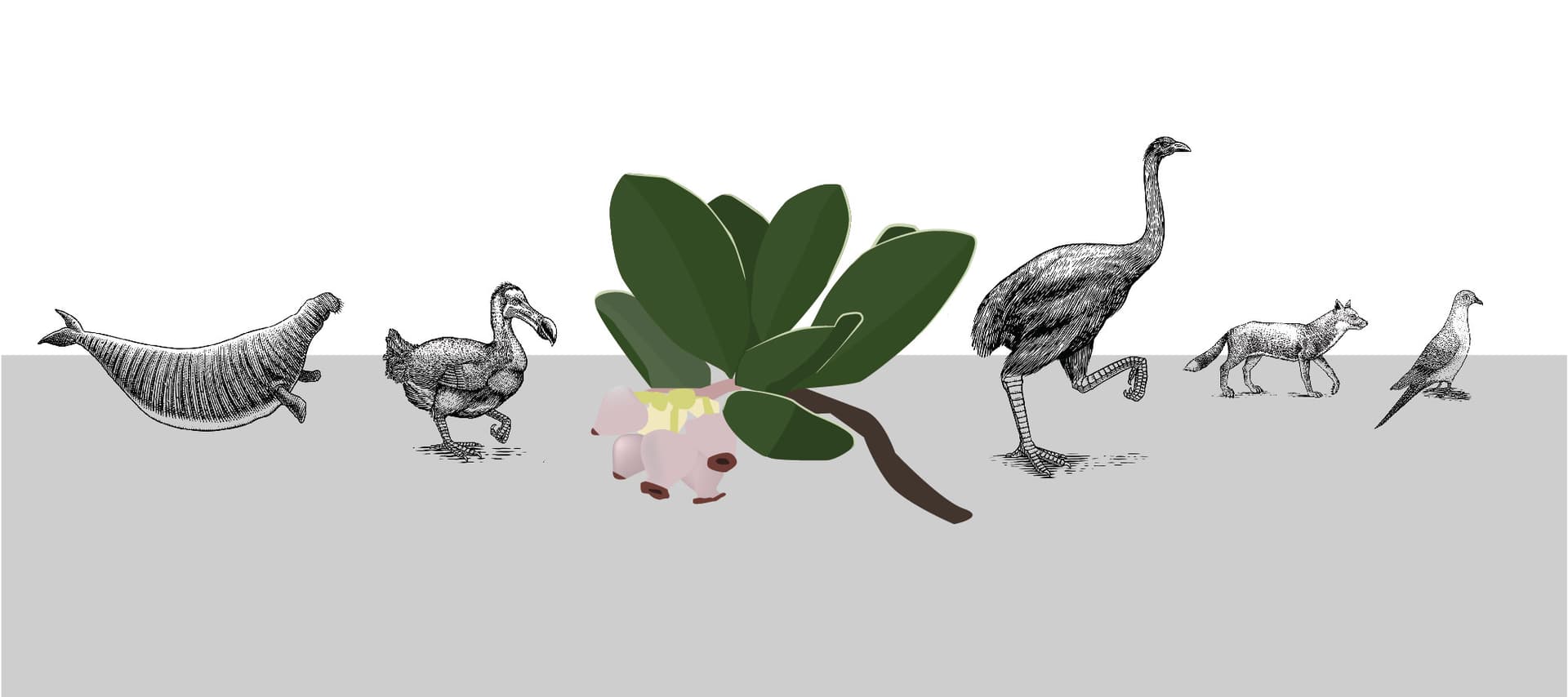
Not just any bush, though. It’s a bush with a pretty good story. I’ll tell the short version here. Native Californians will probably be familiar with the Manzanitas. It is a family of shrubs and small trees with 105 species, 95 of which are found in California. The Francisican Manzanita is one of those species. It was identified in the late 1800s in the San Francisco Bay area, and it was not too long before the massive population growth and construction of the city started competing for space. And in 1947, the last Franciscan Manzanita growing in the wild was bulldozed.
Stump:
Or so they thought.
Hoogerwerf:
Yeah. As the story goes, in 2009, a botanist was driving down the highway past a road construction project which had cleared a bunch of vegetation except for one little patch, and he noticed a strange looking shrub. When he came back with some other botanists they confirmed that it was, as far as they knew, the sole living wild Franscican manzanita. They then went about relocating the specimen to a secret location in the Presidio.
Stump:
Lest we raise the anticipation too high, we can come right out and say that we did not find the secretly located Franciscan Manzanita.
Hoogerwerf:
And to be fair, we didn’t put a whole lot into the search. I did send a few emails, and it turned out I did have some coincidental connections to some people who really might have known something about this. But either they were tight-lipped or the secret has been kept really well. And being from Michigan, my familiarity with Manzanitas is pretty low, so I didn’t even really know what to look for.
Stump:
So mostly we just went for a walk in a place where we knew this last wild-living individual bush was nearby. And we walked around peering suspiciously into the trees wondering whether this ultra-rare bush was somewhere near – just in the shadows, maybe.
Hoogerwerf:
And this brought up lots of questions. Which eventually formed into this series. This exploration of extinction brings us to all kinds of thorny places and even some literally thorny places.
[sounds of walking through brush—You all right?, I stuck a thorn right in my finger]
Stump:
We’ll also go back in time to a meteor impact 66 million years ago, and to some more recent history of humans attempting to understand the strange bones they were finding in the ground.
Hoogerwerf:
This exploration of extinction also brings us to all kinds of interesting places philosophically and theologically. We’ll ponder the tension between understanding extinction as a part of a natural process of change and mourning the loss of creatures that play a part in making our world good and beautiful. And it has us even wondering about the ethics of bringing back some of those creatures that have gone extinct—and wondering about what it would mean for our own species to go extinct. [some foreboding music]
Stump:
Okay, but let’s not get there quite yet. All this will all happen over these three episodes with several other tangents, probably, along the way, and a few cool creatures that we’ll get to meet. But bringing us back to our manzanita. So the series is called Extinction. Obviously, this particular manzanita is not extinct. Not yet. In fact, since the relocation there have been efforts to reproduce more of them. And even before 2009, we knew that it was not extinct—not technically. There were a bunch of samples of this species surviving in botanical gardens.
Hoogerwerf:
Right. So maybe we can start off with a couple of definitions. And we’ll also start to introduce some of our guests who will be with us through the series. We’ll hear more from them going forward.
There are several, kind of, subcategories of extinction. So we could talk about something being locally extinct. Another word for that is extirpation.
Gonzalez-Socoloske
Yeah, extirpation, exactly—a word a lot of people don’t really know or use. Extinction is probably more in the vernacular of most people. But you know, extirpation is just as interesting because for the people that live in that region, it’s gone.
Hoogerwerf:
This is Daniel Gonzalez-Socolozke.
Gonzalez-Socoloske
I’m a professor of biology at Andrews University, and I’m also the director of our Museum for Nature and Science.
Hoogerwerf:
Daniel has spent a lot of time traveling and told one story that highlighted the reality of extirpation.
Gonzalez-Socoloske
So I interacted recently with someone from Mauritius, which is a tiny island in the Indian Ocean, kind of considered part of Africa, but, like, thousands of kilometers from Madagascar, which is already a distance from Africa, right? And we got chatting, and of course, the first thing I always ask people is, “Do you have the animal that I am interested in?” And in this case, it would be the dugong not the manatee. And he’s like, “No, I don’t think we have dugongs.” And a quick Google search shows me that they don’t have dugongs, but they did. So when the island was first found in, like, the 1700s, they had dugongs. They’ve been gone now for 200 years.
Stump:
You could also talk about something being functionally extinct.
Schloss:
So imagine that we had 20 dodo birds still left with 20 individuals, but they were all females. So they’re technically not extinct, but they’re functionally extinct.
Hoogerwerf:
Longtime listeners might recognize that voice.
Schloss:
Hey! I’m Jeff Schloss.
Stump:
Jeff teaches biology at Westmont College, and he’s the Senior Scholar at BioLogos. He’s been on several podcast episodes with us.
Schloss:
Or, you know, we could have several hundred leaf cutter ants. And there are lots of them, but not enough to build a hive and discharge all the responsibilities it takes to raise the next generation.
Hoogerwerf:
You could have something like they thought was true of the Franciscan manzanita—that it’s extinct in the wild, where the only remaining individuals are in captivity or gardens or labs. This is the case for some coral species, where in Florida the situation is pretty dire for a few of these.
Miller:
There has been a huge effort and a huge investment in essentially bringing some of the last few healthy corals from Florida coral reefs into human care, and to get them out of their environment, because their environment is killing them. And we’ve brought them into human care, and taken on that responsibility as a bit of an ark.
Hoogerwerf:
That’s Margaret Miller, another returning podcast guest.
Miller:
I’m the Research Director for an organization called SECORE International.
Stump:
So those are some sub-categories of extinction. And then you have, simply, extinction. That’s an easy one, right?
Brusatte:
It’s great to start off with something so deep and philosophical and thorny. I was gonna say that extinction is probably not as troublesome to define as species, but then I was just about to say, well, extinction is when a species dies out. So okay.
Hoogerwerf:
This is Steve Brusatte.
Brusatte:
I’m a paleontologist, who studies dinosaurs and mammals and other fossils. And I’m a professor at the University of Edinburgh in Scotland and author of pop science books like The Rise and Fall of the Dinosaurs.
Hoogerwerf:
We’ll get back to Steve shortly because he’s going to take us on a tour through the history of extinction, but he’s already pointed out a bit of a roadblock which several guests brought up.
What Is a Species?
Schloss:
First of all, what’s your definition of species?
Sollereder:
I need to build some groundwork here first, though—
Stump:
That voice is Bethany Sollereder. Bethany is a lecturer in science and religion at the University of Edinburgh, and she’s been a frequent contributor to the podcast.
Sollereder:
—because extinction only happens if you have a species delineation. And species delineation is something that humans more or less makeup. Right. So our notion of extinction is tied to our notion of species.
Hoogerwerf:
We’ve talked a little about the species problem before on the podcast, but we’ve talked about it a lot off-air. In fact, I can remember pretty early on when I started working with you, this idea came up, and we’ve been circling around it now for six years.
Stump:
Some of our colleagues play this up as a big debate between us. I’m not sure it’s a debate as much as an attempt to understand how we are each defining the terms. I think we both agree for example, that species are not cut and dried like we often make them out to be.
Hoogerwerf:
Yeah, I think that’s right. But why don’t we explain that just a little bit more. What does it mean that a species is “fuzzy”? We’re not just talking about fur.
Stump:
Well, when you look around you, or maybe if you were to walk through a zoo, the idea of what a species is could seem pretty clear. There is a different one in each enclosure; they look different. But when you zoom in and start to look at similar creatures, like an African and Asian elephant maybe, then it is not so clear. And when you look over time, the differences between types of living things show up as more of a spectrum. It’s not quite as simple as whether two creatures can reproduce.
Schloss:
The kind of the textbook definition that biology undergraduates encounter is the biological species concept—
Hoogerwerf:
—which is determining a species based on whether two individuals can reproduce and create viable offspring. That definition works for a lot of creatures in one slice of time, but it doesn’t work so well for some kinds of creatures, for example those who reproduce asexually. And it doesn’t work so well when you start looking over long time scales. Humans at one point interbred with neanderthals, and yet we say we are different species.
Stump:
I have a book here on my shelf that lists more than 20 different ways of defining what a species is. Besides this reproductive compatibility, there are genetic similarity and morphological similarity, and bunch of other, kind of, intuitive ways to group together individuals into species, but none of these works all the time.
Hoogerwerf:
I remember learning about this problem in biology classes and I fully accept that “species” is a category we have created to group things, and that our categories don’t always work very well. But what I hesitate to do is to say that because our categories aren’t perfect, that means there’s no such thing as dugong or a Franciscan Manzanita, and when the last manzanita dies, that something hasn’t been lost.
Stump:
And my perspective is that the something that has been lost is a group of related individuals that left no offspring. But to say that there’s something else real that’s been lost from the world—a species that’s in addition to those groups of related individuals—I just don’t know what that is.
Hoogerwerf:
Ok, well, I propose we put a pin in this for now, though I imagine it will come up again before we’re done. We can go forward accepting the fuzziness of species but still holding onto the category as scientists have used it to group related individuals.
Stump:
And that would bring us back to the “simple” definition of extinction:
Brusatte:
It’s when something ceases to exist anymore. Not an individual or when an individual ceases to exist, that’s death. But extinction is when an entire group of something ceases to exist. And, I mean, we could talk about a certain population going extinct but normally what we would use the term extinction for is if the entire species or type of organism, whatever you want to say, is gone everywhere. It’s completely died out; there’s none left.
Schloss:
At face value, the very simplest notion of extinction is a species that was here is no longer here; the last representative of that species is dead. Now, extinction really can involve the loss of any taxonomic unit. It could be we could lose a genus or a class or an order. But of course, in order to do that, we have to lose the species that comprise those units.
Stump:
This is really not going to be surprising stuff to most listeners. Extinction is something that has been popularized and well understood. Everyone knows the basic idea of what it means to go extinct.
Hoogerwerf:
Yeah. I grew up hearing about whales and tigers and rhinos and grew up with these stories of the last remaining populations—even the last remaining individuals—and these stories were built around raising the alarm. I remember feeling very worried that when I grew up, I would never have the chance to see a rhino.
Human Understanding of Extinction
Stump:
The idea of extinction is so well told now, that it’s surprising to learn that it wasn’t so long ago that extinction wasn’t even a concept that anyone had considered.
Hoogerwerf:
And I think it will be interesting to try to step into this world for a bit. And we don’t have to go back too far to get to a time when people weren’t sure what to make of the evidence of creatures that they no longer saw in living form.
Davis:
The conversation about that begins really in the 17th century.
Stump:
This is Ted Davis. He is a historian of science and wrote a lot of articles for the BioLogos website in the early days.
Davis:
I’m professor emeritus of the history of science at Messiah University.
Hoogerwerf:
Before the 17th century, it’s not totally fair to say that no one had ever considered the idea of extinction, but it definitely wasn’t the way people were making sense of what they were seeing. But they clearly were finding some strange things in the ground.
Davis:
For example, back in the time of Christ, the Emperor Augustus had a museum of large bones in a villa he had on the island of Capri, and they were recognized as the remains of both land animals and sea animals of great size. And this caused quite a bit of stir in times because, you know, it would have been known that the emperor had this.
Stump:
A couple hundred years later, in his book The City of God, Augustine mentions bones from some large creatures.
Davis:
He mentions how he’s part of a small group of people who found what he describes as a human molar.
Hoogerwerf:
The thing is it’s really big. Like 100 times the size of a typical human molar.
Davis:
He thinks it’s a giant human that he has a molar of, although it was probably a mammoth or Mastodon tooth that he had uncovered roaming the shores of the Gulf of Tunis. And he’s thinking, really, of biblical texts that mention, specifically, you know, there’s giants in the earth in those days, as it says, early in Genesis, and one of them he thinks had been Adam’s son, Cain. How else could one man have built a whole city? He wonders that…he must have been a big guy, if you will.
Hoogerwerf:
So pretty clearly people are finding evidence in the ground of creatures that they do not see walking around. And sometimes the explanation for that could just be that the creatures are no longer in that part of the world.
Stump:
They just moved somewhere else.
Hoogerwerf:
And that’s a pretty convenient explanation for what happened to creatures when much of the world is still unexplored. It starts to get a little harder as time goes on. Another explanation for some of the fossils they’re finding was that it was just a natural process that formed these rocks, and they just happen to resemble living forms. But again, as time goes on, it gets harder to make that case too.
Stump:
Well let’s have time go on a bit here, bringing us up to the 1600s when the scientific conversation about this really heats up.
Hoogerwerf:
Then we better talk about the mystery of tongue stones at the time. People were finding objects in the ground that they decide look a little bit like a tongue, and so they call them tongue stones. We know now that these are the fossilized teeth of huge extinct sharks. But the guy who finally says these can’t be rocks that formed underground…
Davis:
That’s Nicholas Stenson, known often in the literature as Steno.
Stump:
Steno is a Danish scientist who worked for the Grand Duke of Tuscany. That’s kind of like a tenured Harvard position for today’s scientist.
Davis:
in 1666, there was a large shark caught near Livorno, and they brought the head to Stenson for dissection.
Hoogerwerf:
And he sees that the teeth of this shark look an awful lot like those tongue stones.
Davis:
And he believed those tongue stones could not have been formed in the earth because they were often encased in rocks that were imprinted with the shapes of the teeth, and so the teeth had to come first before the rock around them. And he argued for their organic origin the next year in a treatise he called The Head of a Shark Dissected.
Hoogerwerf:
So Steno publishes this stuff—also, great title, they don’t title treatises like that anymore do they?—and this treatise influences a few other people, but mostly people don’t believe him.
Stump:
To be fair, there was a lot going against this idea at that time. Many of the sea creatures being found were at the tops of mountains, nowhere near the sea. And while they knew rocks could “grow” or at least form in the ground from natural processes, they knew it takes a very long time. Without the geological history of earth that we have now, this idea from Steno wasn’t quite ready to take hold.
Hoogerwerf:
And it’s not only the science that is getting in the way. It’s worth noting that many of the important figures were committed people of faith. Steno was a Catholic bishop, and a contemporary of Steno was John Ray.
Davis:
John Ray was a very devout English naturalist.
Hoogerwerf:
And while he was studying fossil shellfish, he became pretty well convinced that these creatures were totally gone. That fact came into some conflict, though, with his theological ideas and he writes a theological treatise in the late 1700s. In that he says that if a kind of creature were to go out of existence—
Davis:
“It would hence follow that many species of shellfish are lost out of the world, which philosophers hitherto have been unwilling to admit, esteeming the destruction of any one species a dismembering of the universe and rendering it imperfect.”
[musical interlude]
Stump:
I don’t want philosophers to take all the blame here, but there was an idea from philosophy and theology that species are static, and even that it would be a stain on God’s creative efficacy if things that God brought into being, could go out of being. So it was not just a lack of convincing fossils that prevented people from accepting extinction, but the underlying ideas about what species are and where they fit into creation.
Hoogerwerf:
Well, let’s move to an important figure who really helped provide the empirical evidence that eventually forced those underlying ideas to change: Georges Cuvier.
Davis:
Cuvier is the one that kind of finalizes this conversation. This is the very late 1700s.
Hoogerwerf:
Cuvier is studying fossil bones from mammoths and mastodons.
Davis:
He is an anatomist by training. He’s a superb comparative anatomist. Nobody in the world knows more about it than he does. And he publishes detailed studies of the jaw bones of these extinct animals. And the fact that these are mammoths and mastodons that he’s working with, I think is a crucial piece of this, because you just had to give up this argument that these things are still out there somewhere. “Oh…really? You know, okay…where are they?
Hoogerwerf:
Thomas Jefferson was kind of famously opposed to the idea of extinction and continued searching for living examples of the fossils he collected into the early 1800s, even sending people like Lewis and Clark out west to find the living examples of these creatures. But over this whole time period, starting in the 1600s and going to the 1800s, science had steadily pushed back the age of the earth, and geological processes had become increasingly understood. And after Cuvier, with a few exceptions, like Jefferson, this idea of extinction is pretty quickly accepted by the scientific community.
Davis:
By about 1800 everybody who was involved in this conversation—and at least in the Western world—accepted the reality of extinction.
Hoogerwerf:
This story of coming to understand extinction as a phenomenon in nature has a lot of other really interesting people and stories that go along with it, that we can’t do justice to here. But I think one of the really interesting takeaways is simply how recent this understanding is, and maybe that’s surprising because of how obvious and engrained this is to us today.
Stump:
The history of ideas is really fascinating in this respect. It’s hard for us to work ourselves back into the framework of how they thought and what was obvious and engrained to them. For example, when you showed me a picture of the tongue stones, my response was: I don’t see a tongue there; it looks like a big tooth! But if you didn’t have the categories of huge sharks that once existed and no longer do, what else are you going to think they are?
Hoogerwerf:
It’s pretty incredible that people over this relatively short time period, about 200 years, were able to make some pretty drastic changes in how they view the world. And they had to rethink a lot of their philosophical and theological worldview to make sense of it. And it’s also pretty interesting, that this seems to be a somewhat forgotten change. Most people I’ve talked to don’t realize how recent our understanding of extinction is.
Scientific Understanding of Extinction
Stump:
Today we know that there have been many many creatures that have existed on this planet that have gone out of existence. In fact, something like 99% percent of all species that have ever existed are now extinct. Sometimes you hear 99.9%
Hoogerwerf:
That seems like actually kind of a significant difference between 99 or 99.9%. I guess some of that is due to the rate at which we continue to discover and describe species; it’s not entirely clear just how many total species there are today, let alone throughout all of history.
Stump:
Yes… and it would help us do the math if we could actually define a species!
Hoogerwerf:
Well let’s take a trip a bit further back into the past to meet some of these…what do you want me to call them?
Stump:
How about “groups of closely related individuals that share important characteristics but have no overarching form or essence”?
Hoogerwerf:
Catchy. Well, let’s go back in time to about 440 million years ago, the Ordovician Period. Just before this was the Cambrian period when there was a great diversification of life—the cambrian explosion. In the Ordivician almost all of the landmass on Earth is in the Southern Hemisphere, mostly centered over the South pole. Most of life is still in the water, but a few creatures started exploring land. The ocean was home to trilobites and nautiloids, which were early cephalopods with tentacles and long pointed shells, some up to 18 feet long. And there were some of the first vertebrate fish that lived mostly in the shallow waters away from the large predators.
Stump:
And then, for the first time on earth, a huge percentage of species went extinct. Estimates are that 85% of the species living then on Earth went extinct at the end of the Ordovician. This is the first mass extinction on earth.
Hoogerwerf:
We probably need to define what a mass extinction is. Let’s go back to Steve Brusatti.
Brusatte:
So there have been throughout Earth’s history, there have been five major mass extinctions. And these are ones that stand out from the background in an extreme way. And this was first identified by a couple of very eminent paleontologists, Jack Sepkoski and David Raup when they were compiling lots and lots and lots of data from the fossil record. This was in the 60s/70s/80s, they were building these big databases really before there were many databases. Now everything’s database, but they were compiling all this information from the published literature, every species of snail, every record of a clam, every ammonite, every fish, and so on. So they could look at big scale patterns and evolution over time. And they built a curve of diversity showing the number of species over time. But they corrected that in various ways, because, of course, the fossil record is not perfect. And they showed that there were these five times over the past 540ish million years, the time that big animals have been alive and plants have been alive and so on before then it was mostly bacteria and smaller things. So in the age of plants and animals, there have been these five times where many, many, many species have died out quite rapidly, at least in geological terms, all around the world, because of some kind of common cause. And that’s what a mass extinction is.
Stump:
Now Steve said there’s not like some specific percentage that it has to be for it to count as a mass extinction. But there does seem to be a kind of running definition that says that around 75% or more of species go extinct within 2 million years. But these five times seem to be pretty big outliers to the way things have normally gone.
Hoogerwerf:
So five mass extinctions. We’ve already talked about the first, at the end of the Ordivician. Often, the line between one geological period and the next corresponds to an extinction event like this one.
Stump:
Not too surprisingly, the same things that cause massive geological changes that can be detected by geologists in layers of rock—things like dramatic climate shifts or volcanic activity—these also tend to cause a lot of extinctions.
Hoogerwerf:
The end of the Devonian is another extinction event. That one we know a little less about, and it’s possible that it may have happened in pulses, more so than the swiftness of Ordovician or the next mass extinction…
Brusatte:
The one at the end of the Permian period, about 250 million years ago, the biggest extinction ever, maybe 95% of species died out. That was caused by big volcanic eruptions.
Stump:
That’s three. Number four is at the end of the Triassic, 200 million years ago when about three quarters of life went extinct, mostly affecting marine life.
Hoogerwerf:
And number five is the most recent mass extinction and the one we know most about.
Brusatte:
Yeah. Well, I mean, it is like a disaster movie.
Stump:
But any good disaster movie needs a little setup. So before we go right to the climax, let’s get a sense for this world before the disaster strikes.
Brusatte:
So things were healing in the Triassic period, the land had all come together and on this new landmass that was recovering you had the first dinosaurs the first mammals. Now from that point on dinosaurs and mammals, their fates would be forever intertwined, but they had different fates. The dinosaurs were destined for greatness. Some would become enormous, you know, literally meat eaters the size of double decker buses, long-necked dinosaurs heavier than Boeing 737 airplanes, absolutely stupendous, sublime animals. Mammals lived alongside those dinosaurs for over 150 million years. But mammals never during that time got to be bigger than a house cat. Because the dinosaurs kept them down. You know, the dinosaurs were so good in those large body ecological niches. But conversely, you never saw a T-rex the size of a mouse or a triceratops the size of a rat, because the mammals became really good at being small, at living in burrows, at hiding and coming out at night. They were fantastic in those small bodied, more hidden ecological niches. And for 150 million years or so that was this evolutionary equilibrium more or less.
Stump:
Which brings us to that fateful day.
Brusatte:
66 million years ago, it was a spring morning, dinosaurs all around the world were waking up, they were still at the top of the food chain, still at the top of their game. There were meat eating dinosaurs, plant eating dinosaurs, big ones, small ones, ones living on the continents, which by that time had been separating from each other for a while, ones living on islands, dinosaurs at the peak, or at least near the peak of their success. And little did they know that hurtling through the heavens, traveling more than 10 times faster than a speeding bullet was this space rock, you know this piece of space junk. An asteroid. And it could have gone anywhere. But it just so happened to make a beeline for the earth and it smashed into what is now Mexico with the force of over 1 billion nuclear bombs put together.
Stump:
As you can imagine, that unleashed some serious destruction.
Brusatte:
It punched a hole in the Earth’s crust more than 100 miles wide. It unleashed tsunamis, earthquakes, wildfires. All the dust and dirt and grime and soot and smoke went up into the atmosphere, blocked out the sun, probably for a few years. So for a few years the earth went dark and cold. It was a global nuclear winter. Plants couldn’t photosynthesize. They died, forests collapsed, and ecosystems collapsed with them. And it was from all of that, that the 75% of species that died, that they met their doom.
Hoogerwerf:
Compared to some of the other mass extinctions, this one happened incredibly quickly.
Brusatte:
If you were a frog or a salamander, and your entire species lived on the Yucatan peninsula of Mexico, you would have been incinerated, the whole thing, in an instant. I mean, crazy. Other species it would have taken longer, you know, but really geologically speaking, it was pretty quick. Probably the whole thing was over within at most a few 1000 years.
Stump:
All this destruction, the loss of 75% of species including all non-avian dinosaurs, was of course the event that led to mammals finally getting a chance to escape the confines of a niche they had been stuck in for 150 million years.
How Should We Feel about Extinctions?
Hoogerwerf:
So this being the last of the 5 historical mass extinctions, that brings us back to the present once again, at least geologically speaking. And that also means that we’re coming to the end of this episode. We’ll move fully into the present in the next episode. And a part of understanding the present is trying to understand how we should feel about all this. When we talk about this mass extinction, I suppose there could be a little sadness. We can empathize with the dinosaurs, probably in part because we’ve been given so many stories and movies and cartoons to help put us in their place and imagine an asteroid hurtling toward us.
Stump:
But even if there is some sadness from not being able to see these awesome creatures, there’s also a positive aspect to the extinction events of the past.
Brusatte:
Extinctions can clear away the old and usher in something new. They can be revolutionary. And they do change things, they replenish and they refresh. And us as mammals, really, the only reason we’re here having this conversation is because that asteroid just so happened to fall out of the sky and wipe out most of the dinosaurs, freeing us from that 150 plus million years, where yeah, our ancestors were successful in their own way, but they were kept down by the dinosaurs. If that asteroid didn’t hit, you know, as catastrophic as it was, as horrible as it might be to think about that destruction, if it didn’t happen, we wouldn’t be here. So in that sense, I’m appreciative of extinction.
Stump:
You could even look at this through more of a theological lens. As we’ve said, 99% of all species that have ever existed are extinct. There’s no way all of those creatures could live on earth at the same time. And so, by creating this way, by having a system which includes death of individuals and groups of individuals, many more things get to exist. So instead of charging God with incompetence or wastefulness, God could be seen as a more lavish creator because of the many kinds of things that have gotten to exist for a time. That might be a bit of a redeeming feature of extinctions.
Schloss:
I think it’s both redeeming but also necessary, because, as you say, all the species we’ve seen could not possibly live on earth at the same time. So for one thing, just the face value level, you have to take turns. But there’s something more going on here. It’s not only a matter of taking turns. Two other things: it’s that species have impact on the environment. And many times the impact of earlier evolutionary stages has been necessary for a subsequent stage to emerge. Environmental resources and niches are created that then downstream species inhabit. So that’s important. And then one other thing. You know, if it’s just a matter of—let’s imagine God created species miraculously, independently, and ”Okay, time for you to go, there’s not enough room anymore, I want to put somebody else on the stage.” But that’s not how it works. Evolution is cumulative. So downstream species actually employ the genetic resources of species that have come before. So what extinct species have done is they have built a genetic scaffolding for what’s to come.
Hoogerwerf:
In that sense, while many individuals, species, even whole genuses and orders have gone extinct, they are all still here in a way, because every living thing that has existed on this planet has become the scaffolding for us and for all our living neighbors. Here’s Bethany Sollereder.
Sollereder:
if I’m thinking theologically I’m gonna say that there’s some sort of story of cruciformity and resurrection that seems to play out in how life responds, that every time meaningless death, you know, seems to overtake the world and shadow our hopes there’s an unforeseen resurrection, in in the way that life rebuilds. But again, the timescales of that are very, very long. Whereas what God has created this world to do, in my idea, is that it is meant to generate novelty, and newness. And extinction is actually a really important part of that process.
Copeland:
Thinking about how those species forms have transformed into a variety of others, helps us think of the fact that some things have gone extinct as not wasteful.
Hoogerwerf:
This is Becky Copeland.
Copeland:
I’m Assistant Professor of Theology at Boston University School of Theology where I run the faith and ecological Justice Program.
Stump:
We had the chance to walk around the Harvard Museum of Natural History just before talking to Becky about extinction, where we saw the bones of many extinct creatures—pterodactyls and ground sloths and many other creatures that are no longer on earth today—and we had a chance just to be in awe of how much diversity has come before us.
Copeland:
It can still be tragic. It’s still something you can mourn, that you will never encounter this particular life form and that no one now can encounter that particular life form, but if it has passed on, because it has transformed into a multitude of ways of being, multiple species, enriching the diversity of the world, enriching the relationality of the world, because there’s more ways of being in relationship now, then it’s a part of transformation that I would think of as growth.
Hoogerwerf:
This could feel like a tidy kind of ending. And we are coming to the end of the episode, but I’ve never been one for tidy endings. This all seems a little too easy. We look back and see all this great destruction and death and we say well it is all actually a good thing because it has led to new life and to us. And there’s truth and wisdom in that, that we’ve just heard. But the thing is extinctions and death and destruction are not only things of the past.
Brusatte:
But where things get different is in the modern world, because there are extinctions happening now. It’s hard to tell if we’re really in a mass extinction, geologically speaking. You know, the number of species dying is very small so far, compared to any of these great die offs of Earth history. But it could go that way. Because climates, temperatures, environments are changing so rapidly in the world today. And it’s because of us. It’s because of us. So there are species that are going extinct because of our species. And so that’s something that I’m not ambivalent about, not value neutral about. I think that’s something we should actively try to stop. And in that way, you know, the extinction of say something like a dodo or a passenger pigeon. That’s very different than the extinction of a T-rex to me.
Copeland:
And I think that’s where we have to distinguish between extinctions that are happening now and what we were looking at in the museum extinctions that happened before human beings. Because we are in the Anthropocene, we are now seeing extinctions that you can’t divide from, you can’t set apart from human abuse of the world. There would have been extinctions without human abuse of the world. But climate change, pollution, toxic waste, plastic waste everywhere, but more more the habitat fragmentation and things like that, we have not left room for the plurality and diversity of life, and it is going. And there is very real grief on the part of those who notice it.
Stump:
So that’s part of what we’ll do in the next episode. We’ll start by exploring the extinctions that are happening today and see what we can learn about the science of current extinctions. And then we’ll start to do the work of figuring out how we should feel about today’s extinction and what we can do about it.
Hoogerwerf:
That’s on the next episode. See you then.
Credits
Hoogerwerf:
Language of God is produced by BioLogos. BioLogos is supported by individual donors and listeners like you. If you’d like to help keep this conversation going on the podcast and elsewhere you can find ways to contribute at biologos.org. You’ll find lots of other great resources on science and faith there as well.
Language of God is produced and mixed by Colin Hoogerwerf. That’s me. Our theme song is by Breakmaster Cylinder. BioLogos offices are located in Grand Rapids, Michigan in the Grand River watershed. Thanks for listening.