Stump:
Welcome to Language of God. I’m Jim Stump.
Hoogerwerf:
And I’m Colin Hoogerwerf
Stump:
This is the second episode of our series, Extinction. Last time we stayed mostly in the past. First we went back only a couple hundred years to when humans first figured out that extinction happens. And then, having caught up to our current understanding we went back a bit further—440 million years to be more exact, to the first mass extinction event—to see how this has played out over Earth’s history.
Hoogerwerf:
In this episode, we’ll stick a little closer to the present, to look at how extinction plays out in a time-scale that is a little bit easier to comprehend and try to see what the science has to say about extinctions happening in these current times. To be geologically accurate we’re sticking in the Holocene for this episode. That’s the geological epoch that started almost 12,000 years ago and goes to today.
Stump:
Some people might want to argue that 12,000 years ago isn’t quite the present.
Hoogerwerf:
Yeah, that’s fair. But let’s channel the geologists a bit and understand that the world 12,000 years ago was at least recognizable in a lot of ways. And we really will spend most of our time in the current century. Actually, if we want to be a little geologically edgy then we could say that we’re now in a new epoch, the Anthropocene, which some geologists are arguing is just beginning. That is not an official geological designation as of yet. Geologists are still arguing over whether it is a new epoch and if it is what date would mark its beginning.
Stump:
Well, as we learned in the last episode, when the earth changes so much that it can be seen by geologists in rock layers, that often comes along with an extinction event. Those 5 mass extinctions from our last episode were examples of that.
Hoogerwerf:
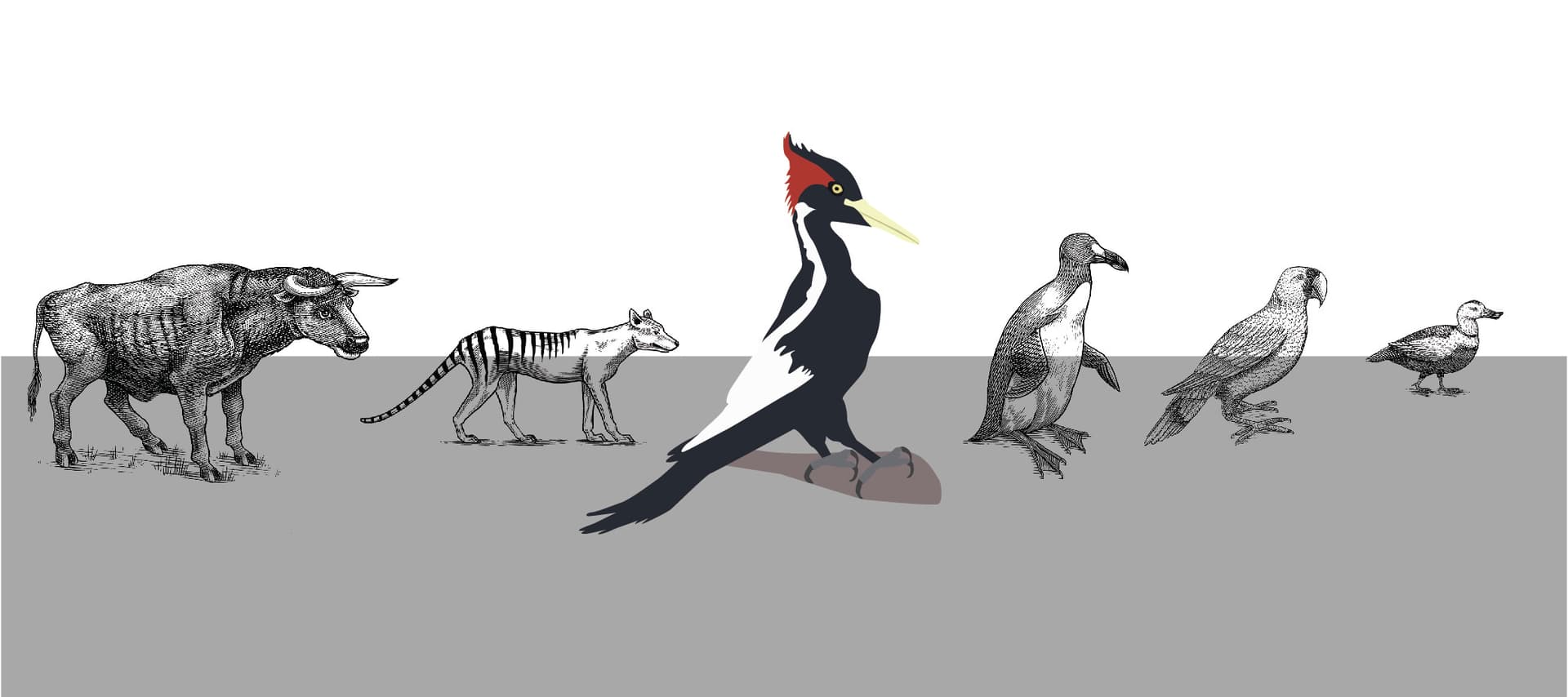
A lot of people probably have heard something about the sixth mass extinction, which refers to the loss of species that is happening now. That would be right in line then with transitioning from the holocene to the Anthropocene, one epoch to the next. The difference is that with the 5 prior mass extinctions there were no humans around. They were caused by things like volcanoes and asteroids, rising and falling sea levels, not by the actions of any one species. Even something as ferocious as a t-rex wasn’t causing global mass extinctions. And now the main causes of extinctions in the holocene are directly tied to human actions. Take some examples from the last century or two: wiping out the passenger pigeons, over-hunting whales, killing large predators like the thylacine in Australia.
Stump:
What are thylacine? Sounds like a medication or a kind of plastic.
Hoogerwerf:
It was a marsupial predator, maybe more commonly known as the Tasmanian tiger. The last known thylacine died in a zoo in Tasmania in 1936. But human interaction with animals goes back a lot longer than a century or even a few centuries.
Harper:
The outsized impact of humans is very old. In fact, it may even to some extent, predate Homo sapiens
Hoogerwerf:
This is Kyle Harper.
Harper:
I’m a faculty member at the University of Oklahoma and the Santa Fe Institute. I’m a historian who studies the interaction of humans and the environment.
Hoogerwerf:
Kyle is working on a book about the history of humans and other animals.
Harper:
Our relatives over the last 2 million years or so, belonging to the genus Homo already have traceable, detectable impacts in the fossil record on biodiversity. And so, one example I would give of this is turtles.
Turtles & Elephants
Stump:
Let’s hear about turtles.
Hoogerwerf:
Yeah. Turtles are a pretty cool group of creatures.
Harper:
They’re reptiles that have been around, relatively speaking, forever, like for half of the history of animals, which is extremely weird. They’re over 250 million years old, as a lineage. They are diverse. They’re abundant. They’ve survived three mass extinctions so far. So they’re really resilient creatures. They fascinate humans, and rightly so. They’re symbolically really powerful in a range of cultures, for good reasons. They’re amazing animals.
Stump:
We got to see a member of the turtle family recently, a green sea turtle named Myrtle, at the New England Aquarium, where we also got to see a bunch of other endangered species.
Aquarium:
Shall we go upstairs and say hi to Myrtle the Turtle?
Hoogerwerf:
Yeah and Myrtle was huge. What did our guide say? Something like 500 pounds. And that’s not out of the range of what they could be in the wild.
Aquarium:
Yeah, it’s not unprecedented. You’re wondering, because she doesn’t have to worry about predators, she has a constant source of food, if it was not unprecedented, but we have had observations of big green sea turtles like her out in the wild.
Stump:
Yeah and somewhere around 70 to 90 years old.
Hoogerwerf:
Turtles, as a family, obviously aren’t extinct. In some ways they’re pretty ubiquitous. You don’t have to go to an aquarium to see a turtle. You can still see them in the wild even in urban places. But that maybe doesn’t capture the story of turtles completely.
Harper:
I think it’s probably hard for us today to really see the way the world was. I personally think that the world used to be totally covered with turtles, and maybe even in some cases quite literally. If you look at some of the accounts of Europeans arriving on on distant, untouched islands that humans just hadn’t been able to get to until the 16th century, the stories that they tell about being able to walk for miles, stepping only on the backs of turtles, is maybe a little dramatic and exaggerated but I think captures some of the really extraordinary reality of the success of this lineage. And yet over a fourth of all turtles known from the Pleistocene are already extinct, and three-fourths of the remaining turtles—there’s 350-something species identified, and surely a few more than that—but some two-thirds or more of the ones that survived are at some level threatened. And surely their abundance is already in many, many cases, dramatically reduced.
Hoogerwerf:
That reduction is pretty well-correlated with the rise of humans.
Harper:
This animal was doing great because it had this really weird adaptation of turning its bones into an external shell that works really well against predators, until you get a predator that has opposable thumbs and goes everywhere and can build tools to crack you open.
Hoogerwerf:
We all know who that is. Well, let’s learn about one more group of creatures that came into a kind of collision with early humans.
Harper:
It’s very dangerous to be a large animal when humans arrive on the scene in the last Ice Age. And I think a sort of prototypical or symbolic animal for understanding this is elephants.
Hoogerwerf:
There are three species of elephants today, and they are well-known and well-loved for good reasons and have become symbols of conversation and protection of animals. But once again, the species that remain are only three of many others that did exist.
Harper:
We should think of elephants—three species—as sort of the remnants of a once really flourishing lineage. Elephants are a flourishing, rich, abundant, dominant lineage right down to the last Ice Age, the Pleistocene. And then something really unprecedented in their very deep evolutionary history happens really suddenly. Over the last 30,000 to 50,000 years, elephants start rapidly contracting and losing their dominance, and then in many cases—like, say, the mammoths—going extinct.
Stump:
And I can see where this is going. Once again this seems to coincide with the rise of humans.
Hoogerwerf:
Yeah. And I mentioned the sixth mass extinction earlier, and we learned about the five earlier mass extinctions last time. But there’s another extinction that doesn’t meet the criteria for a mass extinction but is still interesting, even if it doesn’t have the catchiest of names…
Harper:
Scientists call this the Quaternary megafaunal extinction. Terrible name. Nobody’s going to get excited about that, but it’s a hugely important thing. As humans spread around the world, big animals die.
Stump:
There’s ongoing debate about the exact causes of these extinctions, whether it is human hunting or changing climate. That probably means that both are almost surely part of the reason.
Harper:
There’s no doubt that the arrival of humans who are tool wielding hunters, who in many cases have dogs, who are incredible species as well. Dogs are just gray wolves who are amazing hunters. So the two most successful predators on the planet in the late Ice Age team up, which is extremely unfair; and, you know, not coincidentally a massive number of big-bodied animals die out.
Hoogerwerf:
So there’s a story that starts to emerge that as humans become human, start doing the things that humans do, that we start to play an outsized role in the trajectory that animals take.
Stump:
Can I stop us here and say I’m not sure if I’m ready to blame those early humans in a moral sense for causing the extinctions of large animals when they moved into the neighborhood? It’s a complex story to tell about when our understanding of morality developed. There were hints of it, surely, by this time, particularly in how we treated others in our own clan or tribe, but I’m not sure our moral responsibility yet extended to care for the planet and its ecosystems. For example, Genesis and our designation as image-bearers hadn’t been written yet!
Hoogerwerf:
Yeah, that’s a really interesting question. If we have responsibility for creatures, when did that start? The changes that humans brought also had some really positive effects on some creatures.
Stump:
Those early wolves that we domesticated ended up doing pretty well as the myriad breeds of dogs we can see today.
Counting Extinctions
Hoogerwerf:
Yeah, and other animals that have become domesticated for food—like chickens, sheep and goats. And some wild animals that adapted really well to the new kinds of niches we created—rats and cockroaches. A lot of plants did remarkably well: coffee, sugar cane, Kentucky bluegrass, to name just a few. But pleading ignorance for those early humans doesn’t get modern humans off the hook for continuing the trend. Biodiversity loss has continued at a rapid pace. Along with the sixth extinction, people have probably also heard some of the headline kind of numbers which are thrown around…
Pimm:
You know, you sometimes hear people say, “Well, a million species are about to go extinct” or “30 species are going extinct per day.”
Hoogerwerf:
That’s Stuart Pimm.
Stuart:
I hold the Doris Duke Chair of Conservation at Duke University. And I’m president of a nonprofit called Saving Nature, which restores ecosystems in the biodiversity hotspots.
Stump:
Stuart is a major figure in this field and has published many papers in the journals Science and Nature about extinction and biodiversity.
Hoogerwerf:
Yeah, so this point about how many species go extinct in a day…if you do a quick search, you might find a number like that. Or I actually saw much higher numbers, like 150 a day, which is a number that came out of the UN Convention on Biological Diversity. And I’ve done those searches. In fact, that’s part of what set me off on this whole extinction exploration. For an episode we did a while back, I wanted to say something about biodiversity loss, and I remembered hearing statistics about how many species are lost in a day, and I thought, “Well, if 30 species go extinct every day, I wonder what species went extinct yesterday.”
Pimm:
The problem with numbers like that is we don’t know what those species are because we don’t know how many species there are. There’s a lot of species that we don’t know. We don’t know how many kinds of fungi there are, or how many species of insect.
Stump:
This problem with trying to simplify extinction to a number of species ties back into the talk of the sixth mass extinction. That term—the sixth mass extinction—has become a kind of buzz term, and it seems like it has just slipped into the public consciousness as an unquestioned fact.
Schloss:
And it turns out, there’s some debate over whether we’re in a sixth major extinction.
Stump:
That’s Jeff Schloss again, whom we met last episode.
Pimm:
That’s a term that I don’t like. It sounds, you know, fantastic; it sounds alarming. Well, two things: it hasn’t happened yet. We are moving in the right direction, but the reality is it’s very hard to compare what happened now with what happened when, you know, an asteroid slammed into Yucatan 60 odd million years ago.
Schloss:
There’s no question that the rate of extinctions right now is about maybe probably 1000 times greater than the basal rate of extinctions that we can infer across Earth’s history. But it’s still pretty early. The total number of species that we know or guess we’ve lost is a very, very, very small percentage of total species.
Hoogerwerf:
In the five mass extinction events in the past, there was a loss of 70 percent or more of the currently existing species. Those mass extinctions show up as outliers when we track diversity from the fossil record. And some of the mass extinctions we learned about had 85 percent or even 95 percent of species die out.
Stump:
If we use the same kind of metrics to decide whether we’re currently in a mass extinction event, and we look at the percentage of species we’ve lost even in the last couple of centuries, we’re nowhere near that number. It’s probably somewhere closer to 1 percent.
Schloss:
And so the question is, is there good reason to believe that we can extrapolate that rate and that it will continue into a sixth major extinction? Or, that is to say, are the environmental causes of extinction, operative now, are those sufficient to propel us to a sixth major?
Stump:
Right, so maybe we’re just at the beginning of a mass extinction. We haven’t lost enough species yet to make the cut, but we’re on our way. If you had taken stock during the first few centuries of one of those historical mass extinction events that we talked about last episode, you probably wouldn’t have seen 70 percent of species gone then. Those mass extinctions often took hundreds of thousands of years or more. But if someone had been around to take stock back then, they might have seen that species were dying out faster than new ones were replacing them.
Hoogerwerf:
Right, so that’s an extinction rate. Jeff referenced this idea that extinctions are 1000 times greater than the background rate—that number comes from research by Stuart Pimm.
Pimm:
So all those kind of dramatic estimates of how many species are going extinct are incomplete. So what can we do? What kind of things can we say? So 20-odd years ago, my colleagues and I decided we ought to take a lesson from how we talk about the human condition.
Stump:
When we talk about human populations, we can talk about numbers of deaths, in the same way that we talk about the number of species going extinct each day. And this can be helpful information when we’re trying to understand a problem—for example, how disease or war is affecting populations. But it runs into a problem because it turns out that at the same time as some people are dying, others are being born. So to get a really good sense of what is happening with a population as a whole—whether the whole population is changing in some direction—we need to work out a population growth rate: how many people are dying compared to how many people are being born.
Pimm:
And what we know is species are going extinct at a rate of, let’s say, between 100 and 1000 extinctions per million species per year.
Hoogerwerf:
Remember, we don’t know exactly how many species there are so we cant just say 1000 extinctions per year. But we can estimate that in one year, out of a million species, 1000 will go extinct.
Pimm:
And we can be certain of that rate for the birds and mammals and amphibians and plants and reptiles and a few other things. So we can talk about a death rate, an extinction rate for species.
Hoogerwerf:
I think it’s worth noting we have less of an idea about death rates for species of fungus or invertebrates. And there is a pretty big overall gap of knowledge about non-mammal, non-bird species. There are estimates I found of how many of the species that we actually know exist that have actually been evaluated to figure out how well they are doing. As Stuart mentions, for birds, mammals, and reptiles, that number is pretty close to 100 percent.
Stump:
So almost every bird, mammal, and reptile that we know about and have given a name to, has also been evaluated to see whether it is threatened. And when we know that, we can better estimate the rate of extinction.
Hoogerwerf:
Yeah. Actually for birds we’ve evaluated every single bird species described. It’s 100 percent. It’s in the 90s for mammals and reptiles and pretty high for fish and amphibians. But when you get to invertebrates, the situation is shocking in how little attention we’ve given to some groups of creatures. There are over a million described insects. Only about 12,000 have actually been evaluated to see how they are doing. That’s only 1.2 percent. And out of the 150,000 described mushrooms, only 660 have been evaluated. That’s 0.4 percent. So we just have no idea how many of these species are on the brink of extinction.
This list also doesn’t include any prokaryotic organisms—single-celled organisms without a nucleus—which is interesting, at the least. We’ll come back to this idea of biases in the kinds of creatures we give attention to. But for now, it’s a side note to say that there are some pretty big gaps in our knowledge.
Stump:
So that doesn’t necessarily undermine what Stuart is saying. We can still make a pretty good estimate of the rate of species extinction from the data we do have.
Hoogerwerf:
Right. So scientists feel pretty confident in this rate of how many species are going extinct over time. The death rate for a species. But that’s still only half of the equation. We need to know the species’ birth rate too.
Pimm:
We now have an enormous amount of data on how fast species are being born, how fast species are being created by the process of evolution. We have those data from thousands of studies that people look at DNA, and they look at how similar DNA is between pairs of species, like between us and chimpanzees. And then between us and chimpanzees, and gorillas, and us and other great apes, and so on. And you can put together an estimate of how fast species are diversifying. And that rate is about 0.1 species per million species per year. It varies; some species change faster than others. But we can do it for plants, and we can do it for animals, and we can do it on land, and we can do it in the ocean. And pretty much everything clusters around that single value.
Stump:
That’s pretty interesting. So if there are, say, 10 million species currently existing, we’d get one new species every year through evolution?
Hoogerwerf:
Yeah, so now we have the two sides of this equation. We have the rate at which species are dying:
Pimm:
100 extinctions per million species per year.
Hoogerwerf:
And we have the rate at which they are being born:
Pimm:
That rate is about .1.
Hoogerwerf:
So species are going extinct 1000 times faster than new ones are being born.
Stump:
So, while this probably isn’t as headline grabbing as saying that 30 species went extinct yesterday, it gives some firm, empirical footing.
Hoogerwerf:
I think this is an instance too which shows how hard science communication can be. There is something really compelling and digestible about saying how many species go extinct each day or talking about the sixth mass extinction.
Stump:
And both of those ideas are based on something that’s really happening.
Hoogerwerf:
But it also hides some of the complexity. There is still a lot of scientific investigation going on. I actually learned that there’s another extinction event that happened in the middle of the Permian period, 260 million years ago, that some scientists want to call a mass extinction…that would make the current extinction the seventh mass extinction. Scientists are still trying to figure out some details. Even if there is some debate around whether we are in a mass extinction event and how many there have been before, it doesn’t mean that we aren’t losing species at an alarming rate.
Stump:
We should probably also say a little bit more about why and how this is happening. What is driving this loss of diversity?
Schloss:
This isn’t happening from an asteroid strike. It’s happening from our activity.
Pimm:
The main cause of extinction is we are destroying the habitats where species live. We chop down forests, we pollute rivers, we in various ways convert natural habitats into artificial ones. And since two thirds of all species on land live in tropical, moist forests—rainforests, if you like— the principal driver of extinctions globally is the fact that we are destroying tropical forests.
Hoogerwerf:
There are some other reasons too.
Pimm:
We have been very careless moving species around bringing them into places where they don’t belong. So invasive species are a major problem. We are also capable of overharvesting species. We drove many species of whales either to extinction or to near extinction by harvesting them for their blubber, which we boil down to produce, you know, oil for lamps. But habitat destruction, invasive species, overharvesting—I put those as the three main causes.
Hoogerwerf:
So that’s a pretty straightforward answer to why extinctions today are happening. There’s another aspect to extinction that isn’t as simple as I always was led to believe, which is how extinctions unfold. I had in mind that a species slowly dwindles down to a single pair, and eventually one last individual dies. Maybe the misconception I have is that humans can actually witness that process happening. That would play very well into the story of how many extinctions happen each day, that we can put a time and a date on an extinction event. But that’s not really how most extinctions happen. In the real world, it turns out that creatures move around a lot, many of them are hard to find, and there are lots of different ways that species reproduce. Plants, for instance, can hang out for a really, really long time as seeds.
Stump:
Yeah, so when do you say something like that is extinct?
Hoogerwerf:
Well, it’s not some very objective process like I always imagined. When things are listed as endangered—through the Endangered Species Act, for example—they can be delisted, either because they’ve recovered, or because some new information has shown that they actually weren’t endangered to begin with. It could be that a species we think only has a few individuals actually had more than we thought, simply because they are hard to see or find. And then, of course, an endangered species could be delisted when it goes extinct. And that’s not usually because we actually watched the last individual of the species die. It’s usually more like no one has seen one in a really long time. So there’s an example of this: the Ivory Billed Woodpecker.
Stump:
Which is extinct?
Hoogerwerf:
Well that’s the question. It seems like it probably is extinct. The last confirmed sighting was in 1944. There hasn’t been any compelling evidence in the last 80 years to say that there are still some in existence.
Stump:
But it’s also pretty hard to prove that something doesn’t exist. Kind of like the philosophical problem of proving a universal negative—you have to be certain you’ve checked every possibility.
Hoogerwerf:
And the Ivory Billed Woodpecker has been proposed for delisting due to extinction. So far, it has remained on the list of endangered species in the US Endangered Species Act, which means that there is a plan in place with efforts to protect it and its habitat.
Stump:
If it were delisted, those efforts would stop.
Copeland:
And those efforts are mostly habitat protection and expansion.
Hoogerwerf:
That’s Becky Copeland, who we met last episode. So there’s often a hesitation, at least from those who are interested in protecting habitats, to delist something because there would be a loss of funding for doing work that can be beneficial to a lot of creatures besides just the one that is listed.
Copeland:
And also, there’s a loss of trust in science if you declare it extinct and then later they find it.
Stump:
Right, which means there might be a case where something isn’t officially labeled as extinct for 80 years after it has actually gone extinct, because of reasons that have partly to do with the way science works and partly because of politics and money and other cultural factors.
Hoogerwerf:
Right. So our designation of something being extinct is a little messy—at least messier than the story I’ve been told about it, which seems to imply that we have some perfect knowledge of how and when exactly extinctions happen. But it’s not all just flailing in the dark either. We do know a lot about the causes of extinction, and we can put protections in place that are actually pretty effective. And the science of conservation ecology points to some pretty obvious objectives.
Pimm:
We clearly need to protect more of the world. And a couple of years ago, there was a meeting of all the nations of the world; it’s called a COP (Conference of the Parties). So all the nations of the world came together, and they agreed that we need to protect much more of the planet: we need to protect 30 percent of the planet. And that’s up from the current target of about 15 percent. And we need to protect more of the land, and we need to protect more of the ocean. And that’s going to be the principal way in which we stop extinctions.
Stump:
More is definitely good, but there’s also a smart way to do more. And science can help us here too. It turns out that what is currently protected on the planet is fragmented pieces of land.
Stuart:
Species don’t do very well if they’re in small fragments. You know, if you have a fragment and it has two males in one fragment and two females and another fragment, you don’t need a PhD in biology to know that you’re not gonna get any babies.
Stump:
So doing protection that connects some of these fragmented patches is a really important way to make sure that species can thrive.
Kirtland’s Warbler
Hoogerwerf:
This is not all just talk, of course. This is often the kind of work that scientists are involved in. And I had a chance to go see, first hand, some of the results of the work of protecting an endangered species.
Recording from the field:
car doors closing—”so we have within 500 meters in any direction, about 25, maybe 27 birds, with radio transmitters on them.”]
Hoogerwerf:
A few hours’ drive north of Grand Rapids, Michigan, is the summer home to a small yellow bird, the Kirtland’s warbler. [bird song] The Kirtland’s warbler has probably been a fairly rare species for a long time because it relies on a really specific nesting habitat. It nests on the ground under low branches, mostly of a particular species of pine, the Jack Pine. But it requires trees that are not too young—the trees need to be big enough for protection—but not too old—older trees lose their lower branches. And it needs an area with a certain density of tree coverage and a certain acreage.
Stump:
Those are some pretty picky conditions for the kind of neighborhood they’re willing to live in!
Hoogerwerf:
Well, it’s picky enough that over the last 10,000 years or so, it’s been limited to a pretty small range, mostly in the Midwest around the Great Lakes. But in those 10,000 years, wildfire did a pretty good job of always creating some variation in the density and age of the forests.
Stump:
Then the people come along.
Hoogerwerf:
People come along, and they clear the land and they mostly stop the fires, though they also caused some bigger fires. And the creation of farmland probably helped to expand the range of another bird: the brown-headed cowbird. The cowbird has an interesting strategy for raising its young, which is that it finds other birds’ nests, removes the eggs, and lays its own eggs in the nest. Then it lets other parents raise and feed the hatchlings—and parenting, I know from experience, takes a decent amount of energy without raising someone else’s kids.
Stump:
So between the habitat changes and the cowbird, the Kirtland’s warbler doesn’t fare too well?
Hoogerwerf:
By the time they did the first census of the bird in 1951, they estimated that there were around 1,000 birds. By 1971, that had dropped.
Roels:
Somebody remarked the species at its bottom—less than 400 birds—you could fit the entire species in a shopping bag. Oh that does put things in perspective, doesn’t it?
Stump:
That’s Steve Roels. He’s a friend of BioLogos, previous podcast guest, and he’s the Kirtland’s Warbler Program Director for the American Bird Conservancy.
Hoogerwerf:
But this is a story about recovery from extinction. And in the 1960s and 70s, when these birds were at their lowest point, it also happened to be a time when there was some political and social energy to put behind conservation work. The Kirtland’s warbler was listed on the very first endangered species act in 1967. A plan was developed which involved managing the forests to create suitable habitat and trapping cowbirds. Initially, prescribed burns were used to manage the forests, but eventually they found it was easier—and, it turns out, more profitable—to manage the forest by growing and cutting plantations. This is still how habitat is managed, and you can look at satellite images of northern Michigan and see some funny patterns where they have created these pockets of habitat by cutting and planting pines to very specific densities and ages.
Stump:
And all this has worked?
Hoogerwerf:
Yeah. Today there are estimated to be close to 5,000 individuals, and the species was delisted due to recovery in 2019. I drove up to northern Michigan to see them with Steve last summer and were joined by another friend of the podcast and birder, Ryan Bebej.
Stump:
And you actually saw some?
Hoogerwerf:
Yeah. Steve drove out to some of the managed lands and right away we identified the song.
Recording from the field:
[bird song] It’s right there somewhere.
Hoogerwerf:
And pretty soon after he pointed to a little bird that had landed on a high branch just off the road.
Recording from the field:
It’s on the left side. He’s got some twigs in front of him. He’s right in that open space. Oh!
Stump:
Any big revelations in seeing this bird that just nearly escaped extinction?
Hoogerwerf:
Yeah, it was very cool to see a bird I have known about for many years actually studied these birds and the ethics around why we should protect them for a big final project in college. And to see a little glimpse of conservation success is pretty cool too. In some other ways, it all felt very managed…almost like seeing something in a zoo. Don’t get me wrong: it’s not a zoo; these are wild animals. But the existence of this species is essentially dependent on human management forever. And in some ways there’s not much left in our world where that isn’t the case.
[music and bird song]
Stump:
So the whole world is a zoo? I’m not thrilled with this idea, even if some people might think that is what the humans in Genesis 1 were charged to do: to be zookeepers for the planet? It seems like there is an important distinction between capturing and keeping species alive in artificial conditions, versus allowing them to flourish in the wild. Maybe now is the time to ask how we should feel about all of this. In the previous episode, we asked how we should feel about extinctions in the past. Can we ask this now about the current period of extinction?
Hoogerwerf:
Well, in a lot of ways, it seems like a kind of obvious answer. I think that’s in part because I grew up bombarded with all kinds of media that told me how I should feel about it: bad, scared, alarmed—guilty, even. But I think there’s some more nuance here, as there always seems to be.
Stump:
Once again, there’s not going to be a clear dividing line between extinctions in the past and those happening during our current era. But I’m also still stuck a bit on this other gray area—the whole idea of what it means to lose a species.
Hoogerwerf:
So we’re back to the species problem, as expected. [Jim laughs] One way we could talk about this, while accepting the problem with species designations, is to talk about “a way of being in the world.” Bethany Sollereder used this kind of language:
Sollereder:
So you could look at it and say, “Well, a whole particular way of being in the world is lost with extinction”—
Stump:
But there’s a problem there too.
Hoogerwerf:
Yes, which Bethany also pointed out.
Sollereder:
—but a whole particular way of being in the world is also lost when a single organism dies.
Stump:
So for an example, we could talk about the last remaining individual member of a species.
Hoogerwerf:
There’s actually a name for that. They are called endlings.
Stump:
Okay, so we have some famous endlings, right? I saw the preserved head of the last Dodo bird that is kept in Oxford at the Museum of Natural History.
Hoogerwerf:
Yeah, another one is Martha, the last known passenger pigeon. Martha died in the Cincinnati Zoo at 1 p.m. on September 1st, 1914.
Stump:
Okay, very specific. And we’ll just remember that that kind of detail is more the exception than the rule. But anyway, is there a different kind of grieving that happens for Martha than for any other individual passenger pigeon that died prior to that? There were certainly other passenger pigeons that didn’t have any offspring, that didn’t pass down their genetic line. Is it different for Martha than is for that other passenger pigeon?
Sollereder:
Yeah, for a human observing it, I think it is. For the creature themselves, I’m not sure if it is. But the fact is we’re humans. So I think it can be right to grieve something, even as you said, even if it’s primarily a social concept, right? And I mean species is a little bit more physically embedded than that, right? To be a species, you have to be reproductively isolated from other species—or mostly.
Stump:
Except for when you aren’t. Back to our 20-plus definitions of species from last episode. There are lots of cases where that kind of species delineation doesn’t work, where individuals within the same species can’t reproduce or where individuals from different species can reproduce.
Hoogerwerf:
Right. The species concept isn’t a perfect way to map biology. But actually, what we call an individual happens to be a little bit of a fuzzy boundary as well. It turns out where I start and where I end is hard to say exactly. The bacteria I’m shedding constantly…is that me? What about all the living creatures inside of me that help me to digest and move and think? Just because we can’t perfectly map the boundaries of something, doesn’t mean that something doesn’t exist.
Sollereder:
I totally agree. And, you know, clouds have fuzzy boundaries, but then to decide that there is no such thing as clouds is a little bit of an odd conclusion. [Jim laughs]
Hoogerwerf:
So Jeff Schloss gave another metaphor here, too.
Schloss:
It’s not too clear to me that we need a clear species designation to face the problems that we’re thinking of, and here’s my example. Let’s say you have a museum of 1000 different paintings. They’re all beautiful, we treasure all of them, we’ll consider them species. And a thief comes in and steals them and burns them. They’re extinct for all practical purposes. But now imagine, in one of the rooms of that museum, we don’t have paintings, we have this glorious mural that goes around all four walls of the room, and a vandal comes in and vandalizes one wall of the mural. There’s no particular distinction there. In terms of a taxonomic distinction, it’s all the mural. But nobody would doubt that we have lost something tangible and discernible and beautiful. So whether or not we have clear species designations, we’ve lost the dinosaurs. All non-avian dinosaurs are gone. It turns out, we do have good warrant for making species designations there. But even if we didn’t, it’s clear to everyone that we lost something.
Hoogerwerf:
So how does that all sit with you? Do you feel ganged up on? The producer of the show who got to cut all the clips from interviews that support my idea?
Stump:
Well it at least brings up another nuance, that Jeff just hints at there. He says we’ve lost the dinosaurs, but then he makes a qualification: we’ve lost the non-avian dinosaurs. So one of the things we learned about dinosaurs from Steve Brusatte is that not all of the dinosaurs did go extinct…
Brusatte:
Birds are dinosaurs. You know, they evolved from other dinosaurs; they’re part of the dinosaur family tree. They are every bit a dinosaur in the same way a T-rex or a brontosaurus is. The way to think about birds is the way we think about bats. You know, what is a bat? Well, a bat’s a mammal, right? Obviously, it’s a mammal. They just so happened to be peculiar mammals that evolved wings and developed the ability to fly. And birds are the dinosaur equivalent of that.
Stump:
So then the question is: should I feel worse about the non-avian dinosaurs that are extinct and left no offspring, than I do about the avian ones that no longer exist in that form—in that way of being—even though they had descendants and their line continued but by evolving into other species? The “way of being” is just as gone for the avian dinos as the non-avian ones, right?
Hoogerwerf:
We asked Jeff this question too—about whether it’s any different to be the last remaining individual of a species versus some individual of a thriving species that doesn’t happen to have any offspring.
Schloss:
Well, the first question I’d want to ask is, why do you think it’s somehow less sad or to have descendants than not? Jesus didn’t, and people who take vows of corporate celibacy don’t. But in any case there’s something intuitive there—to be wiped off the earth without any, you might say, contribution downstream. But I would say this, that even species without descendants have oftentimes dramatically influence the future and influence the future of descendants of other species.
Hoogerwerf:
So there’s this kind of tension we’ve been circling around between accepting that species are really just groups of similar individuals and finding a distinct reason to care when a group of those individuals is gone.
Stump:
Right, so how do we care specifically about a group that doesn’t have a firm boundary?
Hoogerwerf:
Well, I wonder if one way to resolve that tension is by thinking about life on earth in a different way. Maybe we have been both too speciesist and too individualistic and we have not thought enough about connectedness and interaction.
Copeland:
What is precious that makes up the goodness of this world, for Chirstians, for those who subscribe to scripture, this world that God called good? Is it the species level that we should be caring about? Is the individual level that we should be caring about? And I don’t think that’s an either-or question necessarily. You can care that there is this magnificent way of being in the world, as you said earlier, that exists amongst all of the members of this species. But there’s also the particular way of being in the world that that one individual representative of that species has. And the fact is, everything that’s alive dies, and species come into existence, and they go out of existence.
Stump:
There might be some other arguments for why it would be appropriate to mourn the loss of the richness of life.
Schloss:
There are different reasons to be sad or concerned. One of them is just because we lost something beautiful.
Pimm:
When Dorothy in The Wizard of Oz says, “Lions and tigers and bears—oh my! Will there be wild things out there?” Wouldn’t it be awful if the answer were “no”? Then our world would be a less wonderful place because we had destroyed nature. Nature is beautiful. It’s extraordinary. And I think we need to recognize that. It’s what my very good friend, the late Ed Wilson, called biophilia. We love nature.
Hoogerwerf:
Okay, this brings me to another tension I’ve had. I understand that there are reasons to grieve and to lament the loss of the richness of life on earth. Sometimes, the response to the feelings we have about that loss doesn’t come out as grief or lament but comes out more as nostalgia. We don’t want things to change. And I wonder if nostalgia should be the feeling that drives our conversation efforts, which could end up looking like just trying to keep everything in the world static.
Schloss:
Nostalgia doesn’t have to be holding on to the past. It can be simultaneously cherishing it, while letting it go for what comes next. And while I’m sitting here looking at a picture of my three boys when they were six, four, and two years old. When I took my son off to kindergarten for the first time, and then when I dropped him off to college for the first time, with tears streaming down my eyes on the plane back home—pure nostalgia. But I was immensely grateful for the current moment. I haven’t figured that out. I think nostalgia is a very complicated emotion. But it doesn’t have to be the resolute unwillingness to let go of the past.
Sollereder:
So if I mean, if I can go back to the human individual, I think if a child dies, and you’re not attached, that’s a real problem. If you don’t try to do everything you can to save a child’s life, there is an issue. A good friend of mine who died at 106, we loved her, we were attached to her, and we grieved her loss. But we also had a really different sense about it. There was an appropriate time and place for her to be going. And so I think with extinctions, what we’re mourning in the loss of species due to our own ecological destructiveness is like the murder of a child, right? It’s too soon, and it wouldn’t have happened without our destructive tendencies, and so there’s an appropriate grieving there. I think the idea that we should stop all extinction is much more akin to the sort of transhumanism—that 106 is far too early for a human to die, and it would have been better if she lived for hundreds of years more. So that kind of worries me because, again, the only way we could stop all extinction from happening would be by the greatest act of domination that humans can possibly imagine, where we’d control everything to prevent extinction. And the whole world would become a laboratory in a way that I think would be really bad. And then again, it would be ignoring that idea that in death are the seeds of new life. And in extinction are the seeds of speciation. So there’s an appropriate balance to be held between saying, “Well, they’re not really carefully defined, and there are human ideas, there’s no need to grieve them,” but then also saying, “We should stop it all the time.” Both of those are wrong.
[musical interlude]
Stump:
I mentioned in our previous episode that this natural way of things allows many more species to exist over time. And I think it’s a really important point to say that there might be a natural lifespan of species too, and that our responsibility is not necessarily to just keep things exactly as they are. But the timescale causes some difficulties here. The changes we’re talking about naturally happen over such vast stretches of time, that for all practical purposes during the few decades of one person’s working career, they really should be trying to keep things the same. When there is change on that scale, it is not going to be natural.
Hoogerwerf:
I think one of the themes of this whole series is that there are some simple ways to think about extinction—
Stump:
Like, “Extinction is always bad.”
Hoogerwerf:
Right, extinctions lead to a loss of the richness of life and a diminishment of a good and beautiful world. But we also learned about how extinction in the past has led to great flourishing—that it’s a natural part of the way the world works, and there’s nothing bad about it. Neither of those is really a complete package. So one way to resolve that would be to say that extinctions in the past are ok, but extinctions now are not.
Stump:
If we allow for the possibility that extinction led to flourishing in the past, we need to allow that extinction now and in the future could lead to future flourishing. I don’t think we can say extinctions were okay in the past for that reason, and not okay today.
Hoogerwerf:
Yeah, I don’t think that works. There’s another way we could go. We know that we are usually the main cause of extinctions today, mostly from our acts of deforestation and habitat destruction, but also from overhunting and just generally from all the things we do to change the climate. So we could say that extinction is bad when we cause it and not bad when it’s natural…
Stump:
But that’s hard because these days it’s pretty difficult to say that there’s any kind of natural system that hasn’t been affected by our actions.
Hoogerwerf:
Which means that we can’t really say, “We’re going to let that frog go extinct because that one isn’t because of us, but we’re going to step in here for this tropical bird because that one is us.” So that leads us to saying, “We’d better step in everywhere; we’d better protect everything.”
Stump:
And…there’s a problem with that too. First of all, it’s pretty unrealistic. What were those numbers you cited earlier about how many described species of mushrooms there are?
Hoogerwerf:
Like 150,000.
Stump:
And we’ve only studied how many of them?
Hoogerwerf:
0.4 percent. 660.
Stump:
So besides there just being a lot of mushrooms to try and protect, there’s a cultural problem: we don’t care that much about mushrooms. There’s a pretty big bias to the things that are getting our attention for conservation efforts: birds and mammals, some reptiles and fish.
Miller:
There are these charismatic creatures that we’re aware of, and have that sort of tendency or even, you know, intent to care for these last few—
Hoogerwerf:
That’s Margaret Miller, a coral ecologist.
Miller:
—but there are lots of species we don’t even know about that go extinct probably everyday. Right? So it’s still a sort of a human bias of what we notice, or what we think is particularly beautiful, or what we have some recognition has value to us as humans. Whereas there is a whole host of creation that we sort of don’t notice. And equally dire things are probably happening there; we just don’t know about it.
Hoogerwerf:
And here’s Daniel Gonzalez-Socoloske.
Gonzalez-Socoloske:
If we struggle to conserve and find a place in our heart to sacrifice for species that are charismatic, highly visible, harmless to us, what hope do we have for a pit viper? For a shark? For a species that most people will never see or some beetle that lives subterraneously? It’s hard, right? So we have to take a completely different attitude towards species.
Hoogerwerf:
This question about how to feel about extinction isn’t just a question about individual emotions. We’re not just trying to give a justification for those who are sad about the loss of a particular species. In fact, I hope we’ve added enough complexity to this issue that those who do tend toward sadness when confronting extinction might find some reasons to realize that sadness isn’t always justified, that it takes some real honest work to pick apart what is just a fear of change from what is actually a reduction of the beauty of the earth and requires some real action.
Stump:
Extinctions happened before we were around and we might even appreciate those extinctions for bringing about a world where we could thrive. But now we’ve got to wonder what kind of world we’re bringing around because we’re the only species that has that kind of power over the kinds of life that is allowed to thrive on earth. And it sure seems as if we’re heading toward an earth that is much reduced in the rich abundance of life that has surrounded us, at least for as long as our species has been able to appreciate it and write poems and hymns about it.
Hoogerwerf:
Well, we’ve got one more episode of the series to come. We’re going to start the next episode by getting to know a few more creatures with the hopes that maybe developing some deeper relationships will help us to answer some of these hard, philosophical, and theological questions. And then we’ll do our best to look into the future.
Stump:
And wonder whether that future should include mammoths or other extinct species brought back from the past.
Hoogerwerf:
And we’ll even ponder our own future, the future of Homo sapiens—how we fit into the scientific story, the theological story, and how it might lead us to live. Thanks for listening.
Credits
Hoogerwerf:
Language of God is produced by BioLogos. BioLogos is supported by individual donors and listeners like you. If you’d like to help keep this conversation going on the podcast and elsewhere you can find ways to contribute at biologos.org. You’ll find lots of other great resources on science and faith there as well.
Language of God is produced and mixed by Colin Hoogerwerf. That’s me. Our theme song is by Breakmaster Cylinder. BioLogos offices are located in Grand Rapids, Michigan in the Grand River watershed. Thanks for listening.