Owner’s Manual - Part 1: The Instructions | Wonderology
What if our bodies came with operating instructions—and we could finally read them?
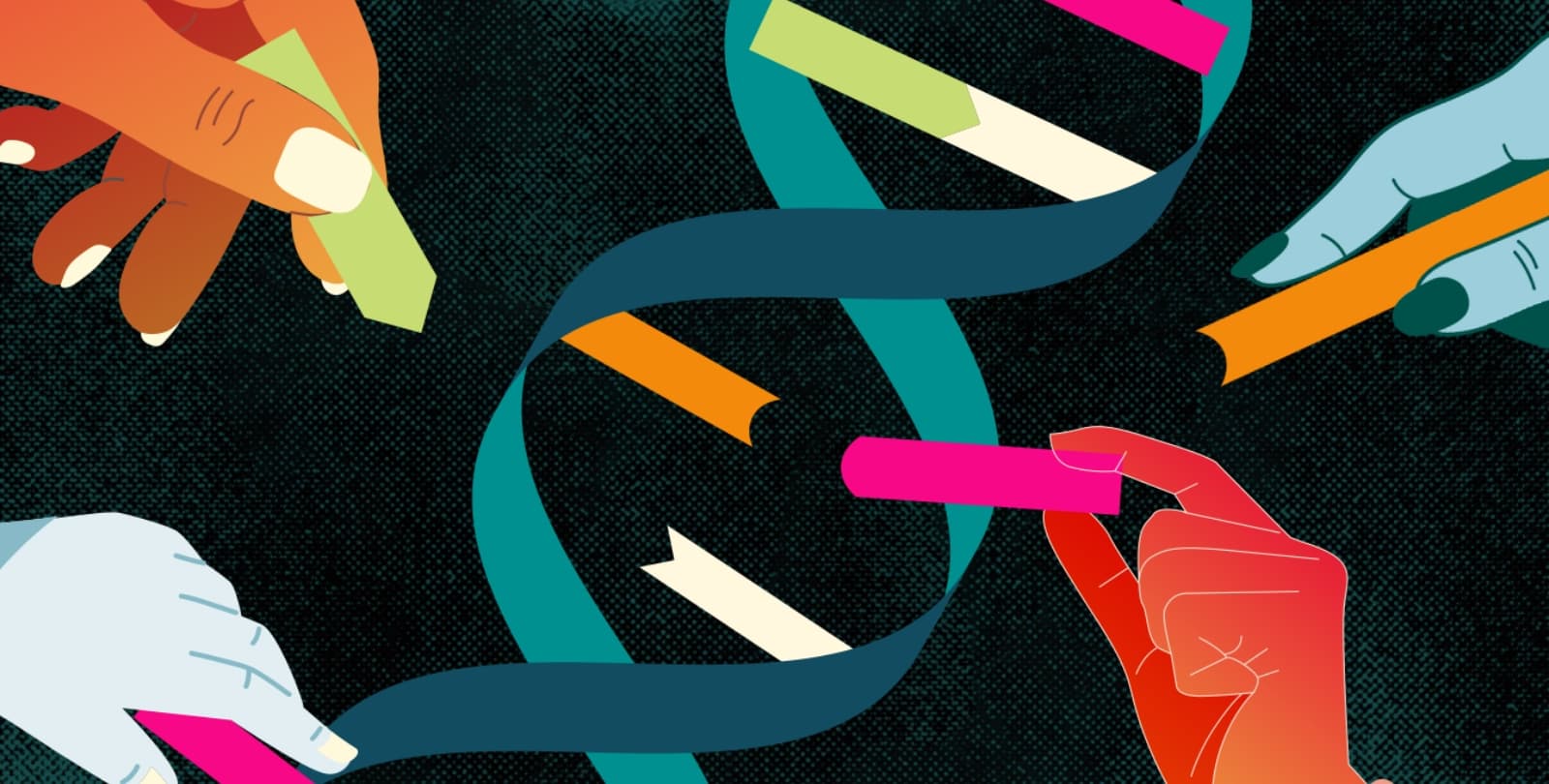
What if our bodies came with operating instructions—and we could finally read them?
Description
In 1904, a young man named Walter Noel walks into a Chicago hospital. He’s been sick for a month and isn’t improving. An intern tries something medicine is only beginning to trust: they look at his blood under a microscope. His cells look nothing like anything they’ve seen before.
Nearly a hundred years later, that moment sets the stage for what could become the biggest medical breakthrough in human history—one powerful enough to explain our past, rewrite our future, and spark a battle that reaches the White House.
- Originally aired on March 18, 2026
- WithJesse EubanksandFaith Stults
Keep Exploring
If Wonderology sparked your curiosity, we’re here to help you dive deeper.
Explore articles, podcasts, and resources that expand on the ideas from this episode and connect them to the broader story of faith and science.
Discover More: Genetics and Faith
Reading the human genome, the very code of life, is merely the end of the beginning. In the resources below, we explore how this knowledge intersects with faith, and what it means to use it wisely and faithfully.
Article (Advanced)
Common Question
Keep Chasing Life’s Big Questions
There’s always more to explore. Join BioLogos’ email list to receive new Wonderology episodes and other resources that spark awe and invite fresh discovery.
Explore More Big Questions
Curiosity doesn’t stop after asking just one question. Keep exploring how faith and science together help us find wholeness.

Common Question
Common Question
Common Question
Transcript
Antuan Sartin
I watched her colors just go to white. To her lips are blue and purple.
Jesse Eubanks
Antuan Sartin is sitting in a hospital room with his daughter, Callie.
Antuan
We always got a beg on standby.
Jesse
How many times, if you were to guess, has Kelly been in and outta the hospital?
Antuan
Oh man. At one point in time, I could tell you. I mean just in 2024, she was in and outta hospital. I mean, if it wasn’t every three weeks, it was once a month.
Faith Stults
When something happens that often, it stops feeling like an emergency. It becomes life.
Antuan
When they start to know you face to face and know you are the, you know, your first name basis, or who your child is, that’s quite a bit of visits to the hospital.
Jesse
Yeah. Yeah. That song “Where Everybody Knows Your Name” should not apply to the hospital.
Antuan
Yes. Not at all.
Faith
Antuan is watching her chest rise and fall.
Antuan
You know, all these different machines, all these different noises going on, and it’s like she couldn’t even breathe, so it was like she was just gasping for air.
Jesse
Antuan needs a moment, and so he steps outside the hospital room.
Antuan
And I had a talk with God and I said, if this is you calling for her, just, you know, gimme the strength. I’ve never told nobody this. I said, gimme the strength. That’s all I asked. If you want her, give me the strength to give her to you. And, uh peacefully.
Faith
He said he tries to keep from feeling angry, but every now and then it slips through.
Francis Collins
I wish he was me going through it and not my child. ’cause I don’t wanna see, you don’t wanna see your child suffering. You would take that pain for them. And that’s, that’s, that’s the times that I’m angry when I wish I could just, I wish it could be me going through it and not her.
Jesse
In that hallway, there’s nothing he can do.
Faith
No fix, no control. Just wait.
Jesse
And for most of human history, this is how the story of disease goes.
Faith
You wait, you hope, and you don’t know why it’s happening.
Jesse
But what if the first step to healing the body is understanding it. Tonight on Wonderology, we’re looking at how one mysterious illness changed the way medicine sees the body.
Faith
The illness Cali lives with was once a complete mystery, doctors could see the pain. They just couldn’t explain.
Jesse
Until one patient in another hospital more than a century ago, forced medicine to look closer and what they discovered didn’t just name a disease. It changed what medicine thought it was looking at.
Faith
We’re asking the question, what if our bodies came with operating instructions and we could finally read them.
Jesse
I’m Jesse Eubanks, a storyteller and journalist.
Faith
I’m Faith Stults, a science educator,
Jesse
So let’s get curious. Today’s story starts in 1904 Chicago. A young man steps off a train. He’s 20 years old, and his name is Walter Noel. He’s come from Granada across an ocean to study dentistry.
Faith
Walter comes from a wealthy family. He’s ambitious, educated. This move is supposed to open his life up.
Jesse
But, something is wrong. He’s fatigued, his joints ache. Breathing is getting harder and it doesn’t let up.
Faith
At first, he tries to push through it. Keeps his routines. Assumes it will pass.
Jesse
But after more than a month. It doesn’t. So he goes to the doctor an intern draws his blood. Early 1900s, medicine is starting to trust the lab. They stain the slide, place it under a microscope, and instead of assuming what his blood looks like, they take a look.
Faith
You probably know what blood cells are supposed to look like. They’re round little discs. Smooth, flexible. They look like full moons.
Jesse
But Walters don’t. Under the microscope, his cells are bent, curved, sharp. They don’t look like full moons. They look like crescent moons, like sickles.
Faith
And that shape matters. Red blood cells are supposed to be soft. They’re built to squeeze through vessels thinner than a hair.
Jesse
And Walter cells don’t look soft. They look like they could snag, like they could jam up traffic.
Faith
And when blood can’t move, oxygen can’t either.
Jesse
And this explains his exhaustion, his shortness of breath. Doctors can see his pain, they just don’t know what’s causing it. A case report publishes in 1910 where a doctor describes Walter’s unusual blood in the years that follow other physicians began reporting the same thing.
Faith
Different hospitals, same symptoms, same misshapen cells.
Jesse
So the disease is named for what it looks like sickle cell anemia. For decades, little changes. Treatment remains limited. There is no cure.
Faith
Meanwhile, other diseases command national attention.
News Clip
There was a statistical survey to determine who needed the polio shots.
Faith
Diseases like polio, tuberculosis, and syphilis. They mobilized public health campaigns, philanthropy, research institutes.
Jesse
Sickle cell does not. In the United States, most sickle cell patients are black. And by the 1920s, some medical journals describe it as a “Negro disease”. In 1916, Walter dies. He’s just 32.
Faith
How does he die? Pneumonia. Days earlier, he had overexerted himself walking a long distance and bathing in the same day. And for someone with sickle cell, that kind of strain can trigger a crisis. A body already fragile can tip and an ordinary infection becomes fatal.
Jesse
Decades pass and people continue to live in constant pain. But by the 1940s, scientists are beginning to suspect that something chemical is going on inside us. A molecule called DNA enters the conversation and new tools, let researchers look past the cell itself, down to the molecules inside it. And so they turn back to sickle cell.
Faith
And what they find changes everything. The problem isn’t the whole blood cell. It’s the hemoglobin. Tiny change in that protein, a single molecular swap, and the cells stiffen, they bend, they sickle.
Jesse
For the first time, a human disease is traced to a change in a single molecule, a molecular typo rooted in the DNA itself.
Faith
Years later, they realized the mutation is actually ancient, a mutation to protect against malaria if you inherit one copy, but devastating if you inherit two. That survival advantage allowed the mutation to become common in much of Sub-Saharan Africa. This is why sickle cell disease disproportionately affects people whose ancestry traces to those regions.
Jesse
Tracing sickle cell to a single molecule raises an obvious question. If you can link one disease to one gene, how many others are written into our DNA decades later, a young physician comes of age asking that question.
Francis
I ended up at the University of Michigan as a researcher teaching medical students, taking care of patients.
Jesse
This is Francis Collins. In the late eighties, he’s working in a hospital, seeing patients every day, families who come back again and again.
Francis
Trying to find the cause of cystic fibrosis. I wanted the diseases that I saw and grieved over because it was so incredibly difficult for individuals and families to deal with.
Faith
Doctors can manage pain, treat infections, ease breathing, but they don’t know what’s underneath.
Francis
And nobody knew anything really about what the problem was or how to treat it other than the sort of symptom treatment.
Jesse
So Francis and his team keep digging. And in 1989, they finally identify the gene mutation that causes cystic fibrosis.
Francis
After five years of incredibly difficult sifting through bits of chromosomes, uh, we found the answer that cystic fibrosis was caused by just three missing letters in one gene on chromosome seven.
Jesse
Three missing letters out of 3 billion. A needle in a genetic haystack.
Francis
But that was really hard to get that answer for just one disorder.
Faith
If it took that much work to answer one question, what about all the others?
Francis
And it was pretty clear if you really wanted to do this for the thousands of conditions that affect us, or you know, something’s misspelled somewhere in DNA, you need to have a reference copy.
Faith
A copy of the long chain of human DNA without any mutations, a master key.
Jesse
A few years later, Francis starts hearing about an idea. It’s big and expensive. The idea? Mapping the entire human genome.
Francis
And when the human genome project was being proposed, and I was a fan of it, uh, most scientists didn’t really support it. They thought, this is never gonna work. This is too hard.
Faith
And they also had ideas about the team behind it.
Francis
And the most offensive one was people who said, well, only mediocre scientists would wanna work on it because it’s gonna be so boring.
Jesse
Francis applied for a small grant anyway.
Francis
I wanted to be part of it so when the first announcement for some funds to get started, I wrote an application and I got one of those first six grants to get the project started in a modest scale.
Jesse
Then, one day, his phone rings. It’s the director of the National Institutes of Health. They want him to apply to lead the Human Genome Project.
Francis
I want you to apply for this job ’cause I think you’re the one to step in and take on what was, at that point, sort of the baby genome project in the crib and see if you can help it grow up and actually accomplish something. That was a big, frightening idea. Most of my colleagues were saying, this isn’t gonna work. Uh, it’s a fool’s errand. Why would you possibly want to put yourself at risk by taking on a project that you will forevermore be remembered as the leader of a failure?
Jesse
Francis says, no.
Francis
You had to become a federal employee. Something my mother told me never to do.
Jesse
So they ask again and he says no again.
Francis
But after a while, I, I had to realize that I was about to sort of walk away from what if it worked was probably the most significant scientific project of our time. Um, yeah, going to the moon was a big one. Uh, splitting the atom was a big one. But this is about us. This is about our very essence. Our own instruction book. You only are gonna do that one time if it succeeds. And I was gonna say, well, it’s not convenient right now? I couldn’t say it. So I said, yes.
Jesse
When we come back, Francis tries to put a team together to embark on a new frontier for humanity: mapping the billions of letters of our DNA code from start to finish.
Faith
And it turns out this effort is going to be hard for far more reasons than just science.
Jesse
We’ll be right back.
Welcome back to Wonderology, Jesse Eubanks.
Faith
Faith Stults.
Jesse
Before the break, Francis Collins said yes to leading the human genome project.
Faith
3 billion letters in the human, DNA billions of dollars. If it fails, he will be remembered as the scientist who bet the future of biWonderWonderWonderology on a fantasy.
Jesse
But if it succeeds, we’ll read our own instruction manual for the first time in human history.
News Clip
Our next segment deals with human genetics and a huge research project to locate and identify all the genes in the human cell. While genes determine appearance and even state of mind, they also carry illness or the predisposition to it. Scientists are developing ways to identify disease carrying genes and how best to deal with them.
Jesse
So what does mapping the human genome even look like? If you wanna know what’s broken in our genetics, you first have to know what normal looks like.
Francis
You need to have a reference copy. You need to be able to start somewhere and say, okay, what’s different here?
Faith
That instruction book is written in a code.
Francis
The language has only four letters in it’s alphabet. They’re actually chemical bases, abbreviated ACG and T.
Faith
One continuous chain of ever-changing patterns. Shift the pattern and the body builds something different.
Francis
Having 3 billion of those letters in a particular order is enough for a single cell to develop this incredibly elegant, beautiful, amazing complexity of a human being.
Jesse
If that number is hard to picture:
Francis
If you printed out the human genome, those 3 billion letters on, on regular paper at a reasonable font size, and you piled the pages up on top of each other, uh, that would be about the height of the Washington Monument.
Jesse
That stack of paper is inside every cell of your body.
Francis
And every time the cell divides, you have to copy the whole thing, and you need to get it right.
Jesse
This is what they’re trying to read. It’s 1993 when Francis steps in as the new leader.
Francis
The technWonderWonderWonderology we had when it started in 1990 was so rudimentary. You might be able to read a hundred letters on a good day, and we had to go to 3 billion. Uh, no way is that gonna happen.
Faith
100 letters on a good day. And by the time France arrives, the technology has not improved much.
Jesse
Day after day. Tiny fragments. With no sense yet of where any of them belong.
Faith
Imagine you’ve been handed a closeup photo of a white highway stripe. Just the paint and asphalt and someone tells you this was taken somewhere on I 95, but I 95 runs from Florida to Maine. That stripe could be anywhere along the way. You just don’t know which mile.
Jesse
They know what they’re looking at. They just don’t know how it fits together. And while the genome seems scattered in fragments, so was Francis’ life.
Francis
I was single. Marriage had broken up. My two daughters, uh, were at that point of being in college and medical school. So it was just me and uh, yeah, that made it slightly less complicated, but also pretty lonely.
Faith
3 billion letters, a skeptical scientific community, and no one at home.
Jesse
Francis also knows that this isn’t a normal science project. He’s gonna need a lot more than just scientists.
Francis
Some of them needed to be engineers and some of them need to be computer experts. And, and some of them needed to be sort of business-minded people about how do you build kind of a factory to actually do the work, not just write it down on a piece of paper.
Faith
This kind of team is unusual at the time. Science mostly lives in silos. Biology over here, computers over there. Now, they’re being asked to work together.
Jesse
And on top of that, Francis is asking people to leave jobs they like. Labs that work. Reputations they’ve already earned.
Faith
And there’s no safety to offer, no clear career upside, no guaranteed success.
Francis
And it really was the whole idea of the historic nature of this. That was my best recruiting tool.
Jesse
Little by little, the team comes together. At first, the plan feels obvious. If reading DNA is slow, a single lab trying to run at super speed isn’t going to work. They needed more labs.
Francis
And I was probably still at that point thinking like an academic. Okay, maybe if we fund 50 of these centers that can all do 2% uh, we’ll get there.
Jesse
So the project spreads across the country, across the world. Genome centers multiply.
Francis
The project also adopts an unusual rule. We were putting all the data up on the internet every 24 hours. All of this data is gonna be immediately available to everybody.
Jesse
This idea was not shared by everyone else.
Francis
There was a lot of debate,
Jesse
But
Francis
ultimately it was a unanimous decision. In retrospect, probably few of the people in the room had the authority to do what they had just agreed to, and we just sold it, but it was the right thing to do.
Faith
There was another reason too.
Francis
We could not afford to be seen, to be slow and inefficient.
Jesse
But posting soon reveals something.
Faith
Some labs are moving fast, others aren’t.
Francis
You could see that of those centers that were trying to do this, there were some that were doing amazing things. They got it. They knew how to scale, and there were others that were just kind of doing what they’d been doing.,
Jesse
Doing good science is not enough.
Francis
They just didn’t quite have the mindset, uh, of what it took to become almost like a factory.
Faith
And that means, Francis has to make a call he never expected to make.
Francis
And it was my job to sort of weed the garden and that was painful.
Faith
These aren’t people who simply failed a performance review. They’re colleagues.
Francis
Many of them have dropped everything else in order to do this
Jesse
Which means the phone calls aren’t abstract, they’re personal.
Francis
It made you ache when you had to say to somebody who’d really, oh put what they thought was their best effort into this, I’m sorry, we’re gonna have to basically cut this off here.
Faith
Even now, years later, that part hasn’t gone away.
Francis
When I think of those folks or when I run into the meeting, I still feel this sadness, uh, that that’s the way it had to be.
Jesse
At the beginning, there were about 20 genome centers.
Francis
And by the time we got done, effectively, there were five.
Jesse
Five teams, five leaders. People who are used to running their own kingdoms. And some of them,
Francis
They did not have small egos
Faith
And they don’t agree on how to finish the job.
Francis
There was still a lot of disagreements about the strategy.
Faith
Imagine someone hands you the pages of an instruction manual, but they’ve been torn into millions of thin strips. You don’t have page numbers. You don’t even know where the first sentence begins, and there are two different proposals on how to repair it.
Francis
It’s the Clone by clone group.
Faith
One side says, let’s rebuild it page by page. Anchor one whole section then move to the next: slow, careful. That’s clone by clone,
Francis
and there’s a shotgun group.
Faith
The other side says, forget pages. Read every strip at once. Feed them into a computer and let the machine piece it all together. That’s shotgun.
Francis
And they didn’t necessarily love each other.
Faith
Both get you the same instruction manual. One is slow and orderly. The other is fast and chaotic.
Francis
Fights would break out. Not physical fights, but intellectual fights about strategy. And sometimes they got pretty animated and it was my job sometimes to after one of those, to take somebody to the woodshed and say, “you really can’t talk to your colleague that way.”
Jesse
But before they can settle the argument, someone else enters the race.
Faith
They’re not here to join the effort. They’re here to replace it and they want Francis and his team out of their way.
Jesse
When we come back a fight over who gets to own the code of life. Stay with us.
Wonderology, Jesse.
Faith
Faith. Before the break, the Human Genome Project has been underway for years. 3 billion letters, slow progress, fragile technology, and scientists who can’t agree on how to finish the job.
Jesse
But before those debates can settle, a new threat appears and suddenly the question changes, not just can we map the genome, but if we succeed, who owns it? A private, well-funded company enters the race.
Francis
A commercial version of this emerged, uh, that was being put forward by a for-profit company.
Jesse
Celera Genomics.
News Clip
The leading genetic scientist Dr. J Craig Venter and a private biotechnology company are teaming up to decode the entire human genome within three years. Years ahead of a federally funded effort called the Human Genome Project.
Jesse
They aren’t saying the genome project can’t be done. They’re saying the government shouldn’t be the ones to do it, and they’re saying they can do it in just three years.
Francis
Basically arguing that the government efforts should just be shut down because they can do it faster, better, if not cheaper.
Jesse
And they don’t whisper it. This is Celera President Craig Venter.
Celera
I think the scientists sort of claimed that they were gonna do this public program. almost started to believe it was their birthright to get all this money and take the next several decades to do this project.
Faith
And in Washington, faster, better, cheaper? That argument lands.
Francis
There was a bit of an existential threat there that the commercial entity might convince the Congress who was funding all this that the government part could basically be phased out.
Jesse
If Congress pulls funding, the public genome dies. Years of work gone. Celera’s promise to map the genome faster and cheaper wasn’t the only difference.
Francis
They were gonna make this into a commodity. You wouldn’t have access to the information unless you paid for it.
Jesse
Now, with a government funded effort and a private funded effort, both happening at the same time, pressures mount from the outside. Politicians, international labs, investors, all urging some kind of deal, but neither side backs down. Celera refuses to promise open access. The public project refuses to privatize the genome.
Francis
That’s our shared inheritance. Our own genome is gonna be owned by somebody? That’s just wrong.
News Clip
It’s not just about science, but also about the race for vast sums of money. Are you gonna win? We’re not gonna lose.
Faith
Now, this isn’t just a race, it’s a fight over ownership. One vision treats the genome like property. Something you patent, something you sell. The other treats it like inheritance. Something shared, something received. And the difference between those two ideas is who gets to read the book.
Jesse
Early 1999, Houston. With the mounting threat of Celera Genomics, the five centers rallied together to decide what happens next.
Faith
Different team members argue for one of the two approaches.
Jesse
But Francis throws a curve ball.
Francis
I’d thought a lot about this. I’d done a lot of mapping and modeling.
Jesse
He proposes a third option.
Francis
I became convinced the right answer was a hybrid.
Faith
Lay down the big structure first so you know where things belong. Then, flood it with fragments and let computer modeling do the rest.
Francis
People were not expecting it and we’re not initially all that receptive. And there was a lot of pushback and then some refinements of what I had put forward to make it better. And by the end of the day, that was the strategy.
Jesse
If this works, they might finish the genome years faster. But if it doesn’t, they’ll only fail faster. After Houston and after years of building the tools and arguing about the plan, they’re now at a threshold.
Francis
Everything up until that point was working on simpler organisms and building the technology, uh, to be good enough to tackle 3 billion. And then we were ready to start scaling up.
Faith
The conveyor belt is suddenly on full speed.
Francis
And once you had the, the bits and pieces of DNA information and have this massive computer effort, uh, to actually assemble, letting them know you got it right and didn’t misconnect things.
Jesse
And over the next year, a map starts coming into focus.
Faith
This is working.
Jesse
By early 2000, both the public project and Celera are claiming that they’re nearing draft completion. With the potential of an announcement in the near future, President Clinton steps in and encourages a compromise.
Francis
Having the chance also to negotiate with the company who I think at that point recognized the public project really was succeeding.
Faith
Both groups will publish separate papers in separate major publications. Both will describe their own drafts and
Francis
that it would be better if we had an announcement of sort of joint success as opposed to somebody won and somebody lost.
Jesse
An agreement is reached.
News Clip
Scientists are expected to announce on Monday that they have mapped the entire human gene structure.
Jesse
But as the White House announcement approaches,
Francis
My sister-in-law. who was this incredibly creative Marinette artist died of cancer, breast cancer, and I gave the eulogy for her on a Saturday in my hometown of Stanton. I had high hopes that the study of the genome would give us insights into cancer so that so many people wouldn’t have to die. And yet, we were too late for her.
Faith
Two days after the funeral, the morning of the announcement arrives.
Jesse
Francis walks alongside President Clinton to a room full of reporters.
News Clip
We are here to celebrate the completion of the first survey of the entire human genome. Without a doubt, this is the most important, most wondrous map ever produced by humankind. More than a thousand researchers across six nations have revealed nearly all 3 billion letters of our miraculous genetic code.
Today’s announcement represents more than just an epic making triumph of science and reason. After all, when Galileo discovered he could use the tools of mathematics and mechanics, he felt in the words of one imminent researcher, that he had learned the language in which God created the universe. Today, we are learning the language in which God created life.
We are gaining evermore awe for the complexity, the beauty, the wonder of God’s most divine and sacred gift. And now, I’d like to invite Dr. Francis Collins to the lectern.
Francis
And uh, because I’d been at her funeral, I was sort of distracted and it wasn’t until five o’clock that Monday morning AM that I started to write down what I was gonna say , at the event in the East Room. And I was so much feeling like this is a moment to not just talk about what science has done, but what God has done, uh, with the creation to make it possible for life like ours to exist. It is humbling for me and awe inspiring to realize that we have caught the first glimpse of our own instruction book previously known only to God. What a profound responsibility it is to do this work.
Jesse
Even now, Francis still seems amazed.
Francis
We really did this, but, wait a minute, before we ever got to it, God really did this and we’ve been given this gift, uh, in a form of worship really, of being able to see this elegant, beautiful, mysterious creation for the first time.
Jesse
For the first time in history, we can read the code of life. But reading was never the end.
Faith
It was the doorway.
Jesse
If mapping the genome was the end of the beginning. Then the next step wasn’t just reading, it was picking up a red pen.
Faith
More than 25 years later, we haven’t just learned to read our instructions. We’ve learned how to revise them. To reach into the code itself and change it.
Jesse
For most of human history, parents like Antuan have sat beside a hospital bed with nothing but hope. Waiting. But what if waiting isn’t the only option anymore? What could it mean to correct the typo that’s hurting his daughter?
Faith
Because once you can edit the code of life, you can relieve suffering in ways that once felt impossible. But you’re also moving from discovery into authorship.
Jesse
How has the power to rewrite our own instructions changed us? And who do we become if our power outpaces our wisdom? That’s next time. Part two of Owner’s Manual.
Faith
Your journey into wonder doesn’t have to end here. If today’s episode sparks something in you, we’ve got more.
Jesse
Check out “Science With Faith”, our exclusive after show where Faith unpacks the deeper layers of science and faith behind each episode.
Faith
Or dive into everything from nothing. Our special mini series hosted by Jesse Exploring Evolution and Christian faith.
Jesse
Both our free and waiting for you at wonderologyshow.com. That’s wonderologyshow.com. Special thanks to Francis Collins and Antuan Sartin. Additional thanks to Matt Stevens. Wonderology is a production of Christianity Today in partnership with Bio Logos.
Faith
It’s hosted by Jesse Eubanks and Faith Stults. Today’s episode was written by Jesse Eubanks, science fact checking and guidance from Faith Stults, Jim Stump and Colin Hoogerworth. It was produced by Jesse Eubanks. Our associate producer is McKenzie Hill. Music by Jesse Eubanks.
Jesse
Editing by Rachel Akers. Post-production by Wind Hill Studios, with sound design, scoring, mixing, and additional story editing by Mark Henry Phillips. Additional music by Mark Henry Phillips and Blue Dot Sessions.
Faith
Eric Petrik is the executive producer of CT Media podcasts. Matt Stevens is our senior producer.
Jesse
Wonderology is generously funded by the John Templeton Foundation. Explore the profound questions of life that inspire awe and wonder by visiting templeton.org.
Faith
If you enjoyed this episode, send it to a friend and leave us a rating and review to help more people find the show.
Jesse
God invites us to experience the awe of all that he’s made, but the known. And the not yet known, so let’s get curious.
Featured guests