On Our Knees with Bees: The Spirituality of Paying Attention
Acts of deep, compassionate attention to the world can be a form of profound spiritual engagement—and maybe even a kind of prayer.
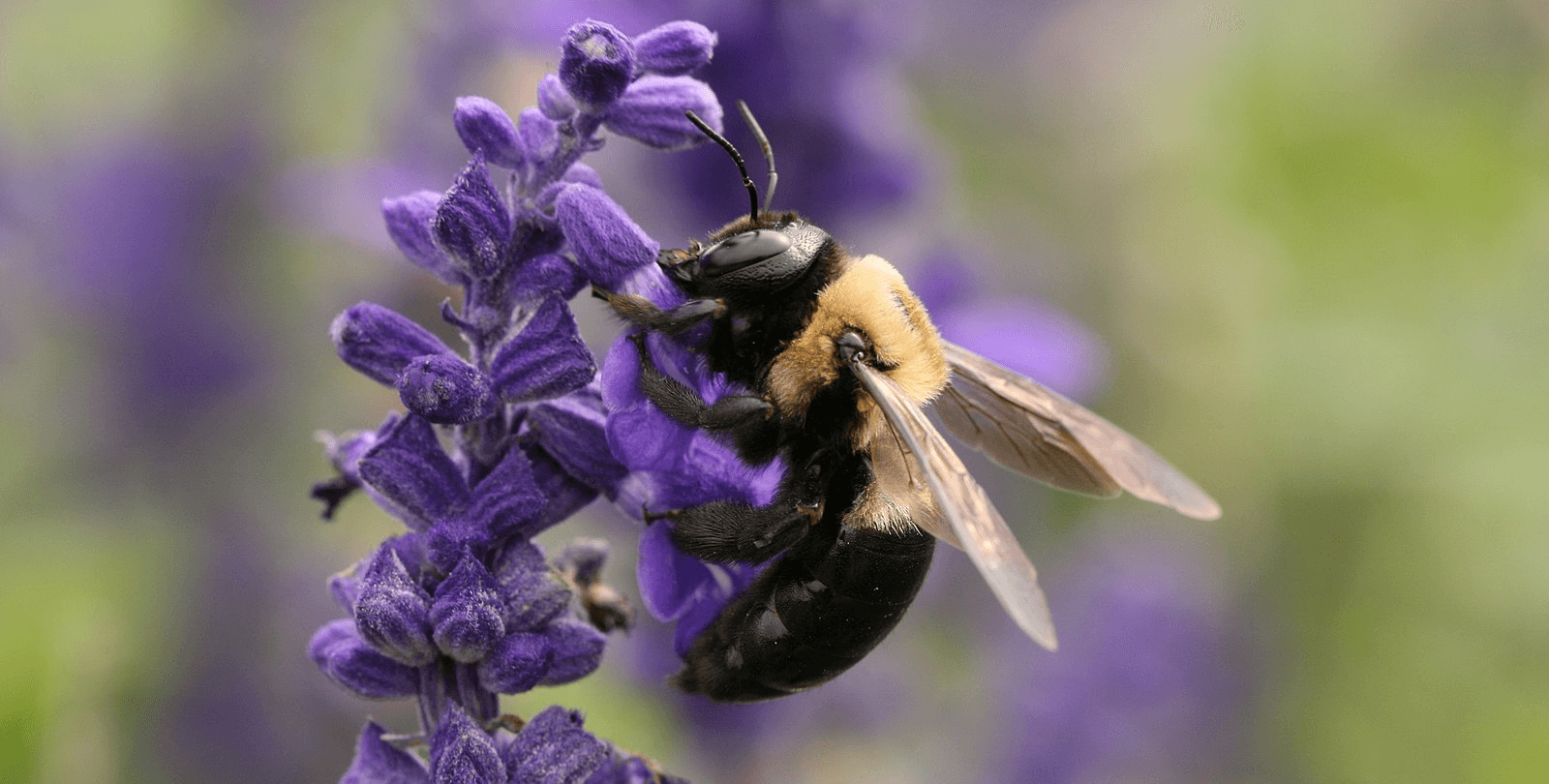
Daniel Schwen, CC BY-SA 4.0 <https://creativecommons.org/licenses/by-sa/4.0>, via Wikimedia Commons
On a sweltering afternoon in Raleigh, North Carolina, two graduate students knelt on the pavement in front of a wooden bench.
The June day was the hottest of the year so far. The sun scorched overhead, beaming down heat that pushed the temperature toward 100 degrees.
A handful of baby carpenter bees wriggled at their feet. They had hatched and crawled out from the tunnel their mother had dug in the bench, but it was too hot for them to fly away. Now, they lay dying on the pavement.
The two graduate students, crouched down in the summer heat, had contrived a device to give the bees little drops of water. Together, they coaxed these baby carpenter bees back to life.
What kind of act is this? It wasn’t part of their research, and the deep compassion of it can’t be explained by data alone. I think it points to something deeper: the power of paying attention to creation, and the way that attentively caring for it can draw us closer to God.
A visit to North Carolina
I heard about the carpenter bees while visiting Dr. Rob Dunn‘s ecology lab at North Carolina State University this summer.
Back in June, I was working on a Language of God podcast episode about the spirituality of paying attention to all the little things in the world around us. And who better to ask than Rob, who runs studies on topics ranging from the biodiversity of belly buttons to the evolutionary history of face mites? So I travelled down to North Carolina to interview members of Rob’s lab.

Rob Dunn & Aminah Bradford | The Spirituality of Paying Attention
A theologian and an evolutionary biologist meet in a lab to study yeast, microbes, and dust—discovering surprising connections between matter, meaning, and faith.
Rob is a biologist by training. He’s also a self-identified atheist and materialist. But several years ago, Rob hired a theologian to work in his lab. Her name is Aminah Bradford.
Aminah had already been a guest on our podcast – a few years back, she joined us for our series on the gift of food. This time, I got to sit in a lab with Aminah and Rob to listen to them talk about microbes, matter, and meaning.
An act of attentive mercy
There was much to marvel at in the conversation, but the story of the carpenter bees in particular led me down a path of reflection about scientific attention to the natural world, prayer, and how the two might be closer than we realize.
Rob had actually seen the pair of graduate students working to save the bees only a few minutes before we sat down to talk. He shared the full story during the podcast:
“You know, today’s a really, really hot day in Raleigh, North Carolina, and I walked into the building next to the one we’re in, and in front of that building is a wooden bench. And for years, there have been carpenter bees in that bench, and Elsa Youngsteadt, who’s a faculty member here, has studied them.
And the carpenter bees plant their babies in sets of sacks, and in each sack they plant food and their babies. And the babies sort of crawl out of those sacks. Well, the babies are starting to crawl out, to fly away, and it’s too hot, and so they’re just falling to the ground and dying.
And so in front of that bench, there were two graduate students, and the graduate students had contrived a little device with water in it, and they were grabbing the bees one by one to place them in the water so that they could drink.
I actually don’t know what those two graduate students study. I don’t think it’s carpenter bees, but what is that act? And so in the same way that there’s a bunch of science that—a bunch of our inquiry that’s germane to thinking about religious practice, there’s also an insufficiency, often in our study of the living world, where other things are in play.
And so what is that act of care that those graduate students were undertaking? It’s not defined by my science. It’s defined by something else in their lives that they thought that on this hottest day we’ve had so far this year, that the thing they most needed to do was to get on their knees in front of this bench, pew-like bench, and to give water to these bees.”
– Dr. Rob Dunn
Bee bread: The intricate way carpenter bees sustain life
I find several aspects of Rob’s story really interesting.
There are the bees themselves. There is this act of helping the bees by the graduate students, kneeling down in front of a pew-like bench. And then there is the noticing of it all by a non-religious scientist, who even subtly hints at this act as one of worship.
Let’s start to unpack this story by taking a closer look at the carpenter bees.
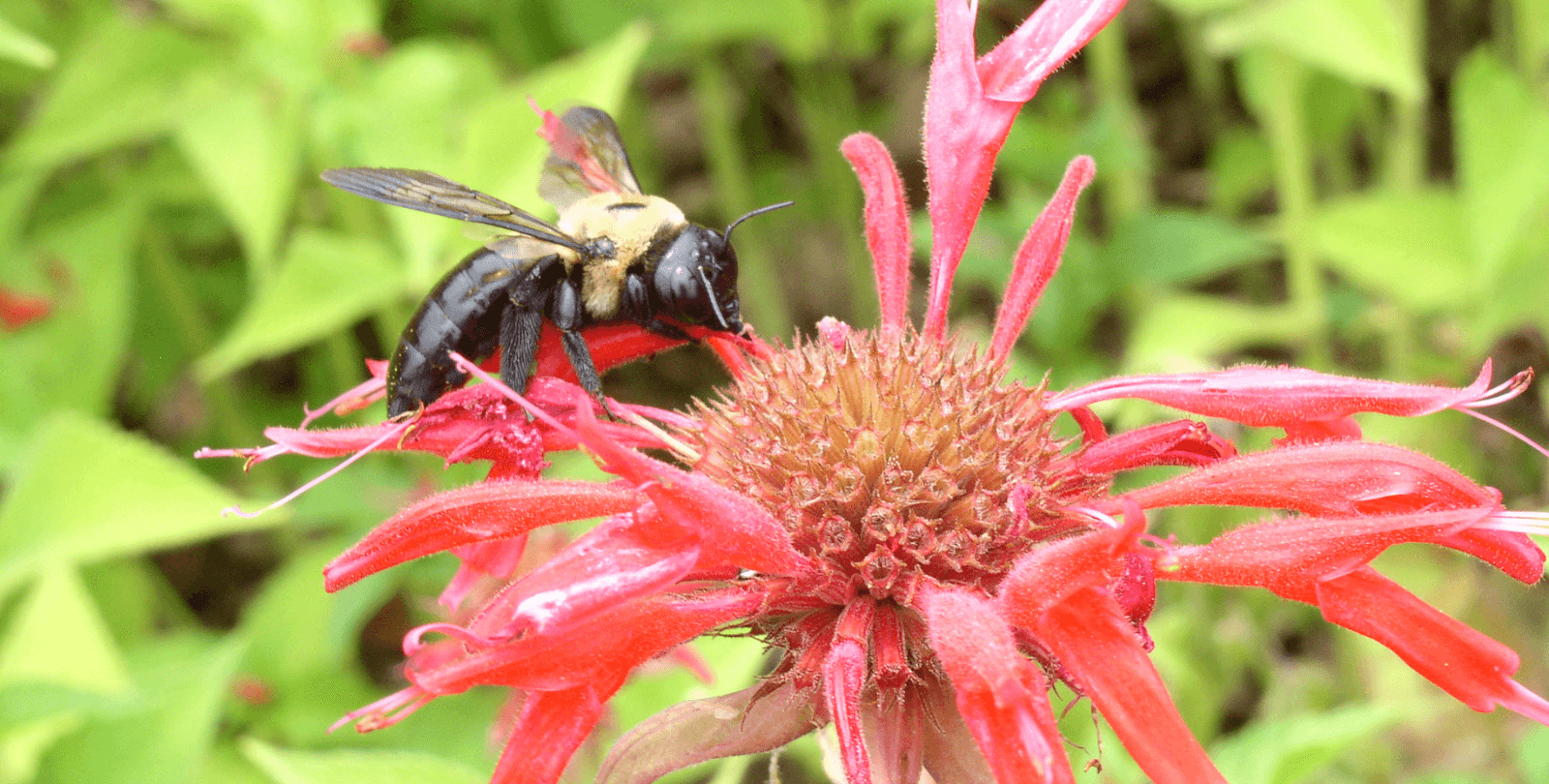
Polinizador, CC BY-SA 2.5 <https://creativecommons.org/licenses/by-sa/2.5>, via Wikimedia Commons
I find carpenter bees fascinating because they do something that is invisible to the casual observer, yet vital to their existence: they make bread.
Well, maybe not bread exactly.

Internet Archive Book Images, No restrictions, via Wikimedia Commons
The mother bee collects pollen, mixes it with nectar and its own glandular secretions, and then packs it into the brood cell. Brood cells are like the hexagonal spots you might imagine in a beehive. The difference is that carpenter bees are solitary, so they place their cells in tunnels they dig into wood.
Then, thanks to bacteria and yeasts—which, remember, are also living things—that live on and in the mother bee, this mixture undergoes a lactic acid fermentation, just like sourdough bread or beer. This process preserves the food, preventing it from spoiling and, crucially, breaking down the tough outer layers of pollen, which makes its nutrients more accessible for the developing baby bee.
Caring for the world means paying attention
This brings us back to Aminah Bradford, the theologian in Rob’s lab:
“I think the best of spiritual traditions are joining with scientists and asking, what does it mean to be wise? We both need the science to help us figure out how to move forward, how to discover, how to keep delighting. I mean, it’s not just to solve problems. It’s also to discover, to delight. And I also think about somebody like the early 20th century mystic Evelyn Underhill. She prayed a lot, but I think she would say being on her knees on hot bricks in North Carolina, trying to rescue a carpenter bee would be one of the best forms of prayer.”
– Dr. Aminah Bradford

British mystic, theologian, and writer Evelyn Underhill in a photo taken in 1926. Pleshey Retreat House, Public domain, via Wikimedia Commons.
Evelyn Underhill was an influential British mystic, theologian, and writer who lived in the early 20th century. She wasn’t focused on an ethereal, otherworldly kind of spirituality. Instead, she argued that true spiritual awakening isn’t about escaping the world, but about fully engaging with it.
For Underhill and for Aminah, and maybe even for Rob in a different kind of way, the deep, contemplative act of paying attention to the world is not just a precursor to prayer, but can be a form of prayer in itself—a way of uniting with reality, of encountering the Divine.
And this deep attention, once cultivated, can lead to compassionate engagement and care for the world as a direct response from one’s relationship with God.
“For lack of attention a thousand forms of loveliness elude us every day.”
Underhill famously wrote: “For lack of attention a thousand forms of loveliness elude us every day.”
We have Rob Dunn, whose keen attention leads him to notice a moment of care that he admits doesn’t have any scientific explanation. He realizes there is “something else” in the human spirit that compels acts of compassion for vulnerable life.
We observe the carpenter bee mother following instincts, but in doing so we see how intricate and complex are all the systems that help to sustain life.
And we hear Aminah Bradford and Evelyn Underhill inviting us to understand that acts of deep, compassionate attention to the world, and leaning into its loveliness and its vulnerability, can be a form of profound spiritual engagement—and maybe even a form of prayer.
Also read:
- Silence and the Whisper of God
- Finding God in His Messy, Abundant World
- Finding Beauty and Hope in the Process
At BioLogos, our commitment to scientific work calls us to the highest form of attention. We dedicate ourselves to understanding the intricate, beautiful, often hidden, and sometimes suffering reality of God’s creation.
This story and these insights challenge us to bring more than just our intellect to our work. We also bring our hearts, our compassion, our willingness to “get on our knees,” metaphorically, or even literally, in humble engagement with the world.
Our attention leads us not only to discover and to delight in God’s creation, but to be moved by its needs, and to respond with lives of profound care and worship.
We should not cease to pray with words, but we might also find ourselves in prayer as we move through our days with a careful attention to the vulnerability of the world in which we live.
About the author