Faith and Science: Two melodies in Harmony
President Deb Haarsma shares, "When we see faith and science in counterpoint, moments of dissonance become opportunities for us to learn humility and seek deeper truth."
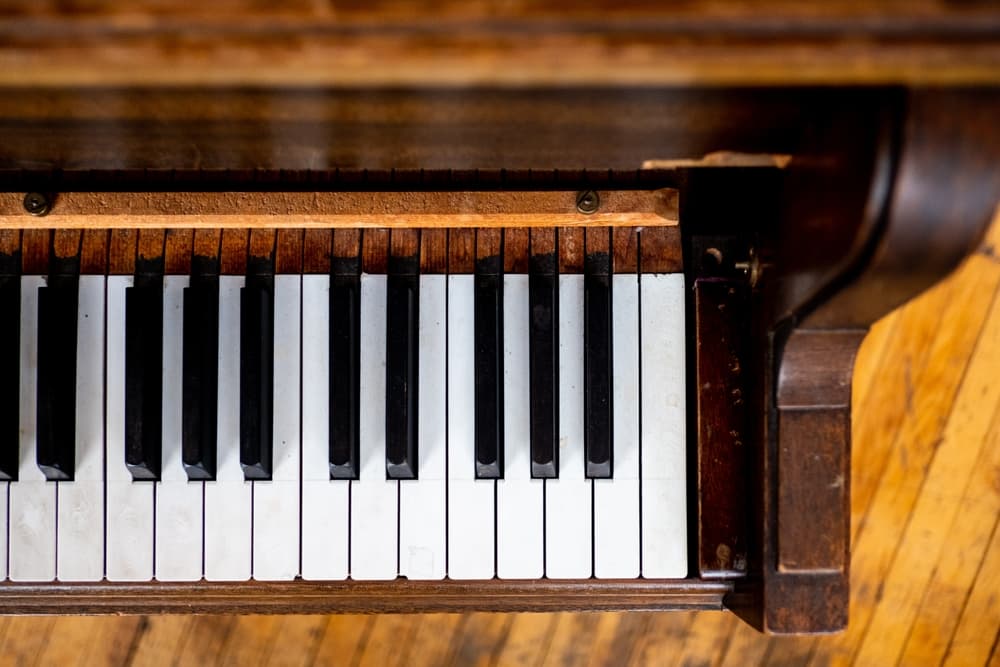
Image used under license from Shutterstock.com
Long before I was an astronomer, I was a pianist. As a little kid, I begged my parents to let me start piano lessons, because my older brother was doing it. He stopped taking piano lessons after a few years, but I loved it! My mom often told me how cute I was at my first piano recital, a 4-year old in a little yellow dress, climbing up on the piano bench. I know she also put up with a lot of wrong notes and dissonant sounds, hearing me practice each day while she cooked dinner.
Dissonance is how many people today see faith and science. In our polarized culture, the two sides are constantly clashing, like wrong notes on a piano. On one side, science gets elevated as the best (or only!) source of truth and hope, while Christian faith is seen as irrelevant or harmful. On the other side, one interpretation of scripture is elevated as the ultimate authority, while science and scientists are seen as untrustworthy and atheistic. These two views are extremes of course – most people hold something more moderate or don’t give it any thought. But the polarized language is infectious. We need better metaphors!
Dissonance is how many people today see faith and science. In our polarized culture, the two sides are constantly clashing, like wrong notes on a piano.
My favorite metaphors are from music – I see faith and science working together in beautiful harmony. But a while back, I realized that people weren’t hearing what I was saying, because in their minds, harmony meant something different than it did to me.
It turns out many people think “harmony” is a complete absence of conflict and tension.

To them, “science and faith in harmony” sounds like a claim that all is sweetness and light. Historian Peter Harrison calls this an “unquestioning harmony.” But obviously faith and science have come into conflict at times. Conflict has come from scientific discoveries, such as when Galileo discovered that the earth moves through space, in contrast to a literal reading of Psalm 104:5 “He set the earth on its foundations, it can never be moved.” Conflict comes up when Christians argue for the existence of God and the need for Christ’s salvation, in contrast to claims that science is the only source of knowledge or technology that can solve all our problems. The relationship between science and faith is not a simple absence of tension.
To other people, “harmony” sounds like two things that have merged together so much that they are no longer distinct. But clearly, science and faith are very different things. You wouldn’t look in the Bible to learn how photosynthesis works, and you wouldn’t do a physics experiment to determine the meaning of life. Christ-centered faith is much larger. It is about our place in the cosmic story, our relationship with God, our call to follow Jesus Christ, and the ultimate destiny of ourselves and the world. In fact, in my scientific work as an astronomer, I was motivated by the scriptures and my faith in God. But the Bible, without the tools of science, can’t tell me the speed a galaxy moves! Scientists and theologians ask different kinds of questions and have different ways of working out the answers. Yet science and theology are not independent and unrelated. On many questions, it is essential that we consider both, such as when we ponder the first humans or the uses of genetic engineering.
In music, the word “harmony” does not mean that two notes are in complete agreement or merging together (musicians use the word “unison” for that). Rather, “harmony” refers to two or more different musical notes sounding at the same time. The notes retain their distinct identity (both can still be heard), yet they come together to make something richer and more pleasing than either note alone. This meaning of “harmony” is similar to some other good metaphors for the relationship between nature and scripture: two books, two wings, two paintings, two maps. In each of these metaphors, we see two distinct things that each give a partial perspective, but together tell a fuller story.
A musician’s definition of “harmony” can actually help us better understand the complexities of studying nature and scripture side by side.
Even more than “harmony,” the musical concept of “counterpoint” is a beautiful metaphor. I love the piano compositions that use counterpoint, like the Inventions and Fugues by J.S. Bach. In these pieces, two or more independent melodies are played at once. The two strands interleave with each other, sounding at the same time yet complementing each other. While each tells its own story, they come together in a beautiful sequence. Sometimes both melodies are going strong, sometimes they echo and repeat each other, sometimes one supports the other or stays silent to let the other speak.
My piano teachers taught me that a beautiful chord was often preceded by a dissonant clash. Dissonances sound harsh by themselves, but without them, the music would sound boring and trite. If a musician rushes past the dissonance, the final resolution is not as beautiful. Instead, I had to learn to pause on the dissonant notes, to carefully place the notes in the context of the surrounding chords. The dissonance and consonance together formed more beautiful music than either alone.
How do we dwell in the moments of dissonance between faith and science? Let us not rush past conflicts and pretend that nothing is wrong! When dissonance arises in music, we don’t just throw out the dissonant notes. Similarly, if a scientific claim seems to conflict with a Bible verse, we don’t give up on biblical authority and ignore the verse. Neither do we ignore what God has revealed in nature and the discoveries of science.
Rather, the tensions are the places where we invest extra attention, in truth-seeking and humility. We dig deeper. We can:
Listen more closely. Do we fully understand each melody, on its own terms? Are scientists still debating some aspects of a scientific model? Are theologians discussing multiple ways to understand a particular doctrine?
Check the alignment. Are the two melodies meant to come together in this way, at this time? Is the Bible speaking about the same event or physical objects as the science? Are the two actually addressing different questions?
Consider the balance. Should one melody be quieter than the other at this point? Is the scientific evidence inconclusive, such as in the question of first life? Is the biblical interpretation disputed?
By digging deeper into such moments of tension, we actually learn more. These dissonances prompt us to think creatively about new questions and to pursue a more vigorous search for truth. And that leads us to scientific models or theological insights we would not otherwise have had. Ultimately, we discover a more beautiful piece of music, a richer understanding of God’s Word and God’s World.
About the author

Deborah Haarsma
Related resources
If you enjoyed this article, we recommend you check out the following resources:
Podcast Episode

Podcast Episode
Podcast Episode