Forums
By 
Francis Collins
 and 
Deborah Haarsma
 on February 12, 2019

Francis Collins Speaks on Genetic Engineering and Christian Faith

At a recent event in Washington D.C., the leading scientist and BioLogos founder shared key insights about the promise and danger of new gene editing technology.

Share  
Twitter
Facebook
LinkedIn
Print

Originally published June of 2018

On June 18, 2018, leading geneticist and BioLogos founder Francis Collins gave a landmark lecture at the National Press Club in Washington, D.C. The event was hosted by The Trinity Forum, a group that brings Christian leaders to public square conversations, and was co-sponsored by BioLogos. Over 350 people attended, packing out the room and extending into the overflow space.

I had the privilege of hearing the lecture in person and feeling the energy in the room. I encourage you to watch it for yourself. Dr. Collins began by sharing his own story, both his scientific journey from earning a PhD in quantum physics to leading the Human Genome Project and directing the National Institutes of Health, and his spiritual journey from atheism to coming to faith in Jesus Christ through the writings of C.S.Lewis. He argued for the underlying harmony between science and biblical faith, and pointed to BioLogos as a place to engage these questions thoughtfully.

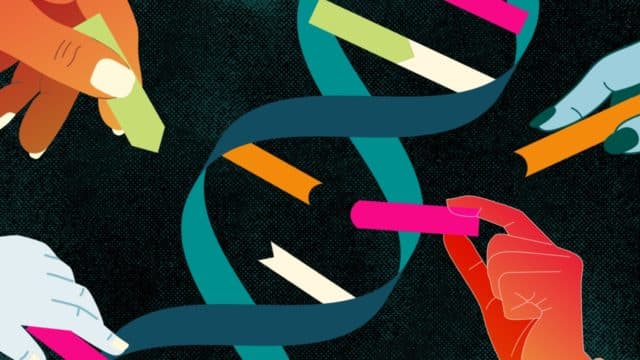
In the second half of his presentation, Collins addressed one of the most cutting edge topics arising from genomics today: genetic engineering. Through the technology of CRISPR-Cas9, it has become fairly straightforward to “find and replace” pieces of the genetic code. He shared amazing stories of how this technology is already being used to effectively treat disease, and its promise for future treatment, when applied to somatic cells (cells in the body other than reproductive cells). However, he emphasized the ethical dangers in using gene-editing technologies on embryos or germline (reproductive) cells. His discussion of the grey areas between treatment and enhancement was illuminating, and his list of questions to be considered sets the stage for the conversations that Christians need to be having today.

Leading philosopher James K.A. Smith served as respondent, affirming Collins’ themes and playing out some of the implications for human identity. He argued that part of what it means to be humans made in God’s image, is that we are, in our very essence, dependent on one another. Smith joined Collins in answering several audience questions at the end of the presentation. The video does not include his slides, but you can view slides from a similar lecture that Dr. Collins gave in July 2018 for the American Scientific Affiliation, by clicking here.

Enjoy the video!

About the authors
BioLogos - Francis Collins

Francis Collins

Francis Collins is one of the world’s leading scientists and geneticists, and the founder of BioLogos, where he is now a Senior Fellow. In his early scientific career, he discovered the gene for cystic fibrosis. Then he led an international collaboration that first mapped the entire human genome. For that work he was awarded the Presidential Medal of Freedom and the National Medal of Science. In 2009 he was appointed as Director of the National Institutes of Health, where he served three presidents until 2021, including oversight of the country’s response to the COVID-19 pandemic. In 2006, Collins wrote the best-selling book The Language of God. It tells the story of his journey from atheism to Christian belief, showing that science actually enhances faith. The tremendous response to the book prompted Collins to found BioLogos. He envisioned it as a forum to discuss issues at the intersection of faith and science and to celebrate the harmony found there. His reputation quickly attracted a large network of faith leaders, including Tim Keller, Philip Yancey, and NT Wright. These and others joined the BioLogos conversation and affirmed the value of engaging science as believers. BioLogos is now an organization that reaches millions around the world. In celebration of his world-class scientific accomplishments and deep Christian faith, Collins was awarded the Templeton Prize in 2020. It honors individuals who are “harnessing the power of the sciences to explore the deepest questions of the universe and humankind’s place and purpose within it.” He joined a prestigious group of previous winners, including Mother Teresa, Francis Ayala, Charles Townes, Desmond Tutu, and Billy Graham.
Deb Haarsma

Deborah Haarsma

Dr. Deborah Haarsma served as President of BioLogos from 2013 to 2024.   Under Haarsma’s leadership, BioLogos grew in both numbers and influence, from private events and a small website to extensive programs and widespread impact (see Our History). During her tenure, BioLogos built an extensive network of experts, writers, and speakers, and developed national conferences, a high-school curriculum, and a podcast.  BioLogos became the leading resource on the viewpoint of evolutionary creation and went on to help Christians wrestle with many complex science topics, always working at the intersection of Christ-centered faith and rigorous science and in a spirit of gracious dialogue.  Haarsma is a frequent speaker on modern science and Christian faith at churches, universities, and conferences. In addition to extensive writing and speaking for BioLogos, she has appeared on several podcasts, including Undeceptions (on Outer Space and on The Multiverse) and the Jesus Storybook Bible podcast. Her writing has been featured at Big Think and Sojourners, as well as in several books, including Four Views on Creation, Evolution, and Design, the collection Calvinism for a Secular Age, and the collection Christ and the Created Order.   She wrote the book Origins with her husband and fellow physicist, Loren Haarsma, presenting the agreements and disagreements among Christians regarding the history of life and the universe.   Previously, Haarsma served as professor and chair of the Department of Physics and Astronomy at Calvin University. In her research, she used telescopes around the world and in orbit to pursue extragalactic astronomy and observational cosmology, with publications on young galaxies, large galaxies, galaxy clusters, the curvature of space, and the expansion of the universe.  Haarsma completed her doctoral work in astrophysics at the Massachusetts Institute of Technology (profile by MIT’s Octet Collaborative) and her undergraduate work in physics and music at Bethel University in St. Paul, Minnesota (profile for 2022 Alumna of the Year award). She and Loren enjoy science fiction and classical music, and live in Grand Rapids, Michigan.

Related resources

If you enjoyed this article, we recommend you check out the following resources: