Becoming the Answer | Why Climate Facts Aren’t Enough
Climate change can’t be solved by science alone so we move from Earth systems to the lived experiences of people already facing its impacts.
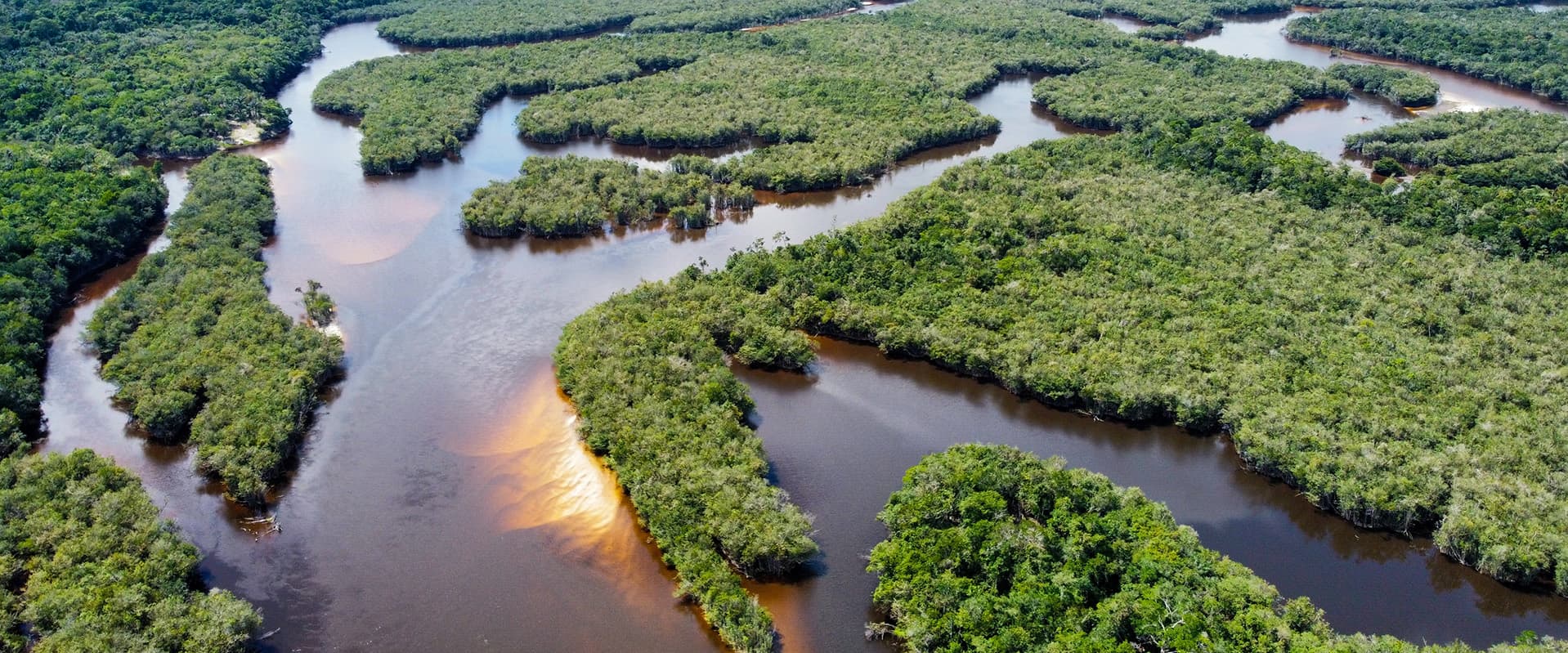
Image used under license from Shutterstock.com
Climate change can’t be solved by science alone so we move from Earth systems to the lived experiences of people already facing its impacts.
Description
The story begins in Brazil at COP30, the United Nations climate summit, where global leaders gather to address climate change. From there, it steps back to ask a deeper question: what kind of problem is climate change, really? Moving from climate science to lived experience, the episode explores why facts and data—while essential—are not enough to motivate belief or action. As stories from vulnerable communities come into focus, climate change emerges not just as a scientific challenge, but as a human one, leaving us unsettled and without easy resolution.
About the Series: This two-part series follows a group of Christians from around the world as they gather in Brazil for COP30, the United Nations climate summit. Rather than focusing on policy outcomes or political winners and losers, the series explores what kind of problem climate change really is—and what kind of response it demands. Through science, lived experience, and faith practices, the series asks how Christians might move beyond information and outrage toward resilience, responsibility, and faithful action in a warming world.
Theme song and credits music by Breakmaster Cylinder. Other music in this episode by Klimenko Music, Superlegal, Ricky Bombino, Diverse Music, Pink Marble, Cosmo Lawson, courtesy of Shutterstock, Inc.
- Originally aired on February 12, 2026
- WithJim StumpandColin Hoogerwerf
Episodes in the Series
Podcast Episode
Becoming the Answer | Why Climate Facts Aren’t Enough (Part One)
Transcript
Stump:
Welcome to Language of God. I’m Jim Stump
Hoogerwerf:
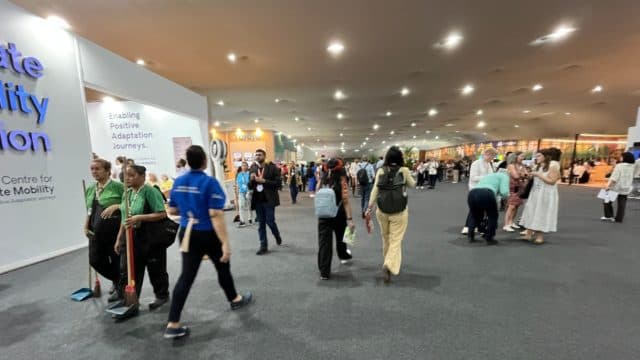
And I’m Colin Hoogerwerf. Our episode today starts in Brazil, in the rainforest region in the Northern part of the country. [rainforest sounds, birds chirping, insects buzzing]
Stump:
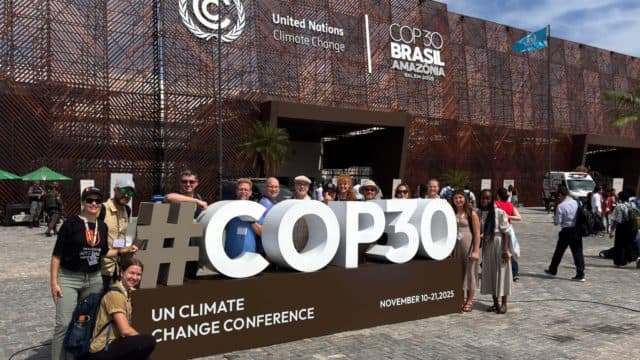
That’s where COP30 was held at the end of last year—the United Nation’s annual climate summit.
Hoogerwerf:
It didn’t sound like this most of the time though.
More like this. [sounds of crowds chattering]
And this. [sounds of U.N. speech opening]
And because we were just about 100 miles from the equator and it was really hot, there was always the constant sound of air conditioners. [sound of machine humming]
Stump:
This was my third visit to a COP, and your second—to this meeting of sorts where the countries of the world (or most of them anyway) gather to try and come up with a plan to avoid the harmful effects of climate change. We’ve gone to COP with a group called the Christian Climate Observers Program, CCOP for short, a group of Christians from around the world and we live together for a week (this year on a boat) and we attend the conference together as a form of discipleship.
We’ve done episodes and other writing about the COPs before but we also realize that a lot of people aren’t closely following the United Nations efforts on climate change. So we’ll make sure to give more explanation as we go along.
Hoogerwerf:
Even though we draw on our experience in Brazil this isn’t really an episode about what happened at COP30 in November of last year. Or really about the United Nations or global policy on climate change at all.
This is an episode that asks whether climate change is really just a scientific or technical problem—and more importantly, it asks what kind of people we want to become in response.
The UN conference has a part to play in that story, and what happens there is worth knowing about—but so are all the individual people from around the world who come from real places with real problems. Their struggles, their hopes and fears, and their creativity and resilience—that’s what we want to explore here.
Stump:
We’re going to start this episode with some climate science and then we’ll follow that into the lives of some particular people in some particular places, where we’ll need more than just science to understand what’s happening and how to respond. Be aware, we’re not looking to tie this up with a happy ending.
In the next episode we will focus more on how people around the world are responding. Things are happening. And we’ll see what kinds of practices and rituals we might follow, and how we might all start to see ourselves as a part of that resilience, even in the face of something that seems unbeatable.
Part One: The Science of Climate
Hoogerwerf:
There is a traditional kind of logic that goes like this: Many people still don’t believe that climate change is a problem. They must not know the facts. We will give them the facts and then they will believe.
Stump:
Sounds like you’re baiting the guy who used to teach logic classes….
Hoogerwerf:
Yeah, professor…what’s wrong with the statement above?
Stump:
Well, there’s a premise stuck inside that is problematic. Which is this: If people know the facts about climate change they would believe it is real and serious. It makes an assumption that belief formation is caused only by evidence or facts. But we know that there are many other factors. Fear, loyalty, trust, economics, and politics all have a role to play too. And many of those seem to have much more of an influence on belief than having more facts.
Hoogerwerf:
This idea that we just need to give people the facts has a name. It’s called the Deficit model. And not only does it not always work, it can actually have the opposite effect. It can make people even more stubborn in their prior beliefs, especially if “The facts” come from someone who is not a trusted messenger. And you might want to say, well let’s just give the facts to those who already agree so they can be better persuaders…well that can just end up increasing polarization, bolstering those who believe and causing those who they are debating to dig further in.
Stump:
Now that we’ve cleared that up, we’re going to give you a bunch of facts about climate change….
Hoogerwerf:
[chuckles] Yeah…well there’s always a good balance. I think it’s possible to go too far the other way. We could say, “let’s not argue about the facts. This is just about loving our neighbors and the science doesn’t matter. We’re not going to talk about science at all.”
The whole point of this podcast at least is to bring science into conversations with faith. We can’t leave it behind.
Stump:
And it’s not only because you and I (and probably our listeners) like science. Science is one—not the only— but one important part of building a belief system, even if loving our neighbors is ultimately our goal. If we want to love our neighbors well, science will be a helpful tool for us.
But, as we know, science does sometimes get left behind. And not only in faith communities. Some people might be surprised to find out that it also happens at the place where you would expect science to be king. At the COP…
Hancock:
One thing that we’ve really seen, across the board, is the negation of science.
Hoogerwerf:
This is Susana Hancock
Hancock:
And my title is the Global Mountains Director with the International Cryosphere Climate Initiative.
Hoogerwerf:
We met Susana in her short open time between several meetings with negotiators.
Hancock:
Okay, so I track several different negotiations. I track RSO, which is the Research and Systematic Observation. It’s actually really the only track in which we discuss science…which is relevant, because when we’re here at climate negotiations, it’s kind of important that we talk about science.
Stump:
This is where we might need to give a little more context. Queue up the “background information music”
Hoogerwerf:
Got it. And go ahead. [music begins]
Stump:
Ok COP…that stands for Conference of the Parties. The parties are countries around the world that have agreed, through the U.N., to deal with climate change — basically almost every country in the world. The conference is the one time they gather together and try to agree on a path forward. They’ve done that 30 times now, and over those meetings they’ve managed a few pretty important things—probably most recognizable is the Paris Accord, from about ten years ago, which set the goal of limiting global warming to 1.5 degrees Celsius above pre-industrial levels. 1.5 degrees is the amount of temperature rise that scientists have continued to say will allow us to avoid the catastrophic effects of climate change.
[music fades]
Hoogerwerf:
Ok, with that taken care of, back to Susana, who is a scientist, and who attends COP with the goal of bringing the science into the negotiations.
Hancock:
How can we overcome some of these roadblocks that we’re seeing, where it’s certain countries that really respect science if it comes from them, and they’re not really interested in science if it’s produced by other countries. There are countries who may respect the science objectively in a one-on-one conversation, but they have orders from their country about what you’re saying and what’s in our national interest, and cutting oil is not in our national interest, even though they know they’re highly climate vulnerable.
Stump:
So you can see that this is already getting complicated. Pitting some science against other science. Pitting science against political mandates. The negotiators themselves are usually not scientists. But they need to know what to negotiate for.
Hancock:
This is actually why we kind of began my organization, is there’s a lot of disconnect between negotiators and what they need to be negotiating. And so they’re relying on experts. And so we are going in and working with them to see what’s important, and how can we support that.
Hoogerwerf:
Most of Susana’s work doesn’t happen in stuffy negotiating rooms near the equator. She studies the cryosphere…
Hancock:
All the frozen regions of the planet.
Stump:
And she doesn’t study it from far away…she goes there, where she gets around on skis and sleeps in tents, not much different than the tents anyone probably imagines setting up in their own backyard…maybe with some stronger poles.
Hancock:
Yeah…So it’s awesome. It’s cold. It’s very cool. It’s, you know, so cool that it’s cold. No, I love it. I’ve been involved in it for a number of years. It’s a place for me that feels very raw and very powerful and very pristine at the same time.
Hoogerwerf:
We might have strayed a long way from the humid negotiating rooms at the Equator in the Amazon region, but as it turns out, the frozen places are pretty important for the rest of our planet.
Hancock:
The cryosphere is, I think, one of the most critical systems for the planet.
Stump:
And understanding what exactly is happening there and how it is changing is crucial information to know when we are trying to anticipate what the future will look like and what we might need to change in order to keep our planet healthy.
Hancock:
75% of the world’s fresh water is held up in ice. A majority of that is in the polar ice sheets, but a significant percentage is in glaciers. Glaciers are rapidly melting. They’re creating cascading and concurrent disasters. You’ll have a collapse of a glacier, or can trigger a flood, what we call GLOF or glacial light outburst flood, which can wipe out entire communities without any warning.
Hoogerwerf:
The scientific research Susana is a part of would help to get some warning systems in place for vulnerable communities. Flooding isn’t the only problem.
Hancock:
People need to be able to get food. And indigenous communities would go out on the ice. They would be hunting, and right now getting onto the ice is a lot more dangerous. The ice is thinner. The ice is not where it’s supposed to be in terms of cycles of when you would eat and where you would eat. So the animals that would normally be on the ice are not there. The animals that rely on the snow are not there. You may have freezing rain instead of snow. So then the animals can’t actually get through and eat the lichen that might keep them alive—reindeer, for example—and so then they’re starving as well. And if you have herds of animals that you’re trying to keep alive yourself, then you have to spend a whole lot more money on now providing food for them, because they can’t naturally eat themselves. So it’s a whole change of lifestyle, but it’s creating, you know, for example, food deserts, where they’re relying on these external ships that can’t come that often and can only bring foods that aren’t necessarily healthy because they’re they have to be packaged and preserved.
Stump:
These are things that are happening now and are specific to polar regions but the importance of the cryosphere is closely connected with much larger global systems
Hancock:
And then we have things like sea level rise.
Hoogerwerf:
Which is really closely related to that temperature threshold of one and half degrees.
Hancock:
If we stabilize at 1.5 we’re able to save about 54% so just over half of the glaciers than we would if we’re at 2.7 which is about where our current emissions tracks are, that alone, in terms of something like sea level rise, is probably a third a quarter to a third of a meter, which is a global average.
Hoogerwerf:
You might think of sea level rise in the way that I’ve always thought about it…essentially like a bathtub with the surface steadily rising.That is helpful for thinking about the volume of water, but it oversimplifies things in other ways. The world’s oceans aren’t really just flat like you think of the surface of a bathtub. There’s a bunch of topography in the water. Wind and currents, temperature and gravity all act on water so that some places are higher or lower than others. So just like with temperature, we talk about averages, but we need to remember specifics too.
Stump:
Susana is talking about the difference between 1.5 degrees celsius of warming and 2.7 degrees.
1.5 is the goal set out by the Paris agreement. 2.7 is what scientists say we’re on track for with the current outlook. That difference might not sound like a lot. It’s not a difference that’s going to change whether you go to the beach or not. But it’s a change that has consequences for the earth.
Hancock:
I mean that’s significant and existential for millions of people around the world.
Hoogerwerf:
Remember, Susana said that at 2.7 degrees of warming we’re looking at something like a quarter to a third of a meter—around a foot—of sea level rise, as a global average. But that doesn’t even highlight vulnerabilities of some specific places.
Hancock:
So coastal communities, for example. I mean, if you look at big populated cities on the coast, Dhaka, for example, in Bangladesh, you know, if it’s right now, it could have a meter of sea level rise by 2070. And that significantly wipes out, maybe half of the city. And if you know, by the early 2100s 2200s we could be looking at three, three meters of sea level rise.
Hoogerwerf:
Dhaka is one of the most vulnerable cities to sea-level rise because of its low elevation and because the land is sinking, on top of global sea-level rise from melting glaciers and ice sheets.
Clearly we start to see that understanding some of the detailed science about the poles is connected to places all around the world. And understanding the complex science behind these changes is important for people and governments around the world to know what to expect, where and how to build new infrastructure, and who will be affected by future changes.
Stump:
And remember, all those millions of people are going to have to go somewhere. So these frozen regions of the planet might seem far away, but they are deeply connected to other critical earth systems…as is the Amazon rainforest.
Richards:
Vast amounts of water comes off the mid-Atlantic in the form of clouds, drives up what is the Amazon Basin going east to west, and nourishes an incredibly complex ecosystem. And it is incredibly complex.
Stump:
This is Ben Richards, a paleoclimatologist by training.
Hoogerwerf:
Which is a fancy way of saying the study of climate of the past.
Richards:
The general thinking of paleoclimate is if you can understand the past climate regimes, then you’ve got a much better grasp of what it’s likely to do in the future. Indeed, actually you can understand the current climate quite well as well.
Stump:
Which brings us to the current climate in the Amazon rainforest and what it does for the worldwide climate.
Richards:
Yeah, a lot.
Hoogerwerf:
So we have all this water coming off the Atlantic ocean into the Amazon basin…
Richards:
And as you go further inland from the ocean, you’re not getting so much water that’s directly from the ocean. You’re actually getting water back into the clouds that’s evaporated from the vegetation and the rivers. So you’ve got this cycling of water as you go inland. I think it’s something like 75% of the rain that falls has evaporated within 24 hours or so, gone back into the atmosphere, and then forms the clouds, which blow a bit further inland, a bit further west, and then they dump the rain on the next bit, and it kind of cycles in like a continuous Caterpillar track or something. So therein, you have already a vulnerability, because if you somehow interrupt that process by not having a whole section of trees, you don’t have this evaporation again, then the further inland sections no longer get as much rainfall as they would have done, and that is actually being observed now through meteorological measurements and satellite so observations.
Stump:
So that’s what’s happening locally, but just like in the poles, that connects to other places…
Richards:
These forests have been a so-called sink of carbon dioxide. That means that the sink is the absorbing capacity. You’ve got sources and sinks in the climate system of atmospheric gasses. So this was a very good sink. I’m using the past tense unfortunately, because in the last two or three years, there’s fairly new data showing that it seems to no longer be a net sink. So you’re no longer therefore getting more oxygen out and more carbon stored here. The reason that’s changed is largely due to two aspects. Firstly, it is the deforestation. It’s about 17% of the land area is now deforested in the Amazon basin. And the second thing is heat stress and water stress. So the plants are just not doing as well as there’s slightly less rainfall.
Hoogerwerf:
Due to many factors—at least one them being deforestation—we have changed the way the Amazon rainforest contributes to being a place that captures carbon from the atmosphere.
Stump:
When you look at the entire carbon system, any one source or sink for carbon might seem like a pretty small percentage compared to all the carbon that is cycling. The carbon that humans emit is only a tiny percentage of all the carbon outputs from decaying organic matter. But it’s really more about balance than about overall percentages.
Richards:
You’ve had these natural emissions, but you’ve also had natural sinks, and during the last, let’s say, 10,000 years, when we’ve had a really pretty stable climate, they’ve roughly equalled, in fact, quite extraordinarily, close to being equal.
Hoogerwerf:
It doesn’t take much to throw off that balance.
Richards:
If we believe in a creator, a climate system that God allowed to have on the planet he made has many different forms. And it can change from them by very small changes.
Stump:
You don’t have to go back very far to see a really different version of climate on earth.
Richards:
So the glacial that happened before, roughly six degrees cooler on a global average, roughly sea levels of 120 meters below what we have now. It’s a round about that. And so that’s a really different climate system. Hard to describe how different that is. There were huge areas with no vegetation, just sand and dust storms off in. In what’s now the United States, next to a huge ice sheet, which was, what two and a half kilometers deep over probably Chicago.
Stump:
And the difference between an ice age and our current climate didn’t take some massive outside change.
Richards:
The small changes that led us from deep glacial to the very stable climate of what we call a Holocene the last 10,000 years, the small change was a fraction of a degree, a percentage difference, let’s say of solar irradiation in the summer versus the winter in the Northern Hemisphere.
Hoogerwerf:
Because of the different ways the earth and sun interact, there are a series of different cycles dependent on the tilt of the earth and the shape of the earth’s orbit that layer on top of each other, but are all very predictable in how they will affect earth’s climate.
Richards:
At the moment, by the way, at the moment, we’re in a phase where we are all the orbital parameters should be moving us into another glacial slowly. So it might take, if we hadn’t messed it up, it might have taken about one and a half to two to maybe 3000 years before we start growing ice sheets again.
Stump:
Those incremental orbital parameters that should be pushing us to a cooler climate have been overshadowed.
Richards:
Really, the problem we’re facing now is that humans are used to a certain climate to the extent that none of us are quite aware of. We haven’t realized because it’s been normal. It’s the river we’ve been swimming in. And what it means is this sudden change, and which means within a generation or two, from a very stable climate to a quite erratic climate with overall a lot more energy than we had. We’re just trapping so much more heat than we used to, that rapid change puts us in peril. I’m using the right sort of word there. It is a very dangerous situation.
Part Two: Stories of Climate
Hoogerwerf:
Earth’s climate is a very complicated system. Small changes can have big effects. Over decades of research, scientists like Ben and Susana have come to understand a lot of the complexity pretty well to the point where they can make predictions. And over and over the scientists have seen those predictions come true. But still, the language we use to talk about the science of climate—average changes in temperature or the volume of an invisible gas in our atmosphere—these things are so abstract they don’t really mean all that much to most of us. It’s when we start to translate these things into the lived experience of people that we start to better grasp what it all means.
Richards:
Talk to any farmers. They are used to the rainfall or the sunlight or whatever, at certain times of year, they rely on it for crops they know grow in that area that is already destabilized in many parts of the world. You talk to almost anybody who’s involved in farming in Africa—and I do this quite often with my role in Youth with a Mission—they’re saying, “but the rain doesn’t come when it used to. We’re not quite sure when to plant.”
Stump:
We ran into someone else who has talked to a lot of farmers in Africa…
Cho:
Hey, everyone, this is Eugene Cho. I am joining you all from. Where are we? In Belem, Brazil.
Stump:
Eugene is the President and CEO Bread for the World, a Christian anti-hunger advocacy organization. I first met him at COP 28 in Dubai, and the very fact that the head of anti-hunger organization is spending time hanging out at climate change conferences points back to this problem.
Cho:
The first time I heard about climate change was about 35 plus years ago. It was not the phrase climate change, it wasn’t even creation care, it wasn’t a seminary class, it wasn’t BioLogos, it wasn’t an event. I was doing research among smallholder farmers in eastern Africa, and when I asked the question, “what’s some of your biggest challenges to smallholder farmers?” I was expecting them to say hunger, because that was the research project I was there for, is just to examine issues of hunger. And I was shocked to hear and to meet smallholder farmer after smallholder farmer, say, in their imperfect English, they were being very gracious to me, but they basically said, “weather patterns unpredictable, weather changing too fast. Can’t grow food.”
Hoogerwerf:
For many of us in the United States and other wealthy countries, we might not really understand the stakes of failing agriculture. We are used to there being food on the grocery store shelves no matter the weather, time after time. That’s not the case for people who grow their own food or people who grow food for a living. And it’s even more complicated than just agriculture. We heard a story from Svenja, who was a part of the CCOP group we traveled with to COP30. As you can tell from her accent, she is from Germany, but she spent many years living in Africa and this story is from her time living in Nairobi Kenya.
Akwaba:
The agriculture is failing a lot. And what I’ve seen is that when it’s dry season, it’s very unpredictable when the rain is going to come. And the more remote you are, the more difficult it is to get any water. We’ve been in a community recently where they basically don’t have any water during the dry season, so now they are trying to prepare to have water basins that collect rainwater to get them through the dry season to at least grow some things to have food, because it’s it has a big impact on food security as well. And I mean, that’s a big issue that needs to be addressed. And on the other side, I have seen huge rainfall. Even in Nairobi, like when we lived in Nairobi, the rain wasn’t coming for a very long time, and you could see, like, literally, creation was groaning, everyone was. And people just, like, everything was just dry. And then the rains came, and it was like a great relief to the entire city, like, finally the rains are there, and then they didn’t stop, and it just rained and rained and rained. And I was so excited in the beginning that it’s finally raining, and I love dancing in the rain, so I did. And then the next day, it was still raining, and we have a river next to our house that is like dry. Well, it’s been dry for years, so people have set up their small buildings in that area, and then the rains came, and I woke up in the morning, all the houses were gone, like they were just washed away. And I don’t—up till today, I don’t know what happened to my neighbors.
[music]
Hoogerwerf:
As I’ve been doing this work and hearing the stories from people around the world, I often come back to a familiar metaphor of a leaking ship.
Cho:
I’m grateful to be here at COP, grateful to have platforms to talk and share and so forth, to do a podcast, but I think it is really important for us to listen to people that are on the bottom of the ship, who might see the impacts of a leaking water and when our global neighbors are saying we’re beginning to see water. I think it’s so important. And that’s my first experience of hearing farmer after farmer saying, there is something happening. This is our biggest challenge.
Stump:
Farmers in Africa aren’t the only ones noticing the leaks. The people that are often first affected tend to be those in rural areas, the poor, those in coastal communities and near the equator and the poles. They also tend to be the ones who have contributed the least to the problem. And the effects show up in different ways in different places. Since we were in Brazil we heard several stories about what is happening in Brazil, and the common story we heard was about flooding.
Guilherme:
I think it’s very important to represent what people are suffering in the global south. So especially at my city and in my country, there was this big event of flooding last year.
Hoogerwerf:
This is Guilherme Gastal.
Guilherme:
I am an Environmental Engineer and member of the Episcopal Anglican Brazilian Church Working Group for Environmental Justice, and also a member of the ACAN that is the Anglican Communion Environmental Network.
Hoogerwerf:
Guilherme is from the far Southern part of Brazil, which has recently experienced severe flooding.
Guilherme:
In Brazil, 2024 became a defining year, especially in the state of Rio Grande do Sul, which faced what is now considered the largest climate related disaster in its history. in just a few weeks of torrential rainfall, 478 municipalities were affected, impacting 2,398,255 people. These numbers reflect families facing displacement, material losses in interrupter routines and the destruction of places they once called home. There were 806 injured, 23 missing and 185 confirmed deaths, each one representing a story, a community and a life that will need rebuilding. Rivers reached historic levels. The Guaiba River in the capital Porto Alegre surpassed all new records, an estimated 1500 square miles around the metropolitan area were submerged. Just talking about urban areas, the area is equal to 5000 soccer fields. Entire neighborhoods disappeared underwater.
In cities like Guaiba on the other side of the lake, entire neighborhoods, including areas around Anglican chapels, were swallowed by the flood waters. In downtown Porto Alegre, the National Cathedral of the Holy Trinity, became accessible only by boat. This image captures the scale of the tragedy.
Hoogerwerf:
We’ll hear more from Guilherme in the next episode. His story about the flooding doesn’t end there, but we’re going to sit with the reality before moving on to what we might want to make into a happy ending. We want to continue to follow Euguene’s advice about listening to the stories from people at the bottom of the leaking ship and the lived experience of those in vulnerable areas.
Stump:
Within our metaphor of a leaking ship, at a place like COP, we hear a lot of people talking about how to stop the leaks, or sometimes arguing about whether there are leaks at all. It’s not quite the kind of conversation you would expect from people on a sinking boat. There doesn’t always seem to be a lot of urgency, or the kind of worry you would imagine.
Hoogerwerf:
One of the people we met in Brazil, Emilie Teresa Smith, had an inkling that the kind of stories she wanted to hear—the ones from those who are feeling the effects—wouldn’t necessarily be found in the negotiating rooms, but on the way to Brazil, which is why she took a bit of an unusual route.
Smith:
Okay, so it was a long story. Let’s see. Where do we start?
Hoogerwerf:
Well we could start in Canada, Emilie’s home.
Smith:
I am the rector of St. Barnabas in New Westminster, part of Vancouver.
Hoogerwerf:
But we don’t stay there, because a couple of years ago Emilie got invited to come to COP30 in Brazil…and Emilie is the kind of person you have to be careful about inviting because she tends to say yes.
Smith:
I say yes to everybody, everything.
Stump:
And so she started looking at a map and realized she could get to Brazil from her home in Canada without flying.
Smith:
So I began a process of imagining, exploring, figuring it out. I’ve been working, I’ve worked for about two years to create a map of how to get here.
Hoogerwerf:
She was quick to point out right away that she did end up having to fly a couple times, mostly out of safety reasons. And while the goal of not flying was partly about carbon use and trying to find better ways to travel, it really was much more about gathering stories and developing relationships in a different way. And she was definitely successful at that.
Smith:
So I visited 25 communities, was in 10 countries. I’ve slept in 37 beds, or busses or trains. I did the math. I can’t sleep at night so I’m going to want to.
Hoogerwerf:
Not everything that Emilie saw and heard about the environmental degradation in these communities was a direct result of climate change. Hold that loosely for a moment. We’ll come back to it. But now we follow Emilie to Central Mexico.
Smith:
The Santiago Lerma river outside of Guadalajara in a little town called Sal El Salto is the most contaminated River in Mexico. A child fell into the river chasing a soccer ball, swallowed some of the water and died. That’s how bad it is. So I met with this guy. He’s big, tall, skinny, wearing a hat, and I and I said to him, I said, like, so, like, yeah, what’s what? What’s going on here? And he just has this vision of the world and how to talk about it. And he’s sitting in the midst of like the most—he’s grown up by this river. This is his River. And he’s sitting there. It’s so toxic. We went to see it, and the water sprays off of where there’s a big waterfall, and it lands on the leaves, and the leaves wither and brown. You can see where the water has hit the leaf and it’s died. Anyway. It’s just devastating.
Now, I’m almost like in a pit, miserable about this, and he’s created an organization called un Salto Por La Vida, which is A Jump for Life. El Salto means to jump, or to leap, a leap for life. And what they’re doing is they’ve created a nursery. I went there to visit, and he’s got all these young people working, creating, you know, the little black bags with trees and and and things in them. And he’s created this nursery where anybody, everybody, can come and get free trees, like 12,000 trees they’ve planted, and they’ve got a whole area they’re reforesting. I’m thinking, like, here’s this man, he’s in the midst of, basically the you know, if you have this concept of creation, that is not a product for our use, but a brother with whom we share life—which is Christian, St Francis, 800 years ago, the canticle of the creatures, sister water—this river is his brother. It’s not just this thing that can be used or not used. It’s a living, now dying thing. The river’s been declared dead, and he’s living beside it, and as he’s living beside his dead brother, and he’s creating life, he’s refusing to allow this monster of death to have the last word.
[music]
Hoogerwerf:
Emilie heard stories like this in many of the places she went.
Smith:
The central thread that’s running through all of the communities I visited, is a real grief and a struggle for protecting their way of being with the earth, with the water.
Stump:
As you mentioned earlier it wasn’t always necessarily an effect of climate change. The polluted river isn’t a result of heat trapping gasses in the atmosphere. But it’s not too hard to trace back from environmental degradation and climate change to find something similar at the base.
Smith:
The common denominator of people making it work, of really having the answer of how to live on the land and also facing this common enemy. I hate the word enemy. I hate the word. I hate the idea that there’s like a monster out there destroying things. But in the sense, it’s not a—there are humans involved, but it’s really—and as a person of faith it’s a human sin that’s grown to proportions we can hardly imagine, of greed, basically, greed and it’s evil twin violence are kind of the driving force behind all the harm that’s being done.
[music]
Hoogerwerf:
When we go to COP and we publicize our trip and talk about it, naturally people ask when we get home how it was. It’s a kind of funny question to try to answer in just a phrase. And my kind of cheeky answer has been, “well they didn’t solve climate change.” People laugh of course, because no one expects that, right? Because this is a really hard problem. But what kind of problem is it actually?
Stump:
Emilie starts to point us in a different direction than the deficit model. Climate change isn’t a scientific problem or a technical problem. It’s not that we just need to get more facts out there or even that we just have to do more research and we’ll suddenly find the answer. The problem is more about what is really important to us and how we decide whose lives matter. There are people who are suffering the effects of climate change now. They may be shouting for help but often we don’t hear them.
Hoogerwerf:
We’ve told a few of the stories from different parts of the world. That’s the beginning of hearing those who are shouting. We’ve been cautious to step too quickly into response because we think it’s important first to really understand that problem from a human point of view. When we understand this more as a spiritual and emotional problem, one that is centered around communal and systemic sin, we respond in a different way. We don’t give facts.
Stump:
So the question then is what do we give? Where do people actually find the capacity to respond? And what kinds of practices, stories or faith might be able to carry this weight?
Hoogerwerf:
That’s where we’ll pick it up in the next episode.
Credits
Language of God is produced by BioLogos. BioLogos is supported by individual donors and listeners like you. If you’d like to help keep this conversation going on the podcast and elsewhere you can find ways to contribute at biologos.org. You’ll find lots of other great resources on science and faith there as well.
Language of God is produced and mixed by Colin Hoogerwerf. That’s me. Our theme song is by Breakmaster Cylinder. BioLogos offices are located in Grand Rapids, Michigan in the Grand River watershed. Thanks for listening.
Featured guests
Susana Hancock
Susana Hancock is a Scientist and Polar Explorer and the Global Mountains Director with the International Cryosphere Climate Initiative.
Ben Richards
Ben Richards is a paleoclimatologist and works for Youth with a Mission (YWAM) in Scotland.
Eugene Cho
Svenja Akwaba
Svenja Akwaba is a Safari Guide and has a degree in Conservation and Wildlife Management and is currently undergoing study in Theology. She lives in Kenya and Germany.