Becoming the Answer | Something is Stirring
We turn to stories of resilience, faith, and practice and ask what it means to say “we are the answer” in a warming world.
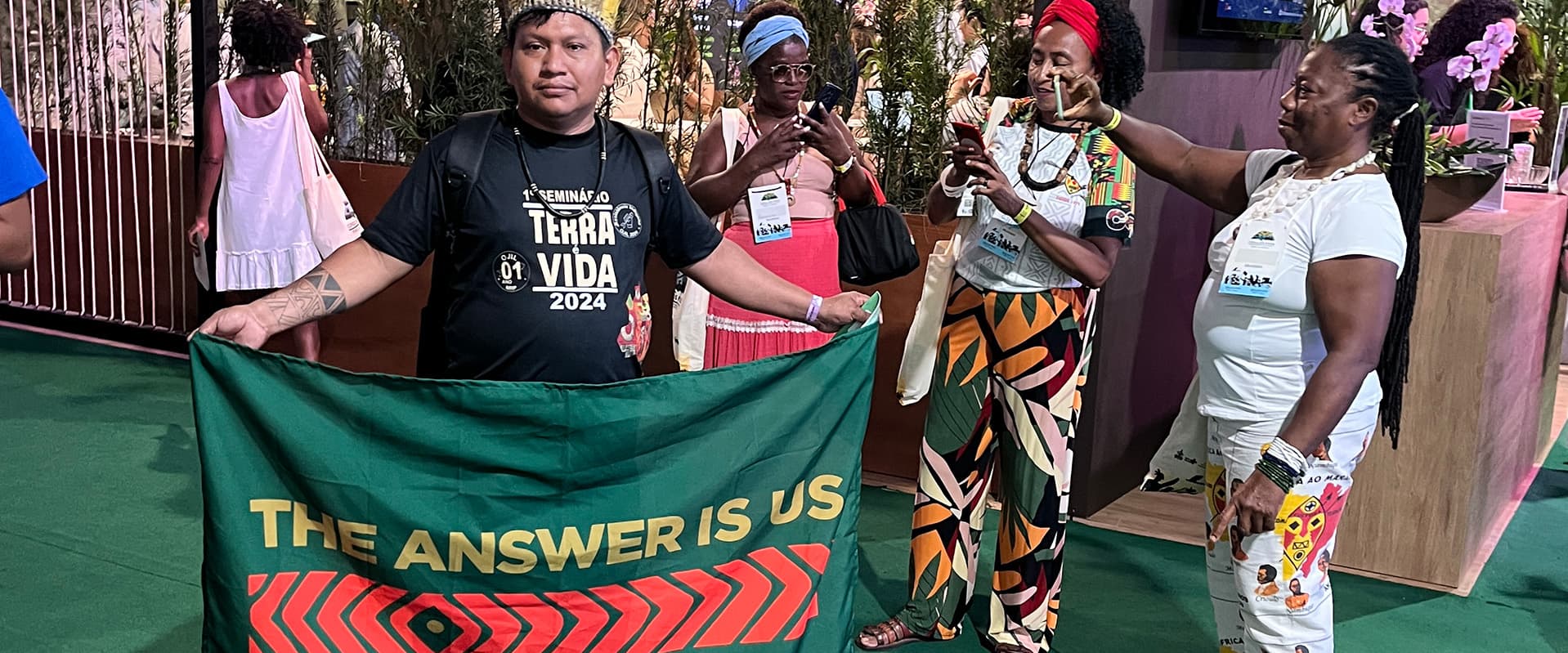
Photo by Colin Hoogerwerf
We turn to stories of resilience, faith, and practice and ask what it means to say “we are the answer” in a warming world.
Description
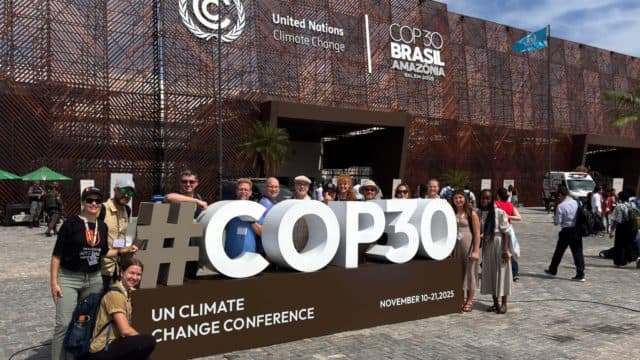
This second episode of our two part series turns toward resilience—without pretending that the climate crisis is solved (Listen to Part One here). At COP30, amid formal speeches and stalled negotiations, the episode highlights moments of disruption, protest, and lived wisdom, especially from Indigenous and local communities. Through stories of resilience, faith, lament, and embodied practices like confession and repentance, the episode asks what it means to say “we are the answer.” Rather than placing hope in global negotiations alone, it points listeners back to their own communities, churches, and daily practices as places where faithful climate action can begin.
About the Series: This two-part series follows a group of Christians from around the world as they gather in Brazil for COP30, the United Nations climate summit. Rather than focusing on policy outcomes or political winners and losers, the series explores what kind of problem climate change really is—and what kind of response it demands. Through science, lived experience, and faith practices, the series asks how Christians might move beyond information and outrage toward resilience, responsibility, and faithful action in a warming world.
Theme song and credits music by Breakmaster Cylinder. Other music in this episode by Klimenko Music, Superlegal, Ricky Bombino, Diverse Music, Pink Marble, Cosmo Lawson, courtesy of Shutterstock, Inc.
- Originally aired on February 19, 2026
- WithJim StumpandColin Hoogerwerf
Episodes in the Series
Podcast Episode
Becoming the Answer | Something is Stirring (Part Two)
Transcript
Stump:
Welcome to Language of God. I’m Jim Stump.
Hoogerwerf:
And I’m Colin Hoogerwerf. This is the second part of a miniseries called Becoming the Answer.
If you’re starting here, we recommend you first go back and listen to Part 1, “Why Climate Facts Aren’t Enough” …In that episode we try to explore what kind of a problem climate change is. There has been a long standing idea that it is a scientific or a technical problem, that it just needs to be solved by giving more facts. It has become pretty clear though that facts don’t lead to belief or action.
Stump:
Not that the science behind climate change isn’t interesting or helpful. It is both of those things. When we dig in, we see that small changes can have big effects. And more importantly, we see how one thing can connect to another so that decisions in one country affect another and that the people who often suffer the most from climate change are often the ones who have contributed the least. And understanding the science helps us to know what kinds of changes need to be made and gives us some timelines. But the science only gets us so far. When we start to hear the stories of people’s lived experience, we see the problem from a different angle and that’s when it becomes more than a science problem or a technical problem.
Hoogerwerf:
That doesn’t make it any easier of a problem. In fact it probably makes it a lot harder. If it were just a science problem we could just put the solutions into place. We actually already know what those are. But we haven’t done it. And that starts to become pretty clear at a formal place like a COP and it’s part of why the results of COP often seem a bit disappointing.
Stump:
Every year at COP, there’s a designated space where a representative from every party gets to make a 3 minute speech. (Almost all of them go over time). A lot of the speeches that come from wealthy countries are people touting all the good work being done. But the speeches from representatives from the more vulnerable countries are one of the few places where the formal kind of language at a COP turns into what feels a lot closer to the shouting from the people at the bottom of a leaking ship. Last year, at COP29, one of the most moving speeches came from a representative from Panama.
[Juan Carlos Monterrey speech segment from COP29]
Hoogerwerf:
Yeah he was really great and did what I really wanted to see more of, which was to break through the formal talk with a bit of passion and emotion. He also walked around in an iconic Panamanian hat. And so when I saw him standing around this year at COP30 in the same hat, I pulled my microphone out, got up my courage and walked over to him—
Can you say your name for me?
Monterrey:
Juan Carlos Monterrey. Climate Envoy Panama.
Hoogerwerf:
—because he’s someone that has found a way to speak some hard truths, especially about the COP process, from within the formal space that is the UN.
Monterrey:
So COP30 has been named the COP of truth. So let’s name a few truths. Truth number one: we’re failing. We’re not only failing, we’re miserably failing to accomplish the goal of the climate convention, which is to stabilize greenhouse gasses in the atmosphere. Over the past 33 years, we have made a number of efforts, but the truth is that we have more than doubled emissions since the first day we started negotiating as a global collective. Yes, we have slowed down the pace at which these emissions are growing, but they are growing nonetheless. That’s truth number one that we need to internalize in order to take stock of where we are and develop better solutions.
Hoogerwerf:
And the problem is, it’s not happening fast enough.
Monterrey:
Time has run out. So there are only two words that really matter, invest and scale. Invest and scale.
Stump:
There has been a growing sentiment that the formal process of COP isn’t going to be able to do what it needs to do. I’ve been to three COPs now and have left each one with a fair bit of disappointment at the official actions taken. And yet, each year, while the negotiations may be uninspiring, this gathering of human bodies in a single space still manages to highlight something important…something is happening.
Anderson:
And I think there’s although this space is quite formal, and everything is done in letters, and it’s “dear distinguished colleagues,” and it’s all done in this language that nobody really understands or would ever use back home—
Stump:
This is Laura Anderson, a climate scientist and accidental social media influencer who has been one of the leaders of the Christian Climate Observers Program.
Anderson:
—But actually, there is a time and a place for the more shaking up kind of moments, and even at the COPs in the middle weekend, on the Saturday, there is normally a large march. That’s something that’s been missing in previous years because of the countries that have hosted it. Next year it’s in Turkey. I guess we have to wait and see whether that is something that we get back again. But certainly this year that did feel like we were able to have that moment of chanting and walking and marching and being creative with placards and dancing and T shirts and whatever it might be.
Smith:
There was the giant demonstration here. I don’t know how many 10s of 1000s of people on Saturday, if you were there…
Hoogerwerf:
This is Emilie Teresa Smith who we heard from in the last episode who trekked to Brazil from Canada, stopping in 25 different communities along the way. She made it just in time to go to the march that happened on Saturday.
Smith:
But the I think that this is like if I came on this pilgrimage looking for an answer—not sure that’s what I was doing—but I think I realized looking back at photos from the demonstration, I think I’ve got the answer. And it is a slogan on a banner, and I’ve seen it more often than not. A reposta somos nós. We are the answer.
Stump:
This was a banner being held up by a group of indigenous people, and it’s a message that we saw and heard throughout the week.
Hoogerwerf:
Here’s Juan Carlos Gomez again
Monterrey:
Science tells us that the best stewards of nature are indigenous communities, Afro-descendant communities and local communities.
Smith:
I mean, we actually don’t have to talk about anything, folks. Let’s just stop talking. Let’s just figure out how to protect the people who are living the answer. So this is the answer. The answer is caring for each other, caring for our sisters and brothers, creatures and and our Mother Earth and our mother grandmother, water. I mean, we just, we have to figure out how to overthrow greed and the violence that’s associated with it.
Hoogerwerf:
After traveling for months through Mexico, Central America, and Colombia, and taking a boat down the Amazon to Manaus, Brazil, Emilie was in her last community and staying with a priest and his wife who was an indigenous anthropologist who was going out to an indigenous community to do some research.
Smith:
She said, You want to come and I’m like, sure.
Stump:
If you remember from last episode, Emilie doesn’t turn down invitations like this.
Smith:
I say yes to everybody, everything.
Stump:
So they hop on a boat.
Smith:
We were on the boat, five hours.
Hoogerwerf:
And after five hours they pull up at their destination
Smith:
And it’s what’s called a riverino or River community. So these are poor people living along the river. And if you ever see you’ll see the little houses along the river and living with the river above the river. The river rises and sinks. And sometimes they’re really close to the river. Sometimes the river floods. Sometimes—last year was a terrible drought.
Hoogerwerf:
Emilie was only there for a couple days but on the last morning one of the men from the village invited Emilie to go fishing.
Smith:
This fellow named Magu.
Stump:
And remember about inviting Emilie places?
Smith:
He said “do you want to go fishing?” And I said, “do I want to go fishing? Yes! is the answer to that.”
Hoogerwerf:
So Emilie hops on another boat with Magu. But before they go fishing, they need to go over to pick some fruit and they boat over to a different community where there’s some land that was Magu’s father’s land.
Smith:
There’s a big sign there called Dios Provera. Dios Provera, God will provide, is the name of where we’re going. I’m like, Okay, I see some sermon illustrations coming up. But anyway, so we pull up, we get out, and we start harvesting. I didn’t know we were going there at harvest, but we got a bunch of fruit called Jenipapo. Never heard of that. Filled the boat. We went to the watermelon field. There was a little net around the whole field without tripping over it he said, “well, that’s to keep the iguanas out.” I’m like, “oh, okay.” A neighbor had stolen a few watermelons. You could see where the watermelon had been, and, like, no watermelon. And he said, “Oh, whatever God will provide.”
I’m like, this is like the poorest man I’ve been with all along. And he’s like, basically barefoot, flip flops. “God will provide.” And so we got a few watermelons. He showed me the squash, and everything. And we go to the mango tree. And the parrots have attacked the mango tree. There are no mangoes left. They’re everywhere. There’s one mango. So he picks up one mango for his daughter. He takes the mango. We get bananas and plantains, we fill the boat, and then we go down river.
Stump:
Now, to the actual fishing.
Smith:
I’ve gone out with my pal with a rod and reel and caught something, and I’ve never been fishing like this. So he’s casting a net. I’m like, “here I am. I’m in the Bible.” He’s casting his net. There’s nothing. He’s casting the net. There’s nothing. He casts the net a third time. We were moving around different spots and this on the Amazon. He cast the net. He brings up one piranha [laughs] And he just untangles the piranha. And then he casts the net and there’s like 25 fish, and he pulls them up. There’s these silver, silver fish. And then we just get busy untangling the fish from the net. And he just turns to me and said, “you never have to be hungry on the Amazon.” I’m like, yep. And now I think, like, there it is. Dios Provera, God will provide. The river will provide—as long as we protect the river and the people the earth will provide. So we’re the ones who need to be transformed
[music]
Stump:
So we see this example from indigenous people, who live alongside the land, who understand the earth as provision and who care for it in that way. But what does this mean for non-indigenous people living in America, in suburbs, or on college campuses?
Smith:
I think that if we want to look for answers in our own communities, in our own churches and our own selves, it’s like to really say the answer is us. We are the answer.
Hoogerwerf:
While we need to recognize the importance of protecting indigenous communities and learning from them, we also need to find ways to enact that care in our own communities.
Smith:
So I think if the answer is us, the answer is us not just in indigenous communities, in the Afro-descendant communities, it’s in our communities too. So how are we going to build a life where our value is understood from our holy book on a relationship with each other, on caring for the outsider, caring for the most vulnerable, inviting the stranger in clothing the naked. I mean, this is we’ve got it all.
Hoogerwerf:
In the last episode we heard from Guilherme Gastal who told a story about the devastating flooding in Southern Brazil. We left that story ending in the tragedy of the rising water.
Gastal:
I may bring one story of the city, called El Dorado, that is on the other side of the big lake, the Lake Guiba in our region. And they don’t have any of the systems to protect them from the flood. The flood came out so violent that it took the majority of the city, and a lot of people spent the night at a road because the road was the most high place to be, and they spent almost two days there waiting for help to come.
Hoogerwerf:
There is more to Guilherme’s story because after the flooding and even amidst the flooding people responded and the church responded.
Gastal:
Amid this devastation, the Anglican Episcopal Church of Brazil responded immediately. Parish communities opened their buildings to serve as shelters, organized networks to collect food, hygiene, eating, clothing, cleaning supplies and medicine and offered emotional and spiritual support.
Stump:
We don’t like ending our stories on tragedy. It’s why all our classic stories have happy endings and all our music eventually finds its way to resolution. We’re trained to expect that and it’s uncomfortable to sit too long in the tension.
With climate change we’re still in the middle of the problem and it might be a good practice resisting going too quickly to solutions because we might miss some important aspects of what is happening. The flooding in Brazil was devastating. The people did respond and there’s beauty in that, but we need to be careful about how to hold that. It can’t let us off the hook. But it can remind us of what resilience looks like.
Gastal:
This morning, my wife asked me to record a voice message so she could play it for our son, who is still in her belly. I began telling him that I’m here in Belem experiencing something extraordinary. With people from all over the world who are thinking about how to make this planet a better place for him to be born into and grow up in. And I said that I don’t know if you will imagine to do everything we should do, but I know for sure that I’m pushing in the right direction.
When I finished this recording, I finally understood why we start to cry more often when we become parents. It’s because the future is no longer abstract. It’s no longer just an idea or an attendance line in a chart of the rising temperatures. It has a face, a name and a life that depends on the choices we make today.
So may our faith keep moving us, may our actions continue rebuilding hope and may our commitment to life be stronger than our fear of the crisis.
[music]
Hoogerwerf:
When Guilherme talks about his son, something shifts. I felt it there in the room, thinking about my own kids and what they will inherit, what I can teach them and give to them in my time.
Stump:
When you put a name and a face to it, climate change stops being abstract. It stops being a graph or a goal or a negotiation. It becomes love.
And love can do strange things. It motivates us—but it also exposes us.
Once the future has a face, we can’t pretend we’re neutral anymore. We’re implicated. Not always because of what we’ve chosen, but because of what we’ve inherited… what we benefit from… what we’re entangled in.
Hoogerwerf:
And for a lot of people, that’s where engagement can stall. Not because people don’t care—but because caring starts to hurt.
The church actually has a name for that moment. And it has practices for it too.
Rienstra:
In confession, we say I have messed up. And in lament, we say I am messed up. We are messed up.
Hoogerwerf:
This is Ron Rienstra who actually lives just down the road from me in Michigan, but he was with us in Brazil. Ron is the Director of Church Partnerships for A Rocha USA and Professor of Preaching and Worship Arts at Western Theological Seminary> He has done a lot of thinking and teaching about liturgy and ritual. When it comes to climate change, lament and confession might be a good place to start to understand how to see our role in the problem.
Rienstra:
In lament, we don’t attribute culpability necessarily. We simply lament the present conditions. In confession, we are more able to actually attribute things, and we are able to own stuff that we have done, and not only that we have done.
Stump:
Climate change is clearly a problem that goes back further than most of us have been alive and was not caused by any one individual. Like racism and systematic oppression, it can make it really hard to figure out how to respond to harms that don’t feel like they were our fault…but that’s where a deeper understanding of confession and lament can help get us unstuck.
Rienstra:
We confess both the wrongs that we have done and the wrongs done on our behalf and that names a dynamic that we may not ourselves have willed certain things to be done, but we have continued to benefit from things that have been done in ways that are more broadly harmful to the people and the more than human creation and so forth.
Hoogerwerf:
Confession and lament help us to acknowledge the problems, acknowledge our complicity, and then lead us to the next step, which in Christian language could be called repentance.
Rienstra:
When you bring people to repentance, because the harm that’s been done has been done in a tangible, physical way, we need to invite people into behaviors of repentance that involve their bodies.
Stump:
The church has a very long history of developing practices and rituals because long ago we realized that we can’t just think our way into following Jesus. Rituals might be symbolic, but they put our bodies and minds into a place where real work can be done.
Hoogerwerf:
If we’re going to say, like Emilie, that “the answer is us” then we need to begin forming new rituals that help us to become a part of the community that is also responding in resilient ways.
As important as it might be, the people in the negotiation rooms at COP are not going to solve the climate change problem. That doesn’t mean the problem can’t be solved. And going to something like COP starts to highlight the fact that most of the movement toward a solution happens in small ways in the places where people live. Hopefully that work finds its way back to COP, influences that process, acts as a foundation which COP can go from. If we want COP to work, we need to do the work.
Monterrey:
This is not only for governments. This is not only for private sector. This is not only for the activists. It is for everyone. And once you realize the gravity of the issue, and once you realize that time is really running out, that is some privilege that you’re going to carry with you and so much weight on your shoulders—because I estimate that at least half of the world population still cannot magnify the gravity of this issue. A lot of them because they are just busy trying to survive. They are busy trying to bring food to the table for their kids. They are busy trying to get a job or a better job. So it is on us, those that have awakened, those that have opened the eyes, those that have the privilege to understand what’s going on. It is on us to activate our networks everywhere.
Lason:
Change starts in your own local community.
Stump:
This is Kit, she was another one of our fellow travelers with the Christian Climate Observers Program, and a student at Cedarville University.
Lason:
Like I can’t walk into some negotiation and make world change happen, but I can figure out where my local constituencies are, my local organizations are where I can make meaningful impact. And I think that’s what a lot of young Americans, especially young Christians, need to realize that you can look for organizations that deal with the climate crisis. You can start your own, you can talk to your church, you can talk to your pastors, you can talk to your local government about starting more climate friendly, climate justice initiatives. And I think that’s something I’ve felt really compelled to do when I get back, is realize that, like I’ve seen all of the global things that are happening, and now I can take that knowledge and bring it back to my local spheres and say, “Listen! These people in the ocean, in the island nations, they are disappearing.”
Butler:
It feels frustrating when you feel like, is anyone even doing anything?
Hoogerwerf:
And this is Jaime. She was also a CCOP participant with us in Brazil and she is the Communications Associate at Young Evangelicals for Climate Action.
Butler:
But I do think it’s really exciting, the prospect of going back and telling people back home, like we were here in this space, and people were having the conversations. And to kind of take these stories back, of like, there are so many things going on, positive things going on, and they’re not perfect, and they take a lot of time, but like, being able to have that patience, because at the end of the day, we’re doing this work for future generations.
Hoogerwerf:
If we really come to believe that in the midst of the overwhelming problem of climate change that something is actually happening, that some change is stirring, and we find ourselves inspired by the action we see from people around the world, what do we do with that?
Stump:
This is where the practice of ritual can be helpful for us, especially for those within Christian worshipping communities who are already involved in ritual practice. And we’ve got four ritual movements we think might be helpful. We call them movements because they are things that are meant to reorient us. They aren’t tasks to be completed and things to check off a checklist. And they will need to be adapted to fit anyone’s lifestyle and location.
Hoogerwerf:
The four rituals we came up with can broadly be described as: Reframe, Speak, Gather, Pray.
Ritual 1: Reframe
Stump:
First, reframing.
We start with this one, because while we think bodies are important to ritual, we still need to start with the ways in which we see and understand the world. And in order for us to see the world as a connected place in which our actions and behaviors have consequences which reach others, we need to practice some different ways of attending.
While I was at COP, I started playing with a way of seeing my everyday life that I can’t quite unsee now. Some people call it the idea of an “energy servant.” It’s a simple thought experiment.
Your body runs on the energy you can extract from food. That’s the way the rest of the animal kingdom works too. For us, it’s around 2,000 calories a day. But modern life isn’t powered mainly by our muscles. It’s powered by stored-up energy we’ve learned to unlock—especially fossil fuels. And once you start translating our lifestyle into “calories,” it’s… unsettling.
The thought hit me while. I was walking down the long central hall at COP, eating a little bag of almonds. Maybe 100 calories. I realized: that tiny snack was basically enough energy for me to walk to the end of the hall and back. My body did the work. Fine.
But our lifestyles now include much more work than I can accomplish with my body alone. Think about heating my house for a day? Or driving to the store? Or buying clothes? For these we need an invisible workforce of energy doing work on my behalf—like having servants, except the servants are coal, oil, and gas.
A few examples make it concrete. One gallon of gasoline can do about 28,000 calories worth of work. So if your car gets 30 miles per gallon, you can drive to the store 15 miles away and back, and that takes the daily energy output of roughly 14 human bodies—fourteen “energy servants”. To heat a typical house in the US for one day when the temperature outside is 20 degrees F, we’re talking more than 100 energy servants’ worth of work. And to build that house? It would take the equivalent of one person’s bodily energy output for centuries.
When you stack up all the things that quietly sustain a normal American day, the estimate is that the average person in the United States lives with something like 120 energy servants working for them every day. That’s what it takes to sustain our lifestyle. But then compare that with lifestyles in India, which average out to needing about 30 energy servants per day, Brazil is around 15, Nigeria only 5.
This is why there is some resistance from less developed countries to moving away from fossil fuel energy. They hear us saying, “You can’t develop using fossil fuels the way we did.” And their response is basically: So you got your fancy lifestyles with 120 energy servants, you destabilized the climate, and now you’re telling us we have to stay at five? That’s not just a technical disagreement. That’s a moral one.
That’s why this first ritual matters: reframing. Because until we can see the hidden energy propping up our lives—and how unevenly it’s distributed—we won’t understand why climate negotiations feel like conflict, not cooperation.
Ritual number 2: Speak
Hoogerwerf:
Ritual number two, is one that has come up before on this podcast. Here’s Naomi, another one of our fellow CCOP attendees to introduce the idea.
Kaczor:
We ought to be, A.) talking about it. Katherine Hayhoe has a great quote about the most important thing you can do to fight climate change is talk about it. And so I think in Christian communities, it’s often much less talked about. And I think it starts by just bringing awareness to our communities and to our churches and bringing that conversation, because there’s so much there to be talked about. There’s so much in the Bible that you can reference to why we have this call to care for creation and this need to take action that fits right in with our faith. And so I think that that could be talked about quite a bit.
Hoogerwerf:
And here’s Laura Anderson again.
Anderson:
Have a conversation, right? Because, like, the more we normalize talking about it, the more we will begin to see change. So even in my work life, right? Like, I’m doing a PhD, I work in a university. I’m talking about sustainability in every space I can, just to normalize it, you know what? If I’m talking to the cafe manager, I’m talking about sustainability. If I’m talking to, you know, the events team, I’m trying to talk about sustainability. Like, where can we all just be speaking about it? I remember I used to work for a charity when we were talking about our pensions being invested more sustainably, right? Like, these are all conversations we can have, and we can also get other people to then start acting on what we’re looking for. So I think that is the biggest thing is just to think, where can I speak about this? Who have I not had a conversation about sustainability?
Hoogerwerf:
Obviously, as someone who is studying this and as a social media influencer, Laura has made a career out of talking about this, but that’s not true for everyone and putting this into practice will look different for different people. But to make this into a ritual, it might mean making a commitment to find some new places to talk about climate change or the environmental crisis. That doesn’t mean it has to be brought up everywhere. It doesn’t mean you have to always be inserting climate change into every exchange you have. But there are definitely places where the conversation would be welcome and beneficial and where it’s not currently happening. And in other other places it might be less welcome, but the practice of speaking will make it more normal. Churches, workplaces, schools, in conversation between parents and kids. Start by becoming aware of those places in your own life and then try it out.
Ritual 3: Gather
Stump:
Ritual number three is to gather together. This could come in a lot of different forms.
We already heard from a couple of people who mentioned the climate march that happened on the weekend between the two weeks of formal negotiations at COP30. I didn’t arrive in time to get over to the march, but you were there too right? What was it like?
Hoogerwerf:
Well it was like 100 degrees and extremely crowded. We were just kind of pushed along with a crowd of people, many of them shouting and chanting through megaphones, holding banners and signs. It was pretty cool to see a lot of different faith groups out there joining in.
I did wonder a bit while I was there what the purpose of it was. I don’t think we were necessarily convincing anyone of any facts, even if many of the signs and banners were very clever in the ways they presented the facts. But we’ve already established that convincing people of facts shouldn’t really be our main priority. Maybe we were convincing in other ways though. Our numbers alone might have been convincing to some of the negotiators and politicians in the city and beyond, just to see the public support for climate action from so many passionate people.
Stump:
The goal of gathering isn’t necessarily to be persuasive to others, even when it is a public protest. I recently learned about AJ Muste. He was pastor and social activist and later in his life he used to stand out in front of the United States capital building, alone, holding a candle and praying. One day a journalist asked him if he thought he was really going to change anything by being there. He said, “No, I don’t do this to change the government. I do this so the government won’t change me.”
Hoogerwerf:
That’s such a great line. Attending COP itself is kind of like that for me. I don’t go to COP so that I can persuade the negotiators to make the right decisions, I go to COP to be changed myself.
Stump:
Well gathering is a way to remind ourselves that we are not alone. Public protest is one form but there are a lot of other ways to be together too. It might mean finding a local group like Citizen’s Climate Lobby, or a campus group. It might just mean getting coffee with a friend who also cares about the same things as you. But making a practice of sharing space with other people who are also on the same journey can help build perseverance and encouragement for everyone involved.
Hoogerwerf:
Here’s Eugene Cho.
Cho:
I think there is a tremendous challenge of hopelessness and cynicism that is confronting a lot of people right now. Whether we like to admit it. I struggle with it on some mornings. I’ll wake up and I just it’s hard, and it’s because there’s such so many overwhelming things that are happening all around the world, whether it’s conflict and war, whether it’s our growing distrust of institutions and authorities, whether it’s issues of climate change and the list goes on, and I think these are the times where we have to remind ourselves we’re never meant to be on an island to ourselves. We got to gather with other like minded, like hearted people, be in fellowship, be in communities. Go to church. I mean, I know that sounds weird, but go to church. Be with like minded, like hearted people, and then say, what are some of the things that I can do on this day, for this week and for this month, knowing that discipleship and I think justice work especially, is not a sprint, but it’s a marathon.
Ritual 4: Prayer
Hoogerwerf:
Finally, our fourth ritual is prayer. This is a ritual many of us already take part in, but here we might think about how climate change becomes a part of our prayer lives. Here’s Laura again.
Anderson:
And then, of course, pray right? Like, you can pray yourself. You can pray with your small group. You can join things like the climate intercessors prayer network. Like, there’s loads of ways we can pray about it. And I think prayer is powerful, and it’s never, even though I’ve said it last, it’s not a like last thing on the list to just tick off. It’s actually like something that should be embedded.
Stump:
Prayer is a mystery. If I’m honest, part of me wishes we could all just pray and God would miraculously pull a few hundred gigatons of carbon dioxide out of the air and the oceans overnight. But that doesn’t seem to be God’s style—God rarely exempts us from the consequences of our actions. More often, God works within the world as it is, within human freedom, within slow processes, within the stubborn reality of cause and effect.
So we pray differently. We pray for people in positions of real responsibility—leaders, negotiators, executives, lawmakers—because I do believe God can influence them, nudge them, woo them toward courage and clarity and the costly good. And we pray for people already carrying the weight of climate change, not as an abstract “the vulnerable,” but as particular neighbors with names and stories. The practice of naming specific people has a way of doing that: it refuses to let prayer float off into vague sincerity. It roots it in love.
Hoogerwerf:
And maybe that’s part of what prayer does in us. When we pray for those who are suffering, we start to notice them. When we pray for justice, we begin to ask what justice would require of us. Sometimes the most unnerving answer to prayer is that we’re invited to become part of the answer. If you want help finding real people and real stories to pray with—and to keep your prayers connected to the world as it actually is—we’d point you to Climate Intercessors as a resource. We’ll put a link in the shownotes.
Stump:
All of these rituals reorient us to a different kind of approach to the problem of climate change. They help us focus on dependence instead of control, gratitude instead of extraction, and participation instead of dominance—without letting any single action become an excuse to remain unchanged.
But they only help us if we actually make them a practice, a repeated attempt which we put into place to build strength for our character and our faith.
Hoogerwerf:
For a long time, many of us have lived as though we could separate ourselves from the consequences of a changing climate—through technology, wealth, or borders. But climate change isn’t just the sudden appearance of new problems. It’s the collapse of an illusion. It’s the moment when it becomes impossible—for some sooner than others—to pretend that we are not embedded in fragile, interdependent systems that sustain us.
And that reframes what success looks like. The goal can’t simply be a return to “normal.” That version of normal depended on ignored costs, exported harm, and assumed stability. If there is a future worth hoping for, it won’t come from restoring things exactly as they were.
It will come from learning how to live honestly within limits—rebuilding our lives, economies, and communities around right relationship with each other and with the more-than-human world.
Stump:
And this is usually the moment when people ask the most practical question: What can I do? We’ve already given some answers to that, in a way, through the rituals we named, but there’s a subtle distinction to make. That question “what can I do” often has underlying it another question which is something like “what action can I take that lets me remain basically the same.” I’m not here trying to say I don’t do it too. But the harder and more faithful question is “who should I be in a world like this?”
Hoogerwerf:
That’s a question Jesus tried to answer, even when people tried to ask him the first question. Very specifically, a wealthy man asks Jesus what he needs to do to have eternal life. And Jesus says “go sell everything you have and follow me”. And in my imagination, the guy is like, “yeah…I’m looking for something a little easier…”. In Matthew it actually says that the man “went away sad because he had great wealth.” The man wanted an action that would allow him to keep his life. But Jesus is asking for transformation.
Stump:
Transformation is already underway.
We hear it in the stories of resilience and creativity from people around the world who, like the man Emilie met in central Mexico, refused to let the monster of death have the last word or like Guilherme (gill-yare-me) who can see the future with the name and face of his child.
We hear it in the voices of people chanting and marching. [sounds of chanting, protests, and marching]
Hoogerwerf:
And if we listen closely we also hear it from all of creation. Jesus told the Pharisees in Jerusalem that if the crowds were silent (which they weren’t!) that even the rocks would cry out.
On my last morning in Brazil, after having spent more than a week inside the always noisy conference grounds, with the constant sound of air conditioners [sound of machine humming] and the occasional sounds of people crying out, I decided to go out early in the morning to the rainforest park at the edge of the city. And I heard a different kind of sound there.
[Rainforest sounds rise]
Of the rainforest. Of life calling out [bird calls]
in witness, in protest, and in praise. [rainforest sounds swell]
Credits
Language of God is produced by BioLogos. BioLogos is supported by individual donors and listeners like you. If you’d like to help keep this conversation going on the podcast and elsewhere you can find ways to contribute at biologos.org. You’ll find lots of other great resources on science and faith there as well.
Language of God is produced and mixed by Colin Hoogerwerf. That’s me. Our theme song is by Breakmaster Cylinder. BioLogos offices are located in Grand Rapids, Michigan in the Grand River watershed. Thanks for listening.

Featured guests
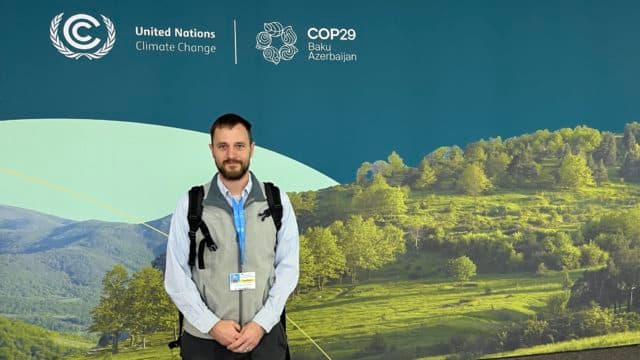
Juan Carlos Monterrey Gomez
Juan Carlos Monterrey Gomez is a climate policy expert and climate negotiator for the country of Panama.
Laura Anderson
Emilie Teresa Smith

Guilherme Gastal

Ron Rienstra

Kit Lason
Kit is a student and was a participant at COP30 with the Christian Climate Observers Program.

Jaime Butler
Jaime Butler is the Communications Associate at Young Evangelicals for Climate Action at was a participant at COP30 with the Christian Climate Observers Program.

Naomi Kaczor
Naomi is a student and was a participant at COP30 with the Christian Climate Observers Program.